
🔀 Juniper EX4650 vs Arista 7280R3A
AI-powered analysis across 26 matched specifications
Performance Overview
Scores based on quantifiable specification values (1-10 scale)
Detailed Specifications
| Specification | Juniper EX4650 Juniper | 7280R3A Series Arista |
|---|---|---|
| Key Metrics | ||
| Throughput | 4 Tbps | Up to 21.6 Tbps |
| Latency | 550 nanoseconds | Sub-microsecond |
| Form Factor | 1U | 2RU fixed or 4RU modular |
| Compute | ||
| Processor | 2.3 GHz quad-core Intel | -- |
| Memory | 16 GB DRAM | -- |
| Storage | 64 GB SSD | -- |
| Memory | ||
| MAC Table Size | -- | 128K–384K entries |
| ARP/NDP Entries | -- | Up to 384K entries |
| Packet Buffer | -- | Up to 24GB |
| Storage | ||
| Internal Storage | 64 GB SSD | -- |
| Networking | ||
| Downlink Ports | 48 × 25GbE SFP28 (1/10/25GbE auto-negotiate) | -- |
| Uplink Ports | 8 × 40/100GbE QSFP28 | -- |
| Port Configurations | Breakout: Each QSFP28 supports 4 × 25GbE → up to 80 total 25GbE ports | Up to 54× 400G (7280DR3A) / 72× 100G (7280CR3A) / 48× 50G (7280SR3A) |
| Routing Protocols | IPv4/IPv6, OSPF, IS-IS, BGP, MPLS, RSVP-TE, LDP, L3VPN, EVPN | BGP, OSPF, IS-IS, MPLS LDP/RSVP, VXLAN, EVPN, BFD, PIM, Segment Routing |
| VXLAN Support | VXLAN encapsulation/decapsulation with BGP EVPN control plane | VXLAN, EVPN |
| ECMP Support | -- | 128-way ECMP |
| IPv4 Routing Capacity | -- | Up to 5M+ prefixes (7280R3AK) / ~800K (standard) |
| IPv6 Routing Capacity | -- | Up to 500K prefixes |
| I/O & Ports | ||
| Port Types | 48 × 25GbE SFP28 + 8 × 40/100GbE QSFP28 | 400G QSFP-DD/OSFP, 100G, 50G ports |
| Management | ||
| Management Platform | Juniper Mist AI cloud, Junos CLI, SNMP, REST API | Arista EOS, CloudVision, eAPI, OpenConfig, gNMI |
| Automation | NETCONF/YANG, gRPC telemetry, ZTP, Python, Ansible, Terraform | OpenConfig, gNMI, ZTP, NETCONF |
| Power | ||
| Power Supply | 4 models: AC/DC × AFI/AFO airflow; redundant dual PSU | AC and DC PSU options; all field-replaceable; hot-swap |
| Physical / Environmental | ||
| Form Factor | 1U, 19-inch rack | 2RU fixed (7280DR3A, 7280CR3A, 7280SR3A) or 4RU modular (7280R3A Modular) |
| Security | ||
| Encryption | IEEE 802.1AE MACsec AES-256 | MACsec (802.1AE), IPsec, VXLANsec — all hardware-accelerated, line rate |
| DCI Optics Support | -- | 400G ZR (100km) and 400G ZR+ (up to 2000km) coherent DWDM — native support |
| Software & OS Compatibility | ||
| Operating System | Junos | Arista EOS |
Expert Analysis
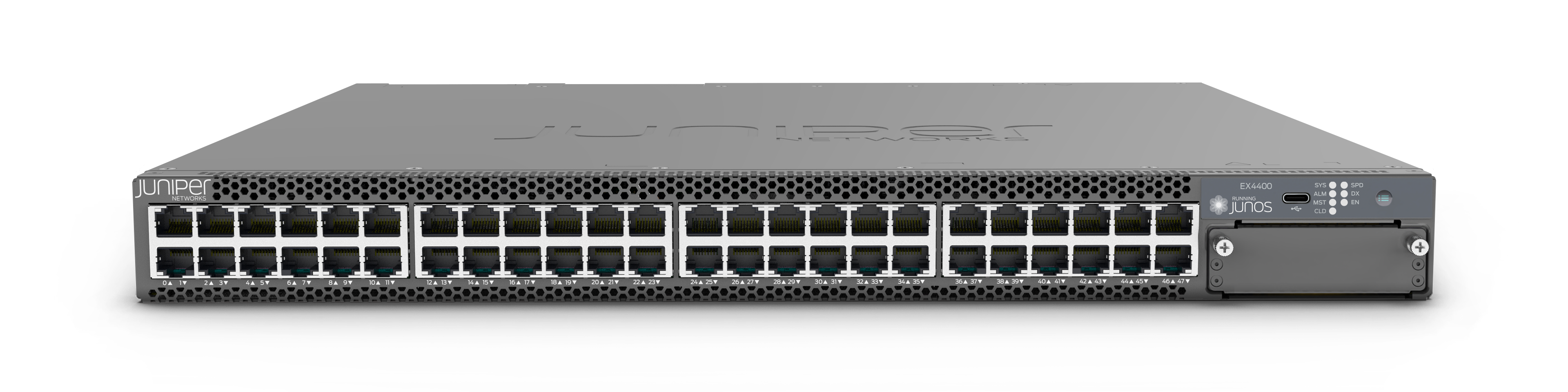
The Juniper EX4650 and Arista 7280R3A Series represent distinct approaches to data centre switching, each excelling in different deployment scenarios. The EX4650 offers a compelling 1U solution with 48×25GbE downlinks and 8×100GbE uplinks, delivering 4Tbps throughput with exceptionally low 550ns latency—making it ideal for leaf-tier deployments in enterprise data centres where space efficiency and predictable low latency are paramount. Its comprehensive routing protocol support including MPLS and EVPN-VXLAN, combined with Juniper Mist AI management, provides strong automation capabilities for fabric deployments.
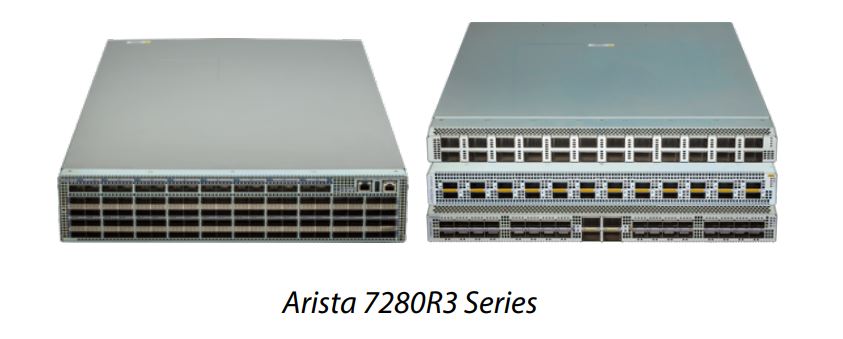
In contrast, the Arista 7280R3A Series delivers substantially higher performance metrics, with up to 21.6Tbps throughput, 54×400G port density in 2RU, and massive 24GB packet buffers with Virtual Output Queues. This makes it suitable for high-density spine deployments, internet peering, or data centre interconnect scenarios where maximum throughput and deep buffering are required. The native support for 400G ZR/ZR+ coherent DWDM optics provides built-in DCI capability without external transponders, while hardware-accelerated MACsec, IPsec, and VXLANsec offer comprehensive encryption.
The key trade-off centres on density versus specialisation: the EX4650 provides excellent 25GbE server connectivity in minimal rack space with Juniper's integrated management ecosystem, while the 7280R3A offers future-proof 400G capabilities and massive scale for core networking roles. Organisations should consider the EX4650 for cost-effective leaf switching with strong automation, while the 7280R3A better serves environments requiring maximum port density, advanced DCI capabilities, or handling extremely large routing tables exceeding 5 million IPv4 prefixes.
Ready to proceed?
Want to compare different products or add more to this comparison?
Open Interactive Comparison Tool →