
📦 Veeam Data Platform vs Veritas NetBackup
AI-powered analysis across 29 matched specifications

Performance Overview
Scores based on quantifiable specification values (1-10 scale)
Detailed Specifications
| Specification | Veeam Data Platform Foundation Veeam | NetBackup Veritas |
|---|---|---|
| Key Metrics | ||
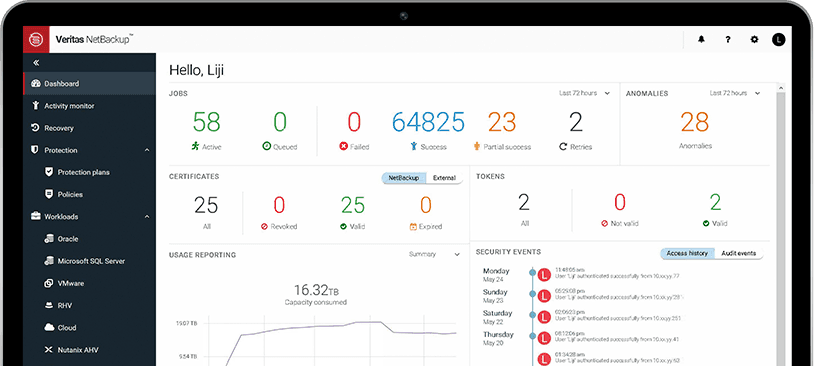
| Product Version | Veeam Backup & Replication v13 | NetBackup 10.4 (released March 2024) |
| Supported Workloads | 500+ Workloads | 800+ data sources |
| Recovery Capability | ~0s Recovery (Instant VM Recovery) | IRE isolated recovery (air-gapped resilience) |
| Trial Period | 30 Days (Free full-feature trial) | -- |
| Maximum Cluster Scale | -- | 2PB+ (Flex Scale); unlimited with federated deployment |
| Compute | ||
| Primary Server OS | Windows Server 2016–2025 (64-bit); Veeam Software Appliance (Linux-based Veeam JeOS) | Red Hat Enterprise Linux 8/9, Windows Server 2019/2022 |
| Database | PostgreSQL 17 (included in setup), 15 or 14; or Microsoft SQL Server 2016–2025 | Oracle, SQL Server, SAP HANA, IBM Db2, MySQL, PostgreSQL, Exchange, SharePoint |
| Minimum RAM (Server) | 16 GB RAM plus 500 MB per concurrent job (8 CPU cores minimum) | -- |
| Deployment Options | -- | Software, Virtual Appliance, Flex Scale Appliance, SaaS (Alta) |
| Software & OS Compatibility | ||
| Virtualisation Support | VMware vSphere: 7.x, 8.x and 9.x up to 9.1 (vSAN, NSX-T supported) / Microsoft Hyper-V: Windows Server 2016, 2019, 2022, 2025; Azure Local / Nutanix AHV: Native image-level VM backup via Veeam Plug-in for Nutanix AHV | VMware vSphere/vSAN ESA, Hyper-V, Nutanix AHV, RHV/oVirt |
| Operating System Support (Clients) | Windows Agent: Windows 10, 11, Server 2012 R2 – 2025 / Linux Agent: RHEL, Debian, Ubuntu, SLES, Oracle Linux, Rocky Linux, AlmaLinux | RHEL 6–9, Windows Server 2012–2022, SUSE, Ubuntu, AIX, Solaris |
| Cloud Platform Support | AWS EC2, Azure VM, Google Compute Engine (native plug-ins included, licensed via VUL) | AWS, Microsoft Azure, Oracle Cloud, Google Cloud |
| NAS Backup Support | SMB 2.0+, NFS v3/v4.x | -- |
| Container/Kubernetes Support | -- | Kubernetes (OpenShift, Tanzu, EKS, AKS, GKE) with malware scanning |
| Storage | ||
| Object Storage Targets | S3-compatible, Azure Blob, GCS, Wasabi, Backblaze B2 | -- |
| Protocols | -- | Fibre Channel, iSCSI, NFS, CIFS/SMB, S3-compatible |
| Deduplication | -- | MSDP: variable/fixed-length, client-side, server-side, distributed |
| Appliance Start Capacity | -- | 10TB usable per node (Flex Scale) |
| Appliance Max Capacity | -- | 2PB+ (scales non-disruptively by adding nodes) |
| Security | ||
| Immutability | Linux hardened repo, S3 Object Lock, Azure Blob Immutability | WORM storage targets; isolated recovery environment (IRE) |
| Encryption | AES-256 in-flight and at-rest, user-controlled keys | AES-256, FIPS 140-2 validated; at rest and in transit |
| Authentication | Zero Trust access — RBAC, four-eyes approvals, SAML SSO, MFA | MFA, SSO/SAML 2.0, LDAP/AD; multi-person authorisation |
| Compliance | -- | DISA STIG, FIPS 140-2, CIS Level 2, GDPR, ISO 27001 |
| Audit Logging | -- | OCSF-formatted events; SIEM integration |
| Security Features | Security & Compliance Analyzer — automated hardening validation | AI-powered anomaly detection for ransomware threat identification |
| Management | ||
| Management UI | Web UI, PowerShell module and RESTful API | Unified web UI; full REST API; Kubernetes-style CLI |
| High Availability | Not included — backup server High Availability requires Premium and the Veeam Software Appliance | -- |
| Resiliency | -- | Erasure coding across nodes; N+1 node redundancy |
| Licensing Model | Veeam Universal License (VUL) — per workload, portable | -- |
Expert Analysis
Veeam Data Platform Foundation and Veritas NetBackup represent two distinct approaches to enterprise data protection, each excelling in different operational contexts. Veeam's solution offers strong virtualisation-focused capabilities with its ~0-second Instant VM Recovery and direct-to-object storage backup, making it particularly suitable for VMware and Hyper-V environments where rapid recovery is paramount. Its Veeam Universal License provides flexibility for mixed environments, while the 500+ supported workloads cover most mainstream enterprise needs. However, NetBackup demonstrates superior scalability with its Flex Scale architecture supporting 2PB+ per cluster and federated deployments for unlimited expansion, coupled with comprehensive support for 800+ data sources including legacy systems like AIX and Solaris.
The key trade-off lies between Veeam's streamlined, virtualisation-optimised approach and NetBackup's enterprise-scale breadth. Veeam delivers excellent value for virtualised environments with its intuitive management and strong cloud integration, while NetBackup justifies its complexity through unmatched scalability, container workload support with malware scanning, and rigorous compliance certifications including DISA STIG and FIPS 140-2. Organisations requiring air-gapped resilience will appreciate NetBackup's Isolated Recovery Environment, whereas those prioritising rapid deployment and ease of use may favour Veeam's 30-day trial and simpler licensing model.
For specific use cases, Veeam's Continuous Data Protection provides near-zero RPO for VMware environments, while NetBackup's AI-powered anomaly detection offers advanced ransomware protection. The choice ultimately depends on organisational scale, compliance requirements, and existing infrastructure—with Veeam serving virtualisation-centric environments well and NetBackup addressing large-scale, heterogeneous enterprise deployments with stringent regulatory needs.
Ready to proceed?
Not sure which one fits your environment?
Our UK specialists will recommend the right option for your workload and send itemised pricing — vendor-neutral, no obligation.
Response within 4 business hours · 20+ yr UK reseller
Want to compare different products or add more to this comparison?
Open Interactive Comparison Tool →Made your choice? Spread the cost.
Whichever you choose, you don't have to pay for it all upfront — finance your new hardware from £258/mo ex VAT on hire purchase or lease. Compare monthly payments and terms in seconds.
See finance from £258/mo →Indicative estimate · subject to change · no credit check at this stage · hire purchase, lease & subscription for UK businesses
Indicative illustration only. Servnet Limited is not authorised or regulated by the FCA and does not provide financial advice or arrange finance. All finance opportunities are referred to Number Eight Business Finance. Finance policy
Work out the capacity you actually need on a 3-2-1-1-0 footing, then configure the tape or disk target to match.
Related comparisons
Other head-to-heads featuring these models — useful if you’re still shortlisting.
Talk to a UK specialist
Get expert advice or a no-obligation quote — servers, storage, networking, maintenance, finance and cloud. We reply the same working day.