
⚡ Dell R760xa vs Supermicro SYS-421GE
AI-powered analysis across 20 matched specifications

Performance Overview
Scores based on quantifiable specification values (1-10 scale)
Detailed Specifications
| Specification | Dell PowerEdge R760xa Dell PowerEdge | SYS-421GE-TNHR2-LCC Supermicro |
|---|---|---|
| Key Metrics | ||
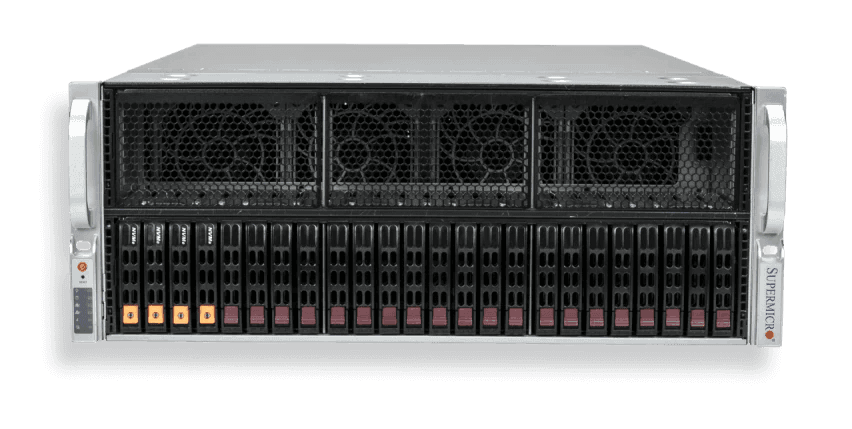
| Form Factor | 2U rack-mountable, 2-socket (2P) | 4U Rackmount (CSE-GP403TS-R000NFP chassis) |
| GPU Configuration | Up to 4 × 400W double-wide PCIe Gen5 GPU; or up to 12 × 75W single-wide PCIe x8 GPU | 8× NVIDIA HGX H100 8-GPU (80GB HBM2e) or HGX H200 8-GPU (141GB HBM3e); SXM form factor |
| Cooling System | Air (front-facing GPU design, up to 6 hot-plug fans); optional DLC | Direct-to-Chip (D2C) liquid cold plate; up to 4× 8cm fans for residual airflow |
| Power Supply Configuration | 2400W Platinum / 2800W or 3200W Titanium hot-swap redundant | 4× 5,250W redundant (2+2) Titanium 96% efficiency — 21kW total capacity |
| Compute | ||
| Processor | Up to two 4th Gen Xeon Scalable / Xeon Max (up to 56c) or 5th Gen (up to 64c) | Dual Socket E (LGA-4677) — 5th/4th Gen Intel Xeon Scalable; up to 64C/128T, 320MB LLC, 385W TDP (liquid) |
| GPU Interconnect | PCIe Gen5 x16 | PCIe 5.0 x16 CPU-to-GPU interconnect + NVIDIA NVLink 4.0 + NVSwitch — 900 GB/s all-to-all bandwidth |
| Memory | ||
| Memory | DDR5 RDIMM (Registered ECC) / 32 DIMM slots / 8 TB at 4800 MT/s (4th Gen) / 5600 MT/s (5th Gen) | 32× DDR5 DIMM slots; up to 4TB at 5600MT/s (1DPC) or 8TB at 4400MT/s (2DPC) ECC RDIMM |
| Storage | ||
| Storage Options | Up to 6 × E3.S Gen5 NVMe (46.08 TB); 6 × 2.5" NVMe (92.16 TB); 8 × 2.5" SAS/SATA/NVMe (122.88 TB) | 8× front hot-swap 2.5" NVMe U.2; 2× M.2 NVMe boot |
| RAID Controllers / Boot | PERC H965i, PERC H755, PERC H755N, PERC H355, HBA355i; BOSS-N1 boot | 2× M.2 NVMe boot |
| Networking | ||
| Network | Optional 2 × 1GbE LOM + OCP 3.0 | -- |
| GPU / Accelerators | ||
| GPU Options | Up to 4 × 400W double-wide PCIe Gen5 GPU; or up to 12 × 75W single-wide PCIe x8; or 8 × single-wide PCIe x16 | 8× NVIDIA HGX H100 8-GPU (80GB HBM2e) or HGX H200 8-GPU (141GB HBM3e); SXM form factor |
| Expansion / PCIe | ||
| PCIe Layout / Slots | 4 × x16 rear (FH, HL) + 4 × x16 front (FH, FL, DW); or 4 × x16 rear + 8 × x8 front (FH, FL, SW) | Default: 8× PCIe 5.0 x16 LP + 2× PCIe 5.0 x16 FHHL; Option A: 8× PCIe 4.0 x16 LP + 4× PCIe 5.0 x16 FHHL |
| Management | ||
| Management | iDRAC9 (Redfish API, Direct, Quick Sync 2), OpenManage Enterprise | IPMI 2.0, dedicated BMC port, SuperDoctor, JumpStart remote access |
| Power | ||
| Power Supply | 2400W Platinum / 2800W or 3200W Titanium hot-swap redundant | 4× 5,250W redundant (2+2) Titanium 96% efficiency — 21kW total capacity |
| Physical / Environmental | ||
| Dimensions | 86.8 × 482 × 933 mm (3.41 × 18.97 × 36.73 in without bezel) | 6.85"H × 17.6"W × 35.25"D |
| Weight | -- | Net: 80 kg (176 lbs); Gross: 98 kg (216 lbs) |
| Operating Temperature | -- | 10°C to 35°C (50°F to 95°F) |
| Security | ||
| Security | -- | TPM 2.0, Silicon RoT (NIST 800-193), Secure Boot, supply chain remote attestation |
| Software & OS Compatibility | ||
| Operating Systems | Windows Server, RHEL, SLES, Ubuntu, VMware ESXi | -- |
| Warranty & Support | ||
| Warranty | 3-year ProSupport (varies by configuration) | -- |
Expert Analysis
The Dell PowerEdge R760xa and Supermicro SYS-421GE-TNHR2-LCC represent two distinct approaches to high-performance computing infrastructure. The Dell server offers exceptional flexibility with its 2U form factor supporting up to 12 single-wide GPUs or 4 double-wide 400W accelerators, making it suitable for mixed AI inference and traditional enterprise workloads where air cooling is preferred. Its comprehensive storage options including E3.S Gen5 NVMe and extensive RAID controller selection provide strong data management capabilities. The Supermicro system, by contrast, is purpose-built for maximum AI training performance with 8 NVIDIA HGX H100/H200 SXM GPUs interconnected via NVLink 4.0, delivering 900 GB/s all-to-all bandwidth that significantly accelerates large language model training. Its direct-to-chip liquid cooling enables higher sustained GPU clock speeds but requires complete liquid-cooled rack integration.
Key trade-offs centre on cooling methodology, GPU architecture, and deployment complexity. The Dell's air-cooled design with front-facing GPU orientation offers easier integration into existing data centres without specialised cooling infrastructure, while the Supermicro's liquid cooling delivers superior thermal performance at the cost of requiring dedicated cooling distribution units. The Dell provides greater storage flexibility with up to 122.88 TB capacity across multiple form factors, whereas the Supermicro focuses on high-performance NVMe storage with 8 front-accessible U.2 drives. Value proposition differences are significant: the Dell offers a balanced approach suitable for organisations seeking GPU-accelerated computing without overhauling their data centre cooling, while the Supermicro targets organisations building dedicated AI training clusters where maximum GPU performance justifies the infrastructure investment.
These servers serve fundamentally different use cases despite both supporting dual-socket Xeon Scalable processors. The Dell R760xa excels in environments requiring GPU acceleration alongside traditional enterprise applications, offering the versatility to support both inference workloads and general-purpose computing with its flexible PCIe layout. The Supermicro system is optimised for pure AI/ML training where GPU-to-GPU communication bandwidth is critical, making it ideal for research institutions and hyperscalers building specialised AI infrastructure. Organisations should choose based on whether they prioritise deployment flexibility and mixed workloads (Dell) or maximum AI training performance with dedicated infrastructure (Supermicro).
Ready to proceed?
Not sure which one fits your environment?
Our UK specialists will recommend the right option for your workload and send itemised pricing — vendor-neutral, no obligation.
Response within 4 business hours · 20+ yr UK reseller
Want to compare different products or add more to this comparison?
Open Interactive Comparison Tool →Made your choice? Spread the cost.
Whichever you choose, you don't have to pay for it all upfront — finance your new hardware from £1,935/mo ex VAT on hire purchase or lease. Compare monthly payments and terms in seconds.
See finance from £1,935/mo →Indicative estimate · subject to change · no credit check at this stage · hire purchase, lease & subscription for UK businesses
Indicative illustration only. Servnet Limited is not authorised or regulated by the FCA and does not provide financial advice or arrange finance. All finance opportunities are referred to Number Eight Business Finance. Finance policy
Related comparisons
Other head-to-heads featuring these models — useful if you’re still shortlisting.
Talk to a UK specialist
Get expert advice or a no-obligation quote — servers, storage, networking, maintenance, finance and cloud. We reply the same working day.