πΎ Dell PowerScale F710 vs Pure FlashBlade//S
AI-powered analysis across 23 matched specifications


Performance Overview
Scores based on quantifiable specification values (1-10 scale)
Detailed Specifications
| Specification | Dell PowerScale F710 Dell Storage | FlashBlade//S Pure Storage |
|---|---|---|
| Key Metrics | ||
| Maximum Raw Capacity per Node/Blade | 1.2 PB | 1.2 PB |
| Maximum System Capacity | 307 PB (252 nodes) | 120 PB (10 chassis, 10 blades per chassis) |
| Maximum Scale-out Units | 252 nodes | 10 chassis |
| Memory per Node/Blade | 512 GB | -- |
| Maximum Network Bandwidth | 2 Γ 100GbE per node | 16 Γ 400GbE per multi-chassis system |
| Compute | ||
| Processor | Not specified | Not specified |
| Performance Claim | Linear scale with capacity | 20β25% better than competitors for RAG, training, inference, simulation; 50% faster vs previous generation |
| Memory | ||
| Memory | 512 GB ECC DDR4 per node | -- |
| Storage | ||
| Capacity per Node/Blade | 38 TB β 1.2 PB raw (NVMe SSD, 10 drives) | Up to 1.2 PB (S500 R2 with 300TB DirectFlash Modules) |
| Drive/Module Types | NVMe QLC/TLC SSD | DirectFlash Modules: 37TB, 75TB, 150TB, 300TB (S200 R2/S500 R2); 18TB, 37TB (S100) |
| Data Protection | N+1 to N+4 node failure tolerance; SnapshotIQ; SyncIQ replication | Global erasure coding; SafeMode Snapshots |
| Data Efficiency Features | SmartDedupe, SmartCompression, SmartTiering | Zero Move Tiering; Purity Turbo |
| Networking | ||
| Front-End Networking | 2 Γ 100GbE or 2 Γ 25GbE SFP28 per node | Up to 16Γ 400GbE (multi-chassis); integrated, upgradeable via XFM |
| Back-End Networking | InfiniBand or 100GbE/25GbE | -- |
| Software & OS Compatibility | ||
| Operating System | OneFS 9.7 or later | Not specified |
| Supported Protocols | NFS v3/4/4.1, SMB 2/3, HDFS, HTTP/S, S3 | NFS v3 and v4.1, SMB 3.x, S3 |
| Replication Software | SyncIQ replication β synchronous and asynchronous between clusters | Rapid Replicas β global file metadata sync |
| Subscription/Service Model | -- | Evergreen//Forever (blade refresh every 3yr) or Evergreen//One (consumption model) |
| Physical / Environmental | ||
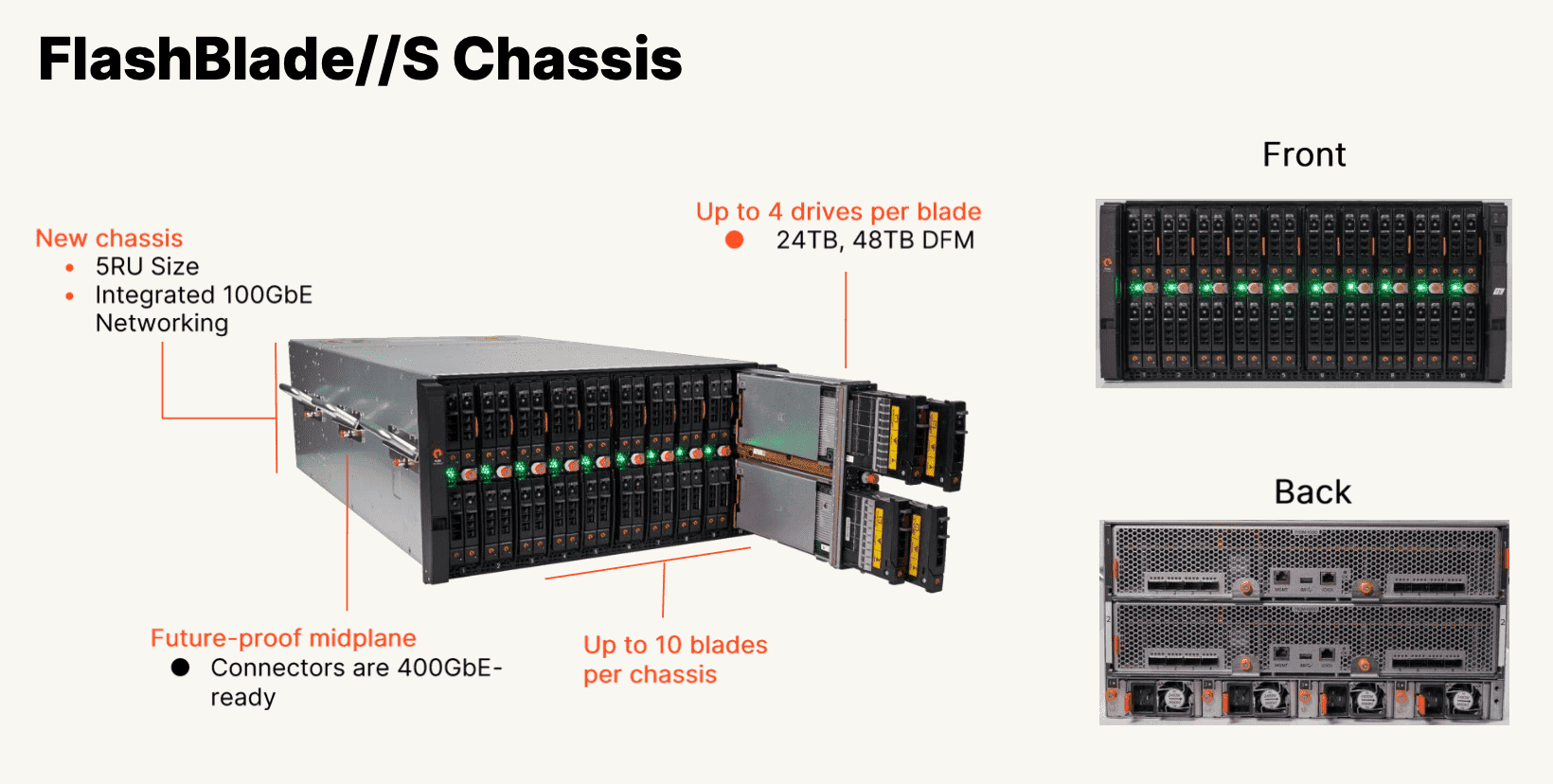
| Form Factor | 1U per node, rack-mountable | 5U per chassis; 1U per XFM; starts 7 blades, scales to 10 blades per chassis |
| Blade/Node Models | Dell PowerScale F710 | FlashBlade//S200 R2 and S500 R2; legacy S100 |
| Security | ||
| Encryption | -- | Always-on AES-256 encryption |
| Management | ||
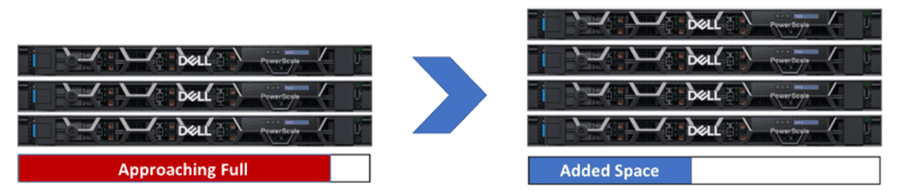
| Scalability Features | Linear scale β add nodes non-disruptively, performance scales with capacity | Scale-out to 10 chassis β independently scale compute and storage |
| Upgrade Process | -- | Nondisruptive blade and module upgrades |
Expert Analysis
The Dell PowerScale F710 and Pure Storage FlashBlade//S represent two sophisticated approaches to scale-out storage, each with distinct architectural philosophies. The PowerScale F710 excels in massive linear scalability, supporting up to 252 nodes for a 307 PB single namespace, making it particularly suited for environments requiring vast, unified storage pools with predictable performance scaling. Its 512 GB memory per node and comprehensive protocol support (including HDFS) position it well for traditional enterprise file services and big data analytics workloads. The FlashBlade//S, conversely, demonstrates superior networking capabilities with up to 16Γ 400GbE interfaces and claims 20β25% performance advantages for AI/ML workloads like RAG and inference, benefiting from features like Zero Move Tiering and Rapid Replicas for global collaboration.
Key trade-offs emerge in scalability models and operational approaches. The PowerScale offers finer-grained, node-level expansion with proven OneFS management, while the FlashBlade employs a chassis-based architecture with independent compute/storage scaling and innovative subscription models like Evergreen//Forever. The FlashBlade's higher networking bandwidth and performance-optimised features command premium positioning for data-intensive AI applications, whereas the PowerScale provides robust, cost-effective scaling for large-capacity general-purpose storage. Value propositions differ significantly: Dell emphasises maximum capacity and linear growth within a mature software ecosystem, while Pure focuses on cutting-edge performance, modern data services, and operational flexibility through subscription offerings.
Organisations should select based on workload characteristics and growth patterns. The PowerScale F710 is ideal for organisations prioritising massive capacity growth, multi-protocol access, and predictable scaling over decades. The FlashBlade//S better serves performance-sensitive AI/ML pipelines, global collaborative environments requiring rapid metadata replication, and organisations preferring operational expenditure models with guaranteed hardware refreshes. Neither system is universally superior; the choice fundamentally depends on whether maximum scalability or peak performance for modern workloads takes precedence.
Ready to proceed?
Want to compare different products or add more to this comparison?
Open Interactive Comparison Tool β