
🔀 FortiSwitch FS-248E vs Cisco 9300-48T vs Juniper EX4400
AI-powered analysis across 23 matched specifications
Performance Overview
Scores based on quantifiable specification values (1-10 scale)
Detailed Specifications
| Specification | FortiSwitch FS-248E Fortinet | Cisco Catalyst 9300-48T Cisco | Juniper EX4400 Juniper |
|---|---|---|---|
| Key Metrics | |||
| Model / Part Number | FS-248E | C9300-48T-A | EX4400-48T/P/MP/F (8 SKUs) |
| Access Ports | 48 × GE RJ45 | 48 × 10/100/1000 Mbps RJ45 | 48-port models: 1GbE, multigigabit 2.5/5/10GbE (MP), 10GbE SFP+ (F) |
| Uplink Ports | 4 × GE SFP | 4 × 10G SFP+ (default), options: 4 × 1G SFP, 4 × 10G SFP+, 2 × 40G QSFP+ | 4 × SFP+, or 4 × 25GbE SFP28, or 1 × 100GbE QSFP28 (via EM module) |
| Switching Capacity | 104 Gbps | 256 Gbps (single switch) | -- |
| Forwarding Rate | 155 Mpps | 190.5 Mpps | -- |
| MAC Address Table | 16,384 | 32,000 | -- |
| VLANs Supported | 4,094 | -- | -- |
| PoE Budget | None (non-PoE model) | None (non-PoE model) | Up to 2,200W per switch (dual PSU) |
| PoE Standard | -- | -- | IEEE 802.3bt PoE++ (90W/port); 802.3at PoE+ (30W); 802.3af (15.4W) |
| Stacking / Clustering | -- | StackWise-480 (up to 8 switches, 480 Gbps) | Virtual Chassis up to 10 units; dedicated VCP ports |
| MACsec Encryption | -- | IEEE 802.1AE hardware (all ports) | IEEE 802.1AE MACsec AES-256 on all ports |
| EVPN-VXLAN Support | -- | -- | Full BGP EVPN / VXLAN encapsulation support |
| Precision Timing | -- | -- | IEEE 1588 PTP (Precision Timing Protocol) support |
| Networking | |||
| Layer 2/3 Capabilities | VLAN, QoS, 802.1X, IGMP | Full DNA Center SD-Access fabric edge support | Full L2 + L3 (IPv4/IPv6, OSPF, BGP, MPLS) |
| Management | |||
| Management Interfaces | FortiLink, CLI, Web UI, SNMP | Cisco IOS-XE with NETCONF/RESTCONF/gRPC APIs | Juniper Mist AI cloud, Junos CLI, SNMP, REST API |
| Automation | -- | -- | NETCONF/YANG, gRPC telemetry, Zero Touch Provisioning, Ansible, Terraform |
| Software & OS Compatibility | |||
| Operating System | -- | Cisco IOS-XE | Junos OS |
| Physical / Environmental | |||
| Form Factor | 1U rack-mount | 1U rack-mount | 1U, 19-inch rack |
| Power Consumption | 50W max | 60W max (non-PoE) | -- |
| Power Supply | -- | Internal AC (100–240V); optional redundant PSU | Dual PSU (for PoE models) |
| Cooling | -- | Fans (field-replaceable) | -- |
| Weight | -- | 5.7 kg | -- |
| Operating Temperature | 0°C to 45°C | -- | -- |
Expert Analysis
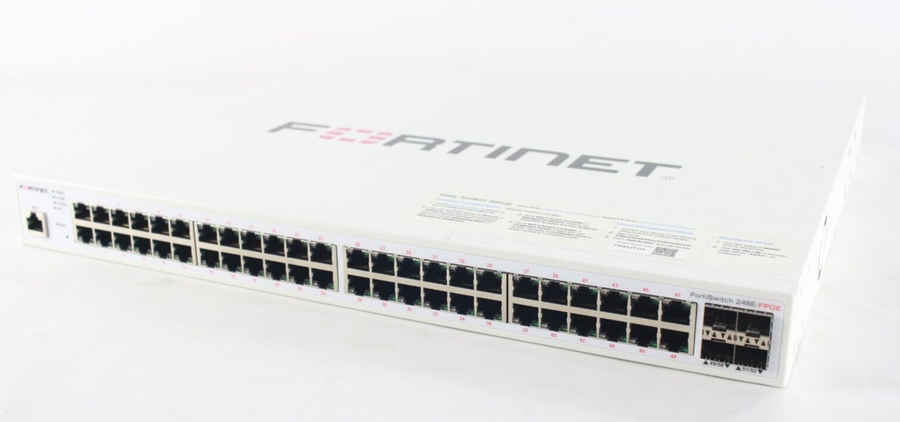
The FortiSwitch FS-248E presents a straightforward 48-port Gigabit Ethernet solution with 4 SFP uplinks, offering 104 Gbps switching capacity and 155 Mpps forwarding rate. It's well-suited for organisations seeking basic, reliable switching with Fortinet's integrated security management through FortiLink, particularly in environments already using Fortinet's security fabric. However, its limited expandability, lack of stacking capabilities, and absence of advanced features like MACsec or high-speed uplink options position it as an entry-level enterprise switch.
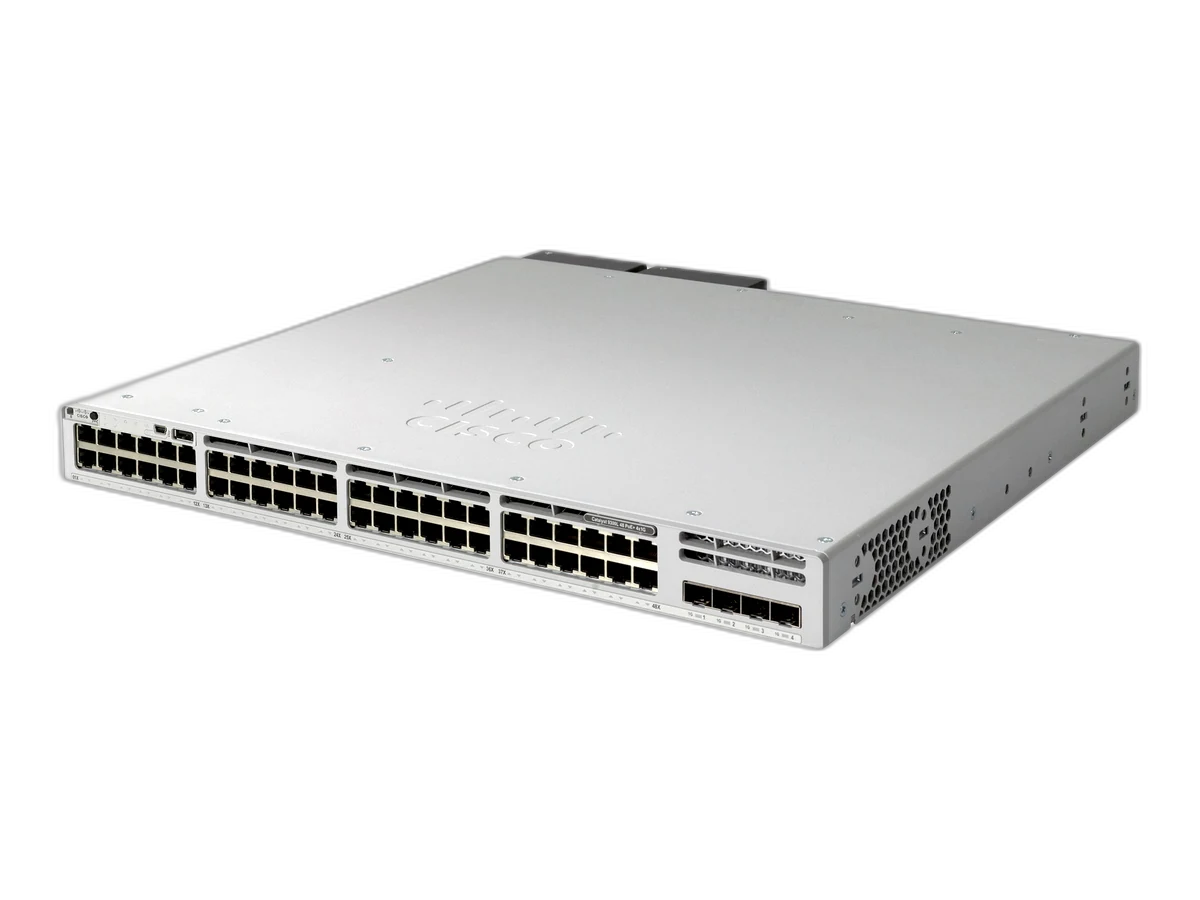
The Cisco Catalyst 9300-48T delivers significantly enhanced performance with 256 Gbps switching capacity, 190.5 Mpps forwarding rate, and the versatile StackWise-480 technology supporting up to 8 switches with 480 Gbps stack bandwidth. Its programmable Uadp 2.0 ASIC and comprehensive Cisco IOS-XE management with modern APIs make it ideal for medium to large enterprises requiring scalable, software-defined networking with full DNA Center integration. The modular uplink options (up to 40G QSFP+) and hardware MACsec encryption on all ports provide future-proofing for evolving network demands.
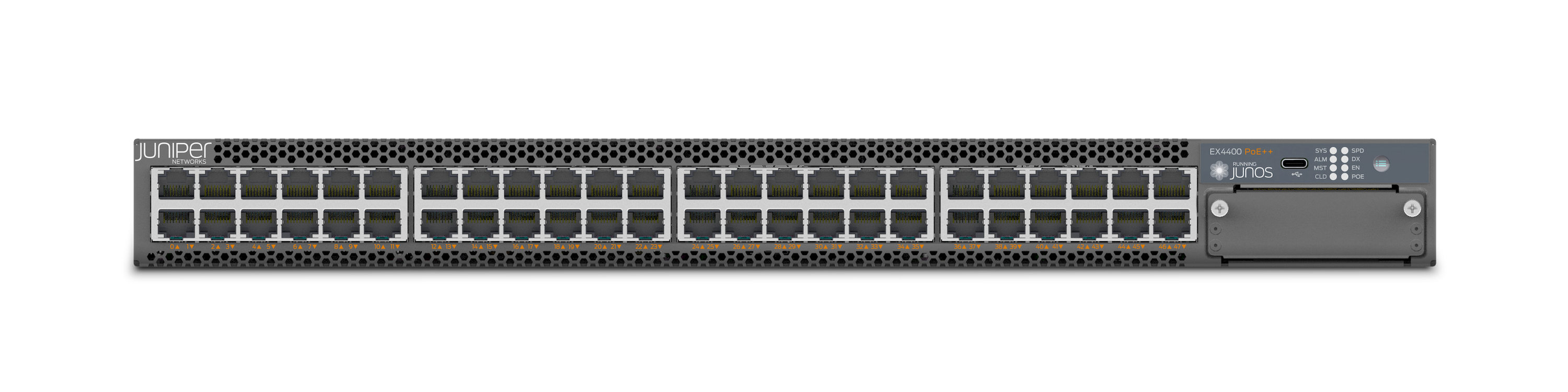
The Juniper EX4400 represents the most feature-rich offering with its eight SKU variants supporting everything from basic 1GbE to multigigabit (up to 10GbE) and fibre connectivity. Its standout capabilities include industry-leading PoE++ support (90W per port, 2.2kW total budget), EVPN-VXLAN fabric support for seamless campus and data centre integration, and sophisticated Juniper Mist AI cloud management with zero-touch provisioning. The optional 25GbE and 100GbE uplink expansion, combined with Virtual Chassis clustering for up to 10 units, makes it particularly suitable for high-density, modern campus environments requiring advanced automation, security (MACsec AES-256 on all ports), and investment protection through flexible port configurations.
Ready to proceed?
Want to compare different products or add more to this comparison?
Open Interactive Comparison Tool →