
🛡️ Juniper SRX345 vs FortiGate 80F vs Cisco Firepower 1140
AI-powered analysis across 17 matched specifications

Performance Overview
Scores based on quantifiable specification values (1-10 scale)
Detailed Specifications
| Specification | Juniper SRX345 Juniper | FortiGate FG-80F Fortinet | Cisco Firepower 1140 Cisco |
|---|---|---|---|
| Key Metrics | |||
| Firewall Throughput | 5 Gbps (large packets) / 1.7 Gbps (IMIX) | 10 Gbps (1518/512/64: 10/10/7 Gbps) | 3.3 Gbps (FTD) / 6 Gbps (ASA) |
| IPS Throughput | 600 Mbps | 1.4 Gbps | 3.5 Gbps |
| IPSec VPN Throughput | 800 Mbps | 6.5 Gbps | 1.4 Gbps (FTD) / 1.2 Gbps (ASA) |
| Concurrent Sessions | 375,000 | 1,500,000 | 400,000 |
| New Sessions/sec | 15,000 | 45,000 | 22,000 (FTD) / 100,000 (ASA) |
| Networking | |||
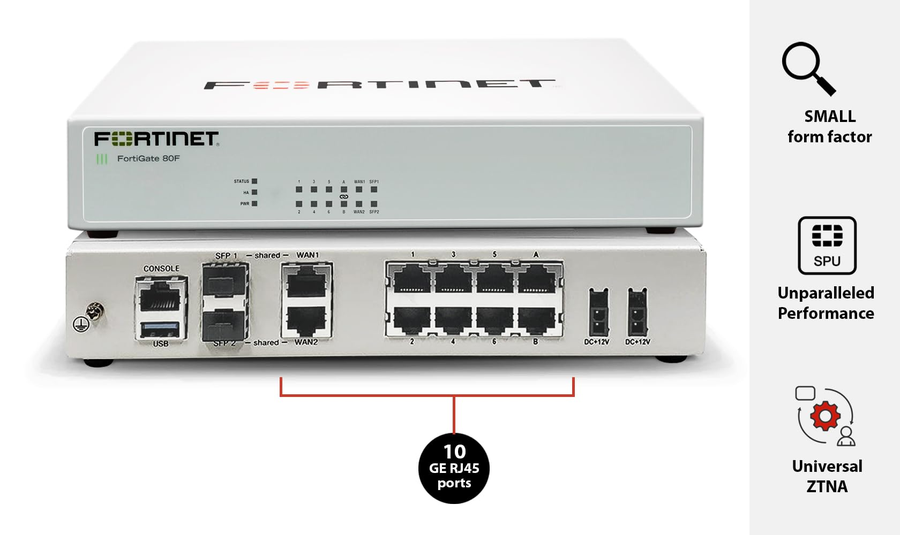
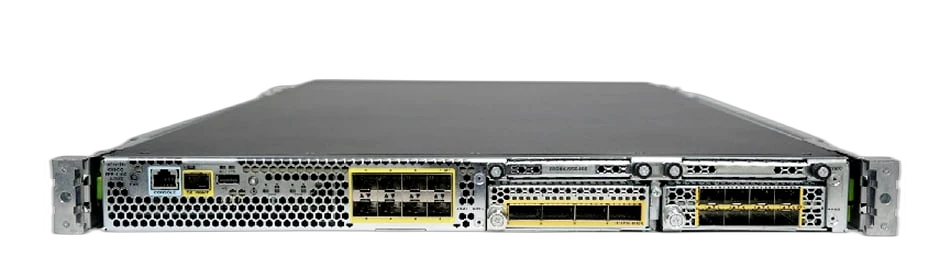
| Network Ports | 16 × GE (8 × RJ-45 + 8 × SFP) | 6 × GE RJ45 + 2 × WAN GE RJ45 + 2 × FortiLink GE RJ45 + 2 × GE RJ45/SFP Shared Media | 8 × 1G RJ45 + 4 × 1G SFP |
| Management Port | -- | -- | 1 × 1G RJ45 dedicated |
| Storage | |||
| Storage | Optional SSD storage for local logging | None | 200 GB SSD |
| Expansion / PCIe | |||
| Expansion Slots | 6 × Mini-PIM slots | -- | -- |
| Physical / Environmental | |||
| Form Factor | 1U rack | Desktop, fanless | 1U rack-mount |
| Power Consumption | 45W typical | 15.5W max | 100W max |
| Operating Temperature | -- | 0°C to 40°C | -- |
| Cooling | -- | Fanless | 1 integrated fan |
| Weight | -- | -- | 3.6 kg (8 lb) |
| Software & OS Compatibility | |||
| Operating System | Junos OS | -- | -- |
| Certifications | -- | FCC, CE, RoHS | -- |
| Management | |||
| High Availability | -- | -- | Active/standby HA clustering |
Expert Analysis
These three next-generation firewalls represent distinct approaches to network security, each with particular strengths suited to different deployment scenarios. The Juniper SRX345 offers balanced performance with 5 Gbps firewall throughput and excellent expandability through six Mini-PIM slots, making it well-suited for branch offices requiring flexible connectivity options and future-proofing. The FortiGate FG-80F delivers impressive 10 Gbps firewall throughput and 6.5 Gbps VPN performance in a fanless desktop form factor with remarkably low 15.5W power consumption, ideal for space-constrained environments where silent operation and energy efficiency are priorities. The Cisco Firepower 1140 provides robust 3.5 Gbps IPS throughput and includes 200 GB SSD storage for local logging, plus comprehensive management features including HA clustering, positioning it for medium-sized enterprises needing integrated security services and reliable failover capabilities.
Key trade-offs emerge between raw throughput, expansion capabilities, and physical design. The FortiGate leads in firewall and VPN performance but lacks expansion options and onboard storage, while the Juniper offers superior modularity at the expense of throughput figures. The Cisco device strikes a middle ground with good all-round performance and built-in storage, though at higher power consumption. Value proposition differences are significant: the FortiGate delivers maximum throughput per watt in a compact package, the Juniper provides maximum flexibility for evolving network requirements, and the Cisco offers the most complete enterprise feature set including advanced management capabilities. Organisations should prioritise based on whether they value modular expansion (Juniper), maximum throughput density (Fortinet), or integrated enterprise management features (Cisco).
Ready to proceed?
Want to compare different products or add more to this comparison?
Open Interactive Comparison Tool →