
🛡️ Palo Alto PA-5260/5280 vs Juniper SRX5800
AI-powered analysis across 18 matched specifications
Performance Overview
Scores based on quantifiable specification values (1-10 scale)
Detailed Specifications
| Specification | Palo Alto PA-5260 / PA-5280 Palo Alto | Juniper SRX5800 Juniper |
|---|---|---|
| Key Metrics | ||
| Firewall Throughput | 55 Gbps (App-ID enabled, appmix) | 2 Tbps (large/ExpressPath) / 1 Tbps (IMIX) |
| Threat Prevention / IPS Throughput | 31 Gbps (appmix) | 860 Gbps |
| IPSec VPN Throughput | 25 Gbps | 230 Gbps |
| Max Concurrent Sessions | 32,000,000 (PA-5260) / 64,000,000 (PA-5280) | 338,000,000 |
| New Sessions per Second | 500,000 | 4,000,000 |
| Compute | ||
| Processor | Not specified | Not specified |
| Routing Engines | Not specified | Dual redundant (RE2) |
| Memory | ||
| Memory | Not specified | Not specified |
| Storage | ||
| Storage | 480 GB SSD pair + 2 TB HDD RAID1 (log) | Not specified |
| Networking | ||
| Network Interfaces | 4 × 10G Cu + 16 × 10G SFP/SFP+ + 4 × 40G/100G QSFP28 | Not specified |
| Expansion / PCIe | ||
| I/O Card Slots | Not specified | 11 |
| SPC Slots | Not specified | 8 |
| I/O & Ports | ||
| Network Ports | 4 × 10G Cu + 16 × 10G SFP/SFP+ + 4 × 40G/100G QSFP28 | Not specified |
| Management | ||
| HA Support | Active/Passive, Active/Active | Full hardware redundancy at every component level |
| Power | ||
| Power Supply | 1200W AC (2, redundant) | Multiple redundant hot-swap AC/DC |
| Physical / Environmental | ||
| Form Factor | 3U rackmount (17.25" W × 20.5" D × 5.25" H) | 11U chassis |
| Software & OS Compatibility | ||
| Operating System | Not specified | Junos OS |
| Warranty & Support | ||
| Status | End-of-Sale (active support) | Not specified |
Expert Analysis
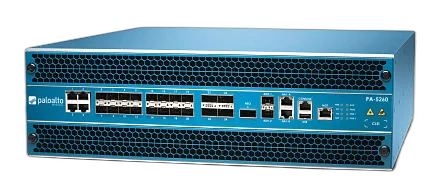
The Palo Alto PA-5260/5280 and Juniper SRX5800 represent fundamentally different approaches to enterprise firewall deployment, targeting distinct operational scales. The Palo Alto appliance offers a compact 3U form factor with respectable 55 Gbps firewall throughput and 31 Gbps threat prevention, making it suitable for large enterprise data centres or service provider edge deployments requiring up to 64 million concurrent sessions. Its fixed port configuration provides 24×10G and 4×40G/100G interfaces, offering substantial connectivity in a relatively small footprint, while the integrated 480GB SSD and 2TB HDD storage supports comprehensive logging capabilities.
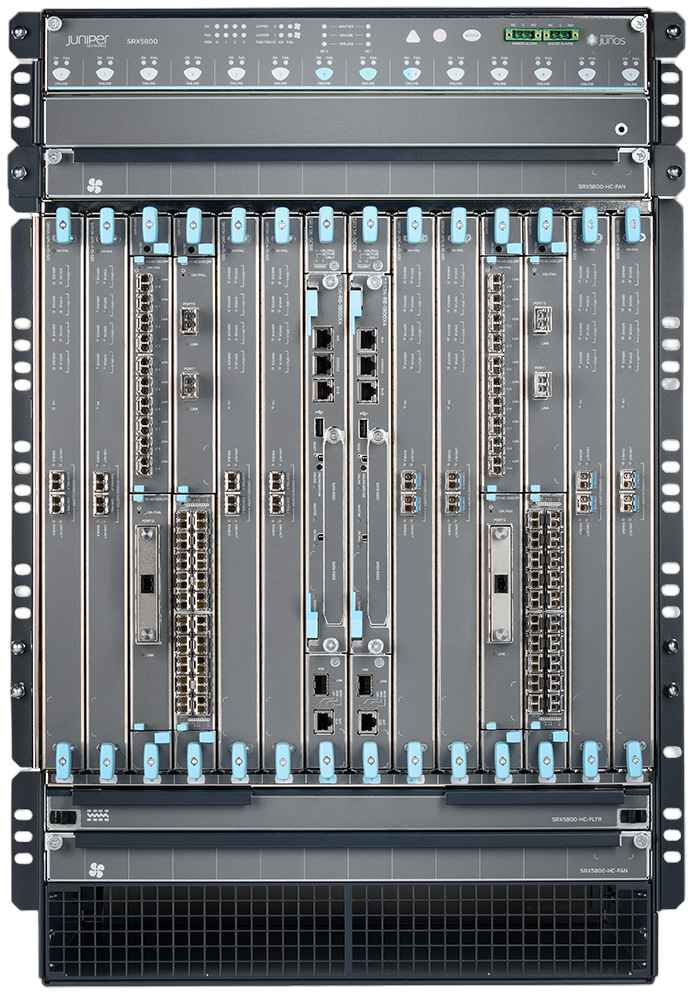
In stark contrast, the Juniper SRX5800 is a carrier-grade modular chassis designed for hyperscale environments, delivering 2 Tbps firewall throughput and 860 Gbps IPS performance—an order of magnitude greater than the Palo Alto device. With support for 338 million concurrent sessions and 4 million new connections per second, it's engineered for internet exchange points, cloud provider perimeters, or large telecommunications networks. The 11U chassis with 11 I/O slots and 8 SPC slots provides exceptional flexibility for future expansion, while the fully redundant architecture ensures carrier-grade reliability.
The choice between these platforms hinges entirely on scale requirements and architectural philosophy. Organisations needing predictable performance in a fixed configuration with comprehensive logging would find the Palo Alto solution appropriate, particularly given its end-of-sale status suggests potential cost advantages. Meanwhile, environments anticipating massive growth, requiring modular flexibility, or operating at true carrier scale would benefit from the Juniper platform's substantially higher throughput and session capacity, despite its larger physical footprint and likely higher initial investment.
Ready to proceed?
Want to compare different products or add more to this comparison?
Open Interactive Comparison Tool →