
Control Where Your Sensitive Data Goes
Six layers of data control that together cover every channel through which sensitive data can leave your organisation — accidentally or deliberately.
Sensitive Data Discovery & Classification
Before you can protect data, you need to know where it lives. DLP platforms scan endpoints, file shares, SharePoint, Exchange, Teams, databases, and cloud storage to find sensitive data — PII, financial records, health data, intellectual property — and automatically classify it using content inspection, regular expression matching, machine learning, and fingerprinting. Classification is the foundation: you cannot enforce policy on data you have not discovered and labelled.
Email & Collaboration DLP
Email remains the most common channel for data loss — both accidental (wrong recipient, unencrypted attachment) and malicious (exfiltration to personal accounts). DLP policies inspect email content, attachments, and recipients in real time — blocking, quarantining, or encrypting messages that violate policy before they leave the mail gateway. Microsoft Purview DLP integrates natively with Exchange Online, Teams, SharePoint, and OneDrive with no additional infrastructure.
Endpoint DLP
Endpoint DLP controls data movement at the device level — blocking uploads to personal cloud storage (personal OneDrive, Dropbox, Google Drive), copying to USB drives, printing to unmanaged printers, screen capture of classified content, and pasting into unapproved applications. Policies are enforced even when the device is offline and not connected to corporate infrastructure. Microsoft Purview Endpoint DLP and Forcepoint ONE deploy as lightweight agents with minimal performance impact.
Cloud & CASB-Layer DLP
Shadow IT — employees uploading work files to personal cloud accounts, using unapproved SaaS tools, or sharing externally without approval — is the most common source of unintentional data loss in modern organisations. Cloud Access Security Broker (CASB) DLP sits inline between users and cloud services, enforcing data policies regardless of which cloud application is used. Real-time session controls restrict download, upload, and sharing based on data classification and user risk score.
User Behaviour Analytics (UBA)
The most dangerous data loss scenario is an employee who is about to leave and decides to take customer data, source code, or proprietary information with them. UBA monitors for behavioural patterns that precede insider data theft — unusual volume of file access, downloading entire SharePoint sites, emailing large attachments to personal accounts, connecting USB drives, and accessing systems outside normal working hours. Alerts are prioritised by risk score rather than flooding analysts with false positives.
Compliance & Audit Reporting
DLP generates the audit evidence that GDPR, PCI DSS, ISO 27001, and cyber insurers require. Every policy match, blocked transfer, user override, and admin exception is logged with full context — who, what data, which channel, what action was taken. DLP investigation tools allow you to drill into a GDPR data breach notification to identify exactly what data was involved, where it went, and when — the precise information required for a 72-hour Article 33 notification to the ICO.
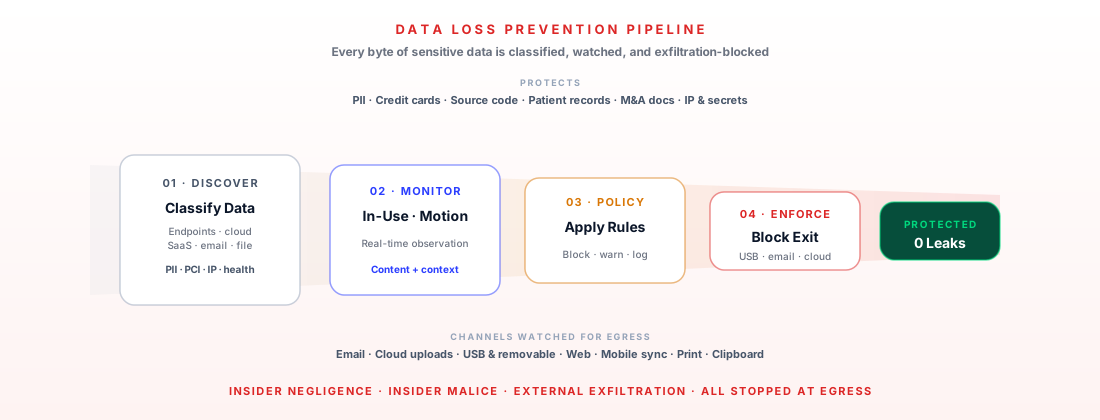
Where Data Loss Actually Happens
GDPR & Regulatory Compliance
- ✓GDPR Article 32 requires technical measures to prevent unauthorised data disclosure — DLP is the primary control that demonstrably addresses this requirement
- ✓Automated PII discovery identifies personal data in unexpected locations — legacy file shares, old email archives, unsecured databases — before a breach exposes it
- ✓Policy enforcement for sensitive categories of data (health records, financial information, criminal records) applies stricter controls automatically based on classification
- ✓DLP audit logs provide the evidence trail required for ICO investigation responses, showing the controls in place and the incident's scope precisely
Insider Threat & Departing Employees
- ✓A departing employee forwarding a customer database to a personal Gmail account is undetectable by perimeter firewalls — only endpoint and email DLP catches it
- ✓UBA baselines establish normal behaviour per user — a sudden spike in file access volume or off-hours activity triggers a risk alert before the employee departs
- ✓USB and removable media controls enforce that sensitive data can only be written to encrypted, managed devices — preventing data walking out on a USB stick
- ✓Departing employee monitoring policies can be applied automatically when HR marks a resignation — applying elevated scrutiny during the notice period
Shadow IT & Cloud Uploads
- ✓80% of enterprise employees use unsanctioned cloud applications — personal Dropbox, Google Drive, WeTransfer — to share work files because corporate tools feel friction-heavy
- ✓CASB DLP distinguishes between corporate-managed OneDrive (permitted) and personal OneDrive (blocked) even though both use the same domain and app
- ✓Real-time coaching messages explain why a transfer is blocked and offer the approved alternative — reducing help desk calls while maintaining policy enforcement
- ✓Shadow IT discovery reports identify which unapproved SaaS applications are in use across the organisation, enabling informed policy decisions about which to approve and which to block
Intellectual Property & Source Code
- ✓Source code, product designs, client lists, M&A documents, and pricing strategies are high-value targets for corporate espionage and departing employees joining competitors
- ✓Document fingerprinting creates a unique signature for sensitive documents — any copy, partial copy, or paste of content from a fingerprinted document triggers a DLP policy match
- ✓Classification labels applied by sensitivity (e.g., Microsoft Information Protection) propagate DLP policies automatically — a file labelled Confidential inherits email encryption and USB block
- ✓Git repository and developer tool monitoring ensures that source code committed to personal GitHub accounts or uploaded to AI coding assistants is detected and blocked
DLP Platforms We Deploy
Matched to your existing infrastructure, cloud footprint, and compliance requirements.
- ✓Native integration with Microsoft 365 — Exchange, Teams, SharePoint, OneDrive
- ✓Endpoint DLP agent for Windows 10/11 and macOS
- ✓Unified classification labels across M365 and Azure
- ✓200+ built-in sensitive information types (PII, PCI, PHI, GDPR)
- ✓Adaptive Protection — applies DLP based on insider risk score
- ✓No additional infrastructure for M365 E3/E5 tenants
- ✓Unified DLP across endpoints, email, web, and cloud in a single policy
- ✓Behavioural analytics and insider risk scoring built in
- ✓CASB-layer controls for all cloud applications (not just M365)
- ✓Advanced fingerprinting and OCR for images and scanned documents
- ✓Risk-adaptive enforcement — raises or lowers controls based on user risk
- ✓Global coverage for multi-cloud and hybrid environments
DLP Deployment Process
We deploy DLP in controlled phases — starting with discovery and audit mode — to ensure policy accuracy before enforcement, avoiding false positives that disrupt legitimate business processes.
Data Discovery & Risk Assessment
We run an automated sensitive data discovery scan across your endpoints, file shares, email, and cloud to map where personal data, financial records, and IP actually reside. The resulting data map identifies your highest-risk exposure areas and informs DLP policy priority.
Policy Design & Classification Taxonomy
We design a DLP policy framework aligned to your regulatory obligations (GDPR, PCI DSS, Cyber Essentials) and business context — defining what constitutes sensitive data, which channels to control, and what actions to take: block, quarantine, encrypt, audit, or coach.
Phased Deployment in Audit Mode
DLP is deployed in audit-only mode first — logging all policy matches without blocking — so we can tune policies against your real data flows before enforcement. This prevents legitimate business processes from being disrupted and builds confidence in policy accuracy before switching to block mode.
Monitoring, Tuning & Incident Response
Post-deployment monitoring tracks policy match volumes, false positive rates, and user override patterns. We tune policies continuously and provide regular compliance reports. DLP alerts integrate with your SOC workflow for investigation of high-risk incidents.
Do you know where your sensitive data is right now?
A data risk assessment maps your sensitive data estate in 48 hours — identifying unprotected PII, high-risk sharing patterns, and shadow IT data flows before they become an ICO notification.
Explore the full Servnet cyber security stack
Defence in depth means stacking complementary controls — start here for the topics that pair with this one.
AI-native EDR/XDR replacing legacy antivirus on every endpoint.
Next-gen firewalls, micro-segmentation and IPS for the perimeter and east-west.
AI-powered email defence against BEC, phishing and credential theft.
CSPM, CASB, CWP and SASE — secure workloads across AWS, Azure and GCP.
IAM, PAM and zero-trust identity — verify every user, every session.
24/7 SOC analysts hunting threats across your environment.
Talk to a UK specialist
Get expert advice or a no-obligation quote — servers, storage, networking, maintenance, finance and cloud. We reply the same working day.