
Network Security from Perimeter to Cloud
Six layers of network security covering every segment of a modern enterprise — perimeter firewall, internal segmentation, IPS, SD-WAN, SSL inspection, and unified visibility.
Next-Generation Firewall (NGFW)
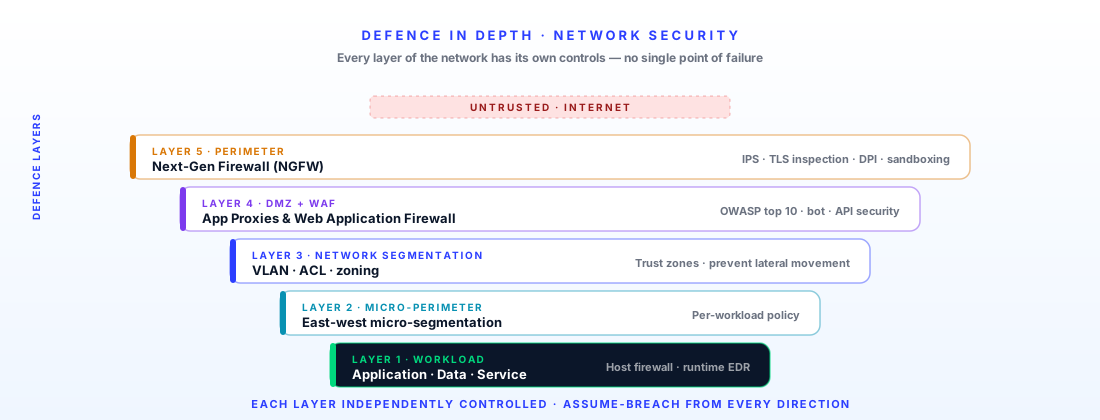
NGFWs go beyond port/protocol filtering — they perform deep packet inspection, application identification (App-ID), SSL/TLS inspection, and inline threat prevention. Every connection is identified by application and user, not just IP address, enabling granular policy enforcement that legacy firewalls cannot match.
Network Segmentation & Micro-segmentation
Flat networks are ransomware's best friend — once inside, attackers move freely east-west. Network segmentation divides your environment into security zones (DMZ, user, server, OT), while micro-segmentation isolates individual workloads using software-defined policies that follow workloads into cloud and virtualised environments.
Intrusion Prevention System (IPS)
Inline IPS inspects all traffic for known exploit signatures, protocol anomalies, and behavioural indicators of attack. Virtual patching protects unpatched systems by blocking exploit attempts at the network layer — buying time between vulnerability disclosure and patch deployment.
Secure SD-WAN
SD-WAN optimises application performance across MPLS, broadband, and 4G/5G links — but security must be built in, not bolted on. Integrated SD-WAN firewall enforces consistent security policy across every branch and remote site, with centralised management and real-time visibility across all locations.
SSL/TLS Inspection
Over 90% of web traffic is encrypted — and 70% of attacks now hide inside TLS tunnels to evade inspection. NGFW decrypts, inspects, and re-encrypts traffic inline, ensuring that threat prevention, application control, and URL filtering apply to all traffic regardless of encryption.
Centralised Network Visibility
Security Operations requires full network visibility — not tool-by-tool silos. Centralised management platforms (FortiManager, Panorama) aggregate logs, enforce policy consistency, and provide unified dashboards across firewalls, switches, and wireless access points deployed across multiple sites.
Network Threats We Defend Against
Ransomware Lateral Movement Prevention
- ✓Network segmentation limits ransomware blast radius — a single infected endpoint cannot encrypt the entire estate
- ✓East-west traffic inspection catches lateral movement between workloads in the same subnet
- ✓IPS signatures block known exploitation of SMB, RDP, and other lateral movement protocols
- ✓Application control prevents untrusted processes from establishing outbound C2 connections
Multi-Site & Branch Security
- ✓Consistent security policy across headquarters, branches, and remote workers — not different tools per site
- ✓SD-WAN prioritises business-critical applications (VoIP, M365, ERP) over best available path
- ✓Zero-touch provisioning deploys branch firewalls without on-site engineers — central management only
- ✓All branch internet traffic hairpins through central inspection before reaching cloud services
OT/ICS Network Isolation
- ✓Operational technology (OT) networks are isolated from corporate IT with hardware-enforced firewall policies
- ✓Industrial protocol inspection understands Modbus, DNP3, and PROFINET — blocking unauthorised commands
- ✓Unidirectional security gateways (data diodes) enforce strict one-way data flows from OT to IT
- ✓OT asset visibility discovers and profiles every device on the industrial network continuously
Cloud & Hybrid Network Security
- ✓Virtual NGFWs (VM-Series, FortiGate-VM) enforce consistent policy within AWS VPCs and Azure VNets
- ✓Cloud-delivered security (Prisma Cloud, FortiCNP) monitors cloud workload configurations and network flows
- ✓Hybrid connectivity between on-premises networks and cloud is inspected — not implicitly trusted
- ✓East-west traffic between cloud subnets and microservices is controlled by security group policy
World-Leading NGFW Platforms


Network Security Deployment
Network Security Assessment
We analyse your current firewall rules, network topology, segmentation boundaries, and traffic flows — identifying rule bloat, bypass paths, missing IPS coverage, and unencrypted east-west traffic that represents exploitable attack surface.
Architecture Design
We design a segmented network architecture with defined security zones, trust levels, and inter-zone policies — aligned to Zero Trust principles. Firewall platform selection (FortiGate vs Palo Alto) is matched to your throughput requirements, feature needs, and budget.
Deployment & Migration
Firewalls are deployed and existing rules migrated — with rulebase cleanup removing dead rules and consolidating overlapping policies. Migration is phased to minimise disruption, with shadow policies validating traffic before cutover.
Ongoing Management
Firewall rules decay over time without governance. We provide change management, periodic rulebase reviews, IPS signature updates, and firmware lifecycle management — ensuring your network security posture improves continuously rather than drifting.
When did you last audit your firewall rulebase?
Most firewall rulebases contain hundreds of unused, overly permissive, or shadow rules that have accumulated over years. A network security assessment identifies every gap — and our engineers fix them.
Explore the full Servnet cyber security stack
Defence in depth means stacking complementary controls — start here for the topics that pair with this one.
ZTNA and micro-segmentation — never trust, always verify.
CSPM, CASB, CWP and SASE — secure workloads across AWS, Azure and GCP.
Security Fabric — FortiGate, FortiAnalyzer, FortiSwitch.
NGFW, Prisma Access SASE and Cortex XDR.
24/7 SOC analysts hunting threats across your environment.
AI-native EDR/XDR replacing legacy antivirus on every endpoint.
Talk to a UK specialist
Get expert advice or a no-obligation quote — servers, storage, networking, maintenance, finance and cloud. We reply the same working day.