
Vulnerability Management Beyond the Spreadsheet
Six capabilities that together form a mature vulnerability management programme — from continuous discovery through risk-prioritised remediation to penetration testing validation.
Continuous Vulnerability Scanning
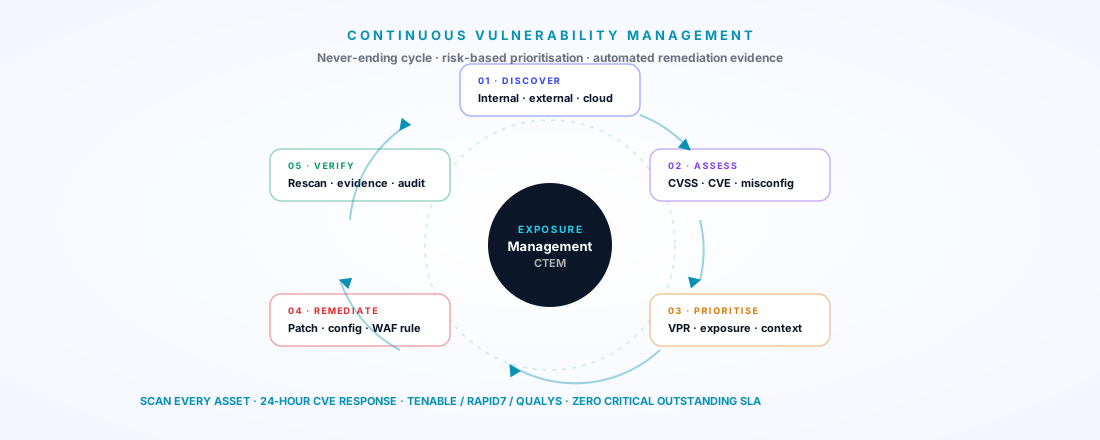
Point-in-time penetration tests reveal your posture on one day per year. Continuous scanning provides a real-time view of every vulnerability across your endpoint estate, servers, network devices, cloud environments, and web applications — updated as new CVEs are published and your environment changes.
Risk-Based Prioritisation
The average enterprise has thousands of open CVEs. Patching everything immediately is impossible. Risk-based prioritisation combines CVSS severity scores with exploit intelligence — identifying which vulnerabilities are actively being exploited in the wild by real threat actors targeting your industry, today.
Patch Management
Knowing about a vulnerability and fixing it are two different things. Automated patch deployment via Microsoft Intune, SCCM, or third-party tooling ensures critical patches are applied within your defined SLA windows — with compliance dashboards showing patch coverage across every managed device.
External Attack Surface Management
Attackers scan the internet continuously for exposed services, forgotten subdomains, misconfigured cloud storage, and unpatched internet-facing systems. External attack surface management (EASM) continuously monitors your digital footprint from an attacker's perspective — finding what they would find before they do.
Penetration Testing
Automated scanning finds known vulnerabilities — penetration testing finds the unknown ones. CREST-accredited penetration testers simulate real attacker techniques to identify logic flaws, privilege escalation paths, and vulnerability chains that automated tools cannot detect. Required for PCI DSS, ISO 27001, and Cyber Essentials Plus.
Vulnerability Intelligence & Reporting
Security teams need data they can act on — not raw CVE lists. Vulnerability management dashboards provide trend analysis, SLA compliance tracking, risk score over time, and board-level reporting that demonstrates measurable security improvement rather than a snapshot of current state.
How Quickly Should You Patch?
Industry best practice patch SLAs — aligned to NCSC guidance, PCI DSS requirements, and Cyber Essentials (14-day critical patch requirement).
Where Vulnerability Management Protects You
Pre-Ransomware Attack Surface Reduction
- ✓Ransomware operators scan the internet for unpatched VPNs, RDP, and public-facing applications before selecting targets
- ✓External attack surface management identifies every internet-facing service in your environment — including forgotten test servers
- ✓CVE intelligence cross-references your open vulnerabilities against known ransomware group exploit kits
- ✓Risk-prioritised patching closes the highest-risk vulnerabilities within hours of ransomware group exploitation being observed
PCI DSS & ISO 27001 Compliance
- ✓PCI DSS Requirement 11 mandates quarterly external vulnerability scans and annual penetration tests
- ✓ISO 27001 Annex A.12.6 requires technical vulnerability management as a mandatory control
- ✓Continuous scanning with evidence retention provides the audit trail required by certification bodies
- ✓Remediation SLA tracking demonstrates to auditors that identified vulnerabilities are addressed within policy windows
Legacy & End-of-Life Systems
- ✓Legacy systems that cannot be patched represent permanent, documented risk that must be risk-accepted or compensating controlled
- ✓Network segmentation and enhanced monitoring compensate for unpatched vulnerabilities in legacy systems
- ✓Exploit telemetry monitoring detects active exploitation attempts against known legacy CVEs in real time
- ✓Lifecycle planning informed by vulnerability data builds the business case for system modernisation investment
DevSecOps & Application Security
- ✓Container image scanning in CI/CD pipelines prevents known vulnerable packages from reaching production
- ✓Infrastructure-as-code (IaC) scanning catches misconfigurations in Terraform and CloudFormation before deployment
- ✓Web application scanning identifies OWASP Top 10 vulnerabilities in customer-facing applications
- ✓Developer security training reduces the introduction of new vulnerabilities at source — shifting security left
How We Build Your VM Programme
Vulnerability Baseline Assessment
We run authenticated internal scans alongside external attack surface discovery to establish a complete vulnerability inventory — ranked by exploitability, asset criticality, and business impact rather than CVSS score alone.
Programme Design
We design a vulnerability management programme matching your risk appetite — scanning cadence, patch SLA targets, penetration testing schedule, exception management process, and metrics framework aligned to your compliance requirements.
Tooling Deployment & Remediation
Scanning tooling is deployed and integrated with your patch management system. Remediation workflows are established — with risk-prioritised findings flowing automatically into your ticketing system with assignee, SLA, and closure verification.
Continuous Improvement & Reporting
Monthly vulnerability posture reports track risk score trend, patch SLA compliance, and mean time to remediate. Quarterly penetration tests validate that your controls hold against a skilled attacker — not just against automated scanners.
Try the Servnet Security Risk Assessment Tool
Our free AI-powered security assessment tool audits 17 categories across your Windows environment — including patch management, vulnerability exposure, OS hardening, and network security — producing an A–F risk score with actionable recommendations.
How many critical CVEs are open in your environment right now?
A vulnerability baseline assessment gives you the complete picture — internal and external attack surface, risk-prioritised by exploitability — in a single engagement.
Explore the full Servnet cyber security stack
Defence in depth means stacking complementary controls — start here for the topics that pair with this one.
AI-native EDR/XDR replacing legacy antivirus on every endpoint.
Next-gen firewalls, micro-segmentation and IPS for the perimeter and east-west.
AI-powered email defence against BEC, phishing and credential theft.
CSPM, CASB, CWP and SASE — secure workloads across AWS, Azure and GCP.
IAM, PAM and zero-trust identity — verify every user, every session.
24/7 SOC analysts hunting threats across your environment.
Talk to a UK specialist
Get expert advice or a no-obligation quote — servers, storage, networking, maintenance, finance and cloud. We reply the same working day.