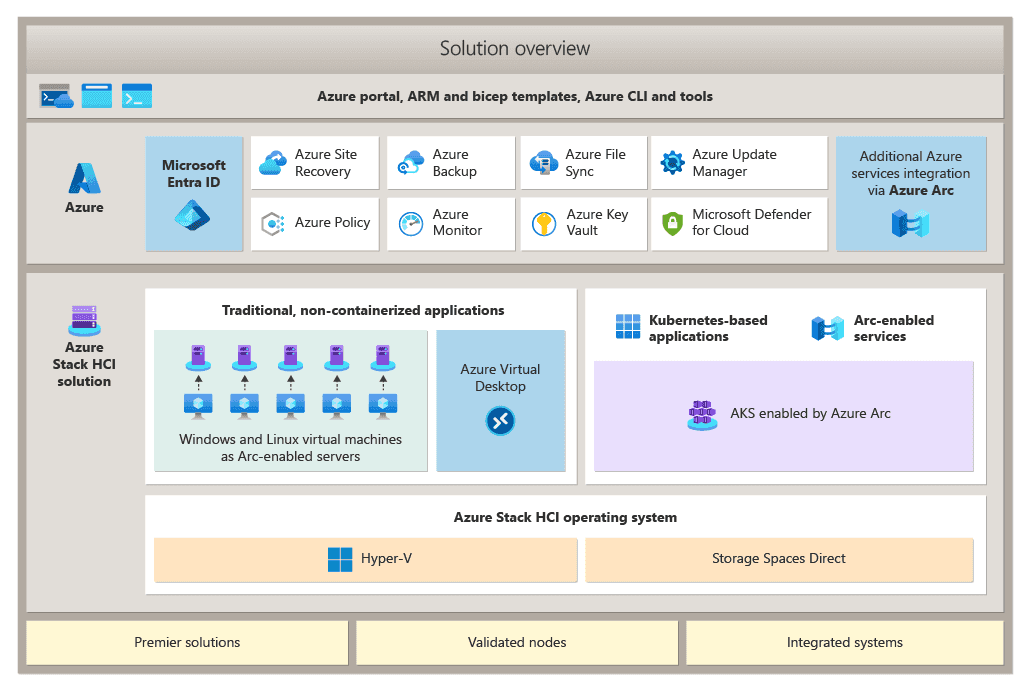
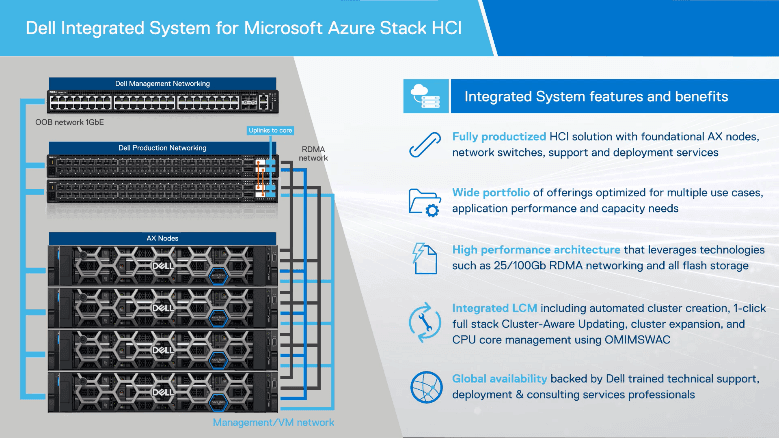
Azure Stack HCI — now branded Azure Local for the latest releases — is Microsoft's hyperconverged infrastructure platform designed to run Azure services on customer-owned hardware. Unlike traditional HCI products, Azure Stack HCI is cloud-native by design: it registers with Azure on day one, is billed like an Azure service, and is managed through the Azure portal alongside cloud resources. This positions it as a compelling choice for organisations that want Azure-consistent operations but must keep workloads on-premises for data residency, latency, or compliance reasons.
Beneath the cloud management layer, Azure Stack HCI uses Storage Spaces Direct (S2D) — Microsoft's proven software-defined storage engine — to pool local drives from every node into a highly available distributed storage pool. S2D supports NVMe, SSD, and HDD drives in all-flash or hybrid configurations, with automatic performance tiering. Clusters scale from a single node (for edge deployments) up to 16 nodes per cluster, supporting up to 4 PB of storage and 1,024 VMs per host. Memory per host scales to 24 TB, making it viable for the largest in-memory database workloads.
Azure Stack HCI 23H2 (now called Azure Local) introduced the Arc Resource Bridge as a mandatory component — a Linux VM that runs on the cluster and provides deep Azure Arc integration for VM management, Azure Policy, Defender for Cloud, and Azure Monitor. AKS enabled by Azure Arc allows Kubernetes workloads to be deployed and managed from Azure, running containerised applications on-premises with the same management experience as Azure public cloud Kubernetes. The latest Azure Local releases (2503, 2505, 2603) add GPU support for NVIDIA RTX PRO 6000 Blackwell, simplified machine provisioning, and improved lifecycle management.