
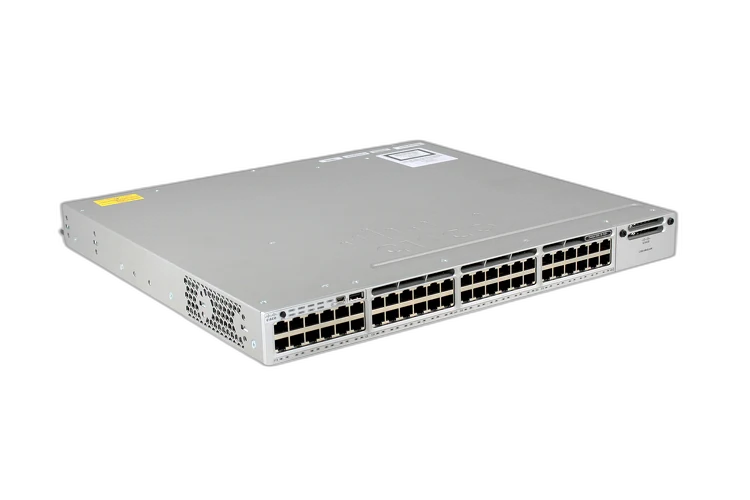
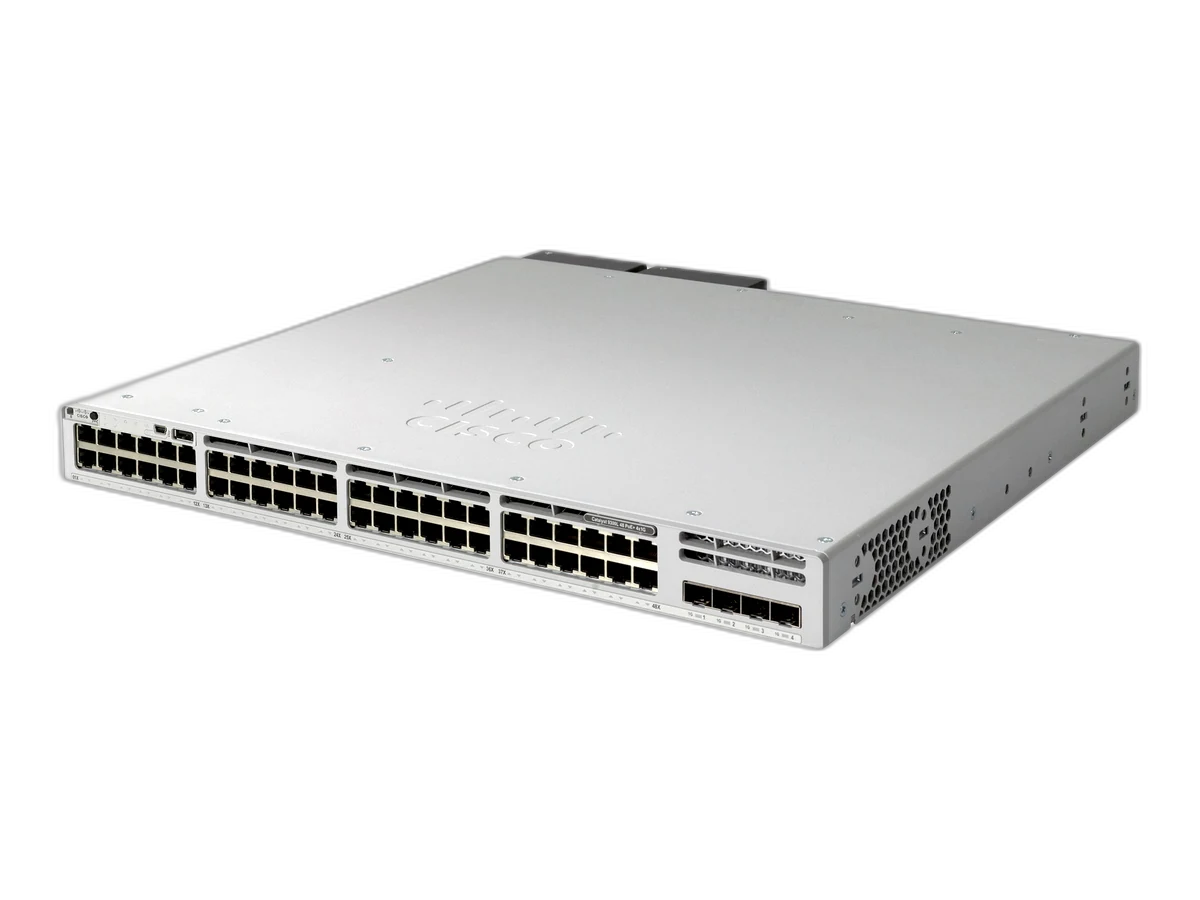
🔀 Cisco Catalyst 3850 (legacy) vs 9300-48T
AI-powered analysis across 29 matched specifications
Performance Overview
Scores based on quantifiable specification values (1-10 scale)
Detailed Specifications
| Specification | Cisco Catalyst 3850 / 3750-X Cisco | Cisco Catalyst 9300-48T Cisco |
|---|---|---|
| Key Metrics | ||
| Access ports | 48 × 1GbE (3850-48 variant) | 48 × 10/100/1000 RJ45 |
| Uplink ports | 4 × 1G SFP or 2/4 × 10G SFP+ (modular) | 4 × 10G SFP+ (modular, up to 8 × 10G or 2 × 40G) |
| Stacking bandwidth | StackWise-480 (480 Gbps) | StackWise-480 (480 Gbps) |
| Stack members | Up to 9 | Up to 8 |
| Lifecycle status | End-of-sale / end-of-support | Current — actively shipping |
| Refresh recommendation | Replace with Catalyst 9300 | N/A — current generation |
| Forwarding & ASIC | ||
| ASIC | Fixed-function (UADP 1.0 era) | UADP 2.0 programmable |
| Switching capacity | 176 Gbps (48-port model) | 208 Gbps |
| Forwarding rate | 130.95 Mpps | Up to 1 Bpps (with full uplinks) |
| Layer 3 routing | OSPF, BGP, EIGRP (IP Services) | OSPF, BGP, EIGRP, IS-IS (Network Advantage) |
| Programmability | Limited — CLI-driven | NETCONF, RESTCONF, gRPC, YANG, Python on-box |
| Security & Encryption | ||
| MACsec | MACsec-128 on selected ports | MACsec-256 on all 48 ports (hardware) |
| TrustSec / SGT | Supported | Supported (inline tagging at line rate) |
| SD-Access fabric edge | -- | Yes — full DNA Center / Catalyst Center fabric edge |
| Encrypted Traffic Analytics | -- | Yes |
| Secure boot / image signing | Limited | Trust Anchor module, secure boot, runtime defences |
| Management & Operations | ||
| Operating system | IOS-XE 16.x (final supported) | IOS-XE 17.x (current train) |
| Controller | Cisco Prime (legacy) | Catalyst Center (formerly DNA Center) + Meraki Dashboard option |
| Telemetry | SNMP, syslog | Model-driven streaming telemetry, SNMP, syslog |
| Software licensing | Perpetual feature sets (IP Base / IP Services) | DNA Essentials/Advantage subscription + Network Essentials/Advantage |
| Cloud monitoring | -- | Meraki Dashboard onboarding supported |
| Power & Physical | ||
| PoE budget (PoE+ variant) | Up to 715 W (1100 W with dual PSU) | Up to 715 W (1100 W with dual PSU); UPOE/UPOE+ on other SKUs |
| PoE standards | PoE+ (802.3at), UPOE on select models | PoE+, UPOE, UPOE+ (90 W) on -U/-H SKUs |
| Redundant PSU | Yes (dual field-replaceable) | Yes (dual field-replaceable, platinum-rated) |
| Form factor | 1U | 1U |
| Lifecycle & Support | ||
| End-of-sale | October 2019 (3850); October 2016 (3750-X) | Actively shipping |
| End of software maintenance | October 2022 (3850) | TBA — current |
| Last day of support | October 2025 (3850); October 2021 (3750-X) | TBA — current |
| Smart Licensing | Partial (later IOS-XE only) | Native Smart Licensing Using Policy |
Expert Analysis
The headline difference is lifecycle, not feature parity. The Catalyst 3850 was the dominant enterprise access switch of its generation and, on a quiet wiring closet, still moves packets perfectly well — but it is past end-of-software-maintenance and the 3850 family reaches last-day-of-support in October 2025. From a UK compliance angle (Cyber Essentials Plus, NCSC guidance on supported software, NIS2 for in-scope operators), keeping 3850s in production beyond that date is increasingly hard to defend on an audit.
The 9300-48T is the direct, like-for-like refresh. The port count, 1U form factor and StackWise-480 stacking are deliberately familiar, so cabling, stack cables and rack layouts carry over. What you actually gain sits underneath: the UADP 2.0 programmable ASIC, line-rate MACsec-256 on every port, hardware Trust Anchor, model-driven telemetry, and — crucially — eligibility as an SD-Access fabric edge under Catalyst Center. If you have any intention of running TrustSec micro-segmentation, ETA, or a controller-driven campus fabric, the 3850 cannot get you there and the 9300 is the entry ticket.
The honest trade-off is the licensing model. The 3850 shipped with perpetual IP Base or IP Services; the 9300 requires a DNA/Network subscription (Essentials or Advantage) on top of the hardware, which changes the TCO conversation. Buyers used to a one-off capex line need to budget for the recurring element, and should size Advantage vs Essentials against whether they actually intend to use SD-Access, ETA and assurance features — paying for Advantage and running it like a dumb L2 switch is wasted money.
Recommendation: if you are specifying new access-layer kit in 2024–2025, there is no scenario in which the 3850 is the right answer — buy 9300-48T (or 9300L/9300X variants where the price/feature mix fits). Keep 3850s only where they are already deployed, fully depreciated, and on a documented refresh plan before the October 2025 LDoS. For PoE-heavy deployments (IP phones, Wi-Fi 6E APs, PoE cameras) look at the 9300-48P/48U/48H rather than the data-only 48T.
Ready to proceed?
Want to compare different products or add more to this comparison?
Open Interactive Comparison Tool →