
🔀 Cisco Nexus 93180YC vs Arista 7050X4
AI-powered analysis across 24 matched specifications
Performance Overview
Scores based on quantifiable specification values (1-10 scale)
Detailed Specifications
| Specification | Cisco Nexus 9300 — N9K-C93180YC-FX Cisco | 7050X4 Series Arista |
|---|---|---|
| Key Metrics | ||
| Switching Capacity / Throughput | 3.6 Tbps | 12.8 Tbps |
| Forwarding Rate | 2,700 Mpps | 5.3 Bpps |
| Latency | -- | 900 ns |
| Software Modes / Management | NX-OS standalone or Cisco ACI fabric | Arista EOS, CloudVision, eAPI, OpenConfig, gNMI, ZTP |
| Networking | ||
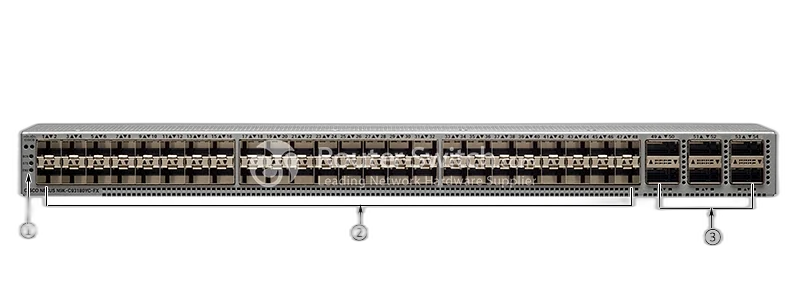
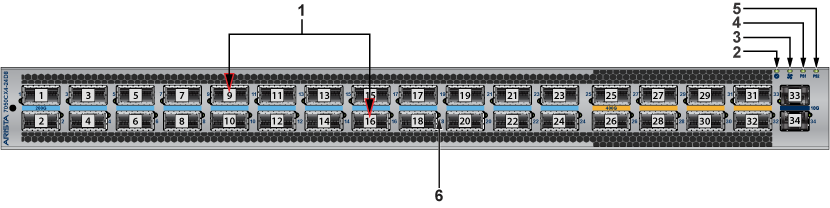
| Server / Access Ports | 48 × 25G SFP28 (breakout to 10G/1G) | Up to 128 × 25G (via breakout) or native in hybrid configs |
| Uplink / High-Speed Ports | 6 × 100G QSFP28 (breakout to 4 × 25G each) | Up to 32 × 400G OSFP/QSFP-DD (breakout to 128 × 100G) |
| MAC Address Table Size | 176,000 entries | 128K entries |
| IPv4 Routing Capacity | 128,000 prefixes | 800K prefixes / 320K host routes |
| IPv6 Routing Capacity | -- | 500K prefixes / 80K host routes |
| VXLAN Segments / Support | 16,000 segments | VXLAN support |
| ECMP Support | -- | 128-way ECMP with Dynamic Load Balancing |
| MACsec Support | IEEE 802.1AE (all ports) | MACsec (select models) |
| Routing Protocols | VXLAN BGP EVPN | BGP, OSPF, IS-IS, VXLAN, EVPN, MPLS, BFD, PIM, IGMP |
| Buffer Memory | -- | 132MB integrated intelligent buffer with dynamic allocation |
| Physical / Environmental | ||
| Form Factor | 1U rack-mount | 1RU (7050PX4-32S, 7050DX4-32S) or 1RU/2RU (hybrid models) |
| Weight | 10.9 kg | -- |
| Cooling | Redundant fan trays | -- |
| Power | ||
| Power Supply Configuration | Dual hot-swap AC/DC (port-to-power or power-to-port airflow) | 1+1 redundant hot-swap PSU |
| Max / Typical Power Draw | 380W | Approx 353W typical (32× 400G) |
| Power Efficiency | -- | >94% efficiency |
| Management | ||
| Telemetry & Monitoring | Rich telemetry: streaming, SNMP, syslog, ERSPAN | CloudVision, eAPI (JSON-RPC), OpenConfig, gNMI |
| Provisioning | -- | Zero Touch Provisioning |
| Software & OS Compatibility | ||
| Operating System / Software Platform | Cisco NX-OS | Arista EOS |
| Fabric / SDN Support | Cisco ACI (Application Centric Infrastructure) support | -- |
Expert Analysis
The Cisco Nexus 9300 N9K-C93180YC-FX and Arista 7050X4 Series represent distinct approaches to modern data centre switching, each excelling in different deployment scenarios. The Cisco offering provides a balanced 48-port 25G access switch with 6×100G uplinks, delivering 3.6 Tbps switching capacity with comprehensive MACsec encryption across all ports. Its dual-mode operation (NX-OS standalone or ACI fabric) makes it particularly suitable for organisations invested in Cisco's Application Centric Infrastructure ecosystem or requiring consistent NX-OS operations. The Arista 7050X4, in contrast, delivers exceptional density with up to 32×400G ports in a single rack unit, achieving 12.8 Tbps throughput with sub-microsecond latency from 900ns. Its 132MB intelligent buffer and 128-way ECMP with dynamic load balancing provide superior performance for high-scale leaf-spine fabrics and latency-sensitive applications.
Key trade-offs centre on port density versus feature completeness. The Arista switch offers 3.5 times greater throughput capacity and supports significantly larger routing tables (800K IPv4 prefixes versus 128K), making it better suited for large-scale cloud and hyperscale deployments. However, the Cisco switch provides MACsec encryption on all ports as standard, whereas Arista offers it only on select models. The Cisco's ACI integration provides comprehensive policy-based automation for enterprises with existing Cisco infrastructure, while Arista's CloudVision and EOS platform offer extensive programmability through modern APIs including OpenConfig and gNMI.
Value proposition differences are pronounced: the Cisco switch delivers a robust, enterprise-focused solution with strong security features and Cisco's extensive support ecosystem, ideal for traditional data centre modernisation. The Arista switch provides cutting-edge performance metrics and density for organisations building high-performance, scalable fabrics where throughput, latency, and routing scale are paramount. Neither represents a universal 'best' choice; rather, selection depends on whether an organisation prioritises integration with existing Cisco ecosystems and comprehensive security features, or requires maximum port density and performance for next-generation workloads.
Ready to proceed?
Want to compare different products or add more to this comparison?
Open Interactive Comparison Tool →