
🖥️ Vertiv ACS8000 vs Raritan LX II
AI-powered analysis across 26 matched specifications
Performance Overview
Scores based on quantifiable specification values (1-10 scale)
Detailed Specifications
| Specification | Avocent ACS8000 Vertiv | Dominion LX II Raritan |
|---|---|---|
| Key Metrics | ||
| Device type | Serial console server | KVM-over-IP switch |
| Port count options | 8, 16, 32 or 48 serial ports | 8 or 32 server ports |
| Primary connection | RJ45 serial (RS-232/422/485) | Cat5/6 to CIM dongles (VGA/USB) |
| Remote access | SSH, HTTPS, IPsec VPN, 4G LTE | HTML5 browser, no Java client |
| Encryption | FIPS 140-2 validated, TLS 1.3 | AES (256-bit) over HTTPS |
| Concurrent user sessions | -- | Up to 4 |
| Connectivity | ||
| Console / KVM ports | 8–48 RJ45 serial | 8 or 32 Cat5 server ports |
| USB ports | 8 USB (host/device, USB consoles) | Local USB keyboard/mouse |
| Network uplinks | Dual GbE copper plus SFP fibre | Dual GbE copper |
| Cellular WAN | Integrated 4G LTE with failover | Not supported |
| Local console | Yes (admin port) | Local KVM port (VGA + USB) |
| Video resolution | N/A (serial only) | Up to 1920×1080 (1080p HD) |
| Security & Authentication | ||
| Crypto certification | FIPS 140-2 module | AES, no FIPS certification published |
| Secure tunnelling | IPsec, OpenVPN, TLS 1.3 | HTTPS (TLS) sessions |
| Directory integration | LDAP, AD, RADIUS, TACACS+, Kerberos | LDAP, Active Directory, RADIUS |
| Role-based access | Granular per-port RBAC | Per-port permissions |
| Audit & logging | Local + remote syslog, data buffering per port | Event log, syslog |
| Management & Automation | ||
| Zero-touch provisioning | Yes (ZTP) | No |
| Centralised management | Vertiv Avocent DSView / ADXRM | Raritan CommandCenter Secure Gateway |
| Scripting / automation | Python, shell, Docker container support | Limited (CLI + CC-SG) |
| Virtual media | Not applicable (serial) | Yes — remote ISO/USB mounting |
| Browser client | HTML5 web UI + SSH | HTML5, Java-free |
| Hardware & Power | ||
| Form factor | 1U rack | 1U rack |
| CPU | Dual-core ARM | Not published |
| Power supplies | Dual AC or DC options | Single AC (dual on 32-port model) |
| Operating temperature | 0–50 °C | 0–40 °C |
Expert Analysis
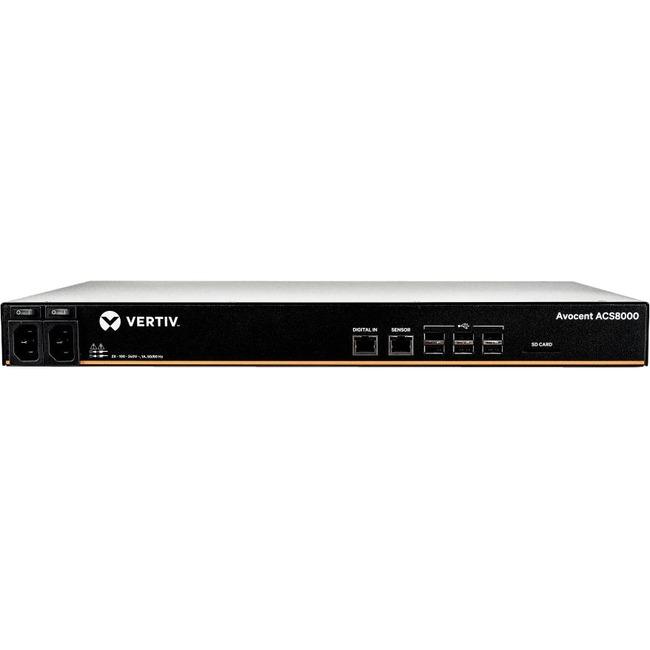
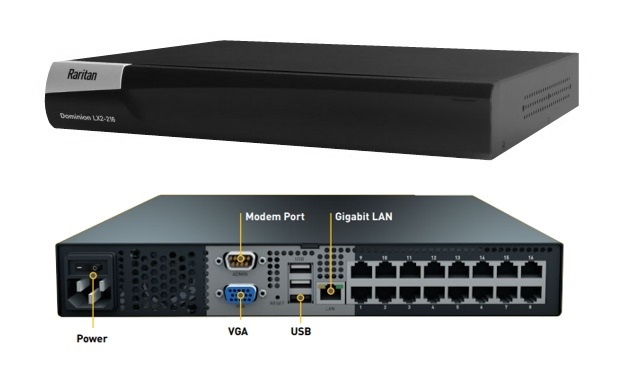
These two products solve different problems and shouldn't be cross-shopped without first deciding what you actually need to reach out-of-band. The Vertiv Avocent ACS8000 is a serial console server: it terminates RS-232 console ports on network kit, servers' serial headers, UPS and PDUs, and gives you a hardened path in via SSH, VPN or 4G LTE. The Raritan Dominion LX II is a KVM-over-IP switch: it captures keyboard, video and mouse from up to 32 servers and streams 1080p sessions to remote admins, with virtual media for ISO mounts.
Where the ACS8000 wins decisively is resilience and compliance. The integrated 4G LTE radio, dual power options, FIPS 140-2 cryptographic module, TLS 1.3, IPsec and SFP fibre uplink make it the obvious choice for UK sites that have to satisfy NCSC CAF, FCA operational-resilience or NIS2 expectations for genuinely independent out-of-band access. Zero-touch provisioning, Python scripting and Docker support also make it the better fit for large estates managed through automation.
The LX II's strength is at the OS and BIOS layer. When a Windows or Linux host has hung before SSH is up, or you need to mount a recovery ISO over the network, a serial console can't help — you need KVM. The LX II delivers that cleanly with HTML5 access (no Java), AD/LDAP auth, AES encryption and up to four concurrent users, at a meaningfully lower price point than enterprise KVM platforms. It is, however, a more modest device: no cellular failover, no FIPS validation, and fewer automation hooks.
For most UK enterprise buyers the honest answer is that you need both classes of device, not a choice between them — serial consoles for network and infrastructure gear, KVM-over-IP for bare-metal server recovery. If budget forces a single pick, choose the ACS8000 when the estate is predominantly network, security and Linux infrastructure with console ports; choose the LX II when the estate is Windows servers, lab benches or remote sites where engineers need pixel-level access to the OS.
Ready to proceed?
Want to compare different products or add more to this comparison?
Open Interactive Comparison Tool →