
Backup That Is Genuinely Recoverable
Six capabilities that together ensure your backup is immutable, verified, complete, and actually recoverable within your business requirements.
Immutable & Air-Gapped Backups
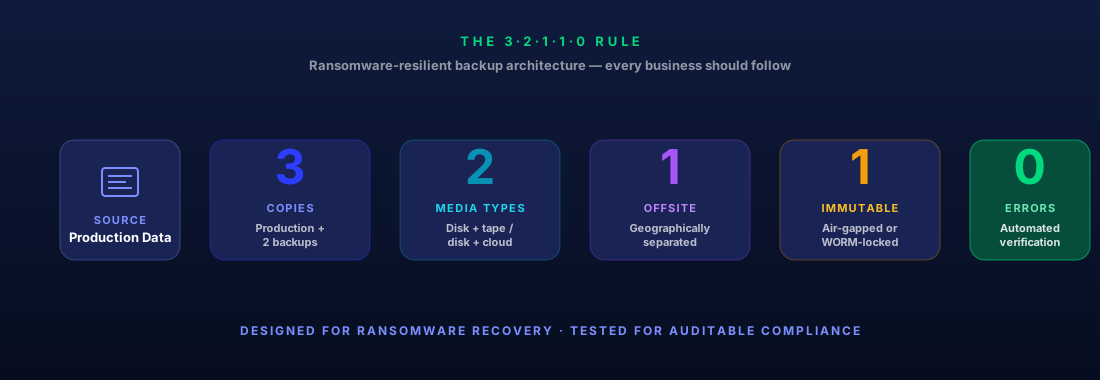
Immutable backups — written once, never modifiable — are the definitive defence against ransomware that targets backup infrastructure. The 3-2-1-1-0 rule governs modern best practice: 3 copies of data, on 2 different media types, with 1 off-site copy, 1 air-gapped or immutable copy, and 0 unverified backups. S3 Object Lock, Veeam Hardened Linux Repository, and tape air-gaps all provide immutability at different tiers.
Recovery Time & Point Objectives
RTO (Recovery Time Objective) defines how quickly you must be operational after a failure. RPO (Recovery Point Objective) defines how much data loss is acceptable. These are business decisions, not IT decisions — a 4-hour RTO for a trading system and a 72-hour RTO for an archive server reflect very different business impacts. We work with stakeholders to define realistic RTOs and RPOs, then design the infrastructure required to meet them, with contractually-backed SLAs.
Tested & Verified Recovery
An untested backup is not a backup — it is a hope. Veeam SureBackup and SureReplica automatically verify every backup by spinning up VMs in an isolated sandbox environment, running application-level health checks, and confirming services respond correctly. Automated verification runs after every backup job — not just periodically — so you know within minutes of each backup whether it is genuinely restorable, not on the day you actually need it.
Hybrid & Multi-Cloud BDR
Modern backup architectures protect workloads across on-premises, Azure, AWS, Google Cloud, Microsoft 365, and SaaS applications in a single unified platform. Cloud backup offers elastic storage without capacity planning — you pay for what you use. Backup data replication between cloud regions or providers ensures resilience against cloud zone outages. Veeam Backup for Microsoft 365 protects Exchange, SharePoint, Teams, and OneDrive data that Microsoft does not natively retain beyond the recycle bin.
Disaster Recovery Orchestration
A disaster recovery plan that exists only as a PDF document fails under pressure. Runbook automation, pre-staged failover environments, and one-click orchestrated recovery mean your IT team is executing a tested, automated workflow — not improvising under stress. Zerto continuous replication provides near-zero RPO for Tier 1 applications, replicating at the journal level with recovery point granularity measured in seconds rather than hours.
Backup Monitoring & Compliance
Backup failure is silent by default — most organisations only discover a failed backup when they need to restore. Proactive monitoring alerts on every failed job, unexpected data change rate, storage capacity, and backup window breach. Detailed audit logs track who accessed backup data, what was restored, and when — satisfying GDPR data retention requirements, ISO 27001 audit trails, and cyber insurance policy stipulations that require documented backup procedures.
What Your Backup Must Survive
Ransomware Recovery
- ✓Modern ransomware attacks specifically target backup infrastructure first — deleting shadow copies, disabling backup agents, and encrypting NAS-mounted backup repositories
- ✓Immutable S3 Object Lock backups cannot be modified or deleted by ransomware even with administrative credentials — the retention lock is enforced at storage layer
- ✓Air-gapped tape or cloud backups physically cannot be reached by network-connected ransomware, providing a guaranteed clean restore point
- ✓Veeam Instant Recovery restores servers from backup in minutes directly onto VMware or Hyper-V — minimising the operational window between incident and recovery
Microsoft 365 & SaaS Data Loss
- ✓Microsoft's Shared Responsibility Model explicitly states that data protection in Microsoft 365 is the customer's responsibility — Microsoft protects the platform, not your data
- ✓Deleted Exchange mailboxes are permanently purged after 30 days by default; SharePoint items after 93 days — outside these windows, data is unrecoverable without third-party backup
- ✓Ransomware propagated through OneDrive sync can encrypt cloud files — Microsoft 365 version history is limited and cannot substitute for point-in-time backup
- ✓Veeam Backup for Microsoft 365 retains Exchange, SharePoint, OneDrive, and Teams data indefinitely with granular item-level restore — single email, single document, single conversation
Regulatory & Insurance Requirements
- ✓ISO 27001 Annex A.12.3 mandates information backup — auditors will review backup procedures, test results, and restoration logs
- ✓Cyber insurance underwriters increasingly require documented 3-2-1 backup strategies, immutable copies, and evidence of tested recovery as policy conditions — not just recommendations
- ✓GDPR requires that personal data be recoverable in the event of a physical or technical incident (Article 32) — lack of backup capability is a direct GDPR compliance failure
- ✓NIS2 Directive requires organisations to have documented, tested business continuity plans and backup procedures as part of the 10 baseline security measures
Hardware Failure & Site Disaster
- ✓Storage array failure, server motherboard failure, and SAN fabric issues are the most common causes of unplanned downtime — hardware fails even in the best-maintained environments
- ✓Site-level disasters — fire, flood, power failure, or ISP outage — require off-site recovery capability that on-premises-only backup cannot provide
- ✓Veeam Instant Cloud Recovery allows failed on-premises workloads to be spun up directly in Azure or AWS within minutes, without pre-provisioned infrastructure
- ✓DRaaS (Disaster Recovery as a Service) provides a pre-staged cloud recovery environment on a subscription basis, eliminating the capital cost of a traditional warm DR site
Backup & DR Platforms We Deploy
We are vendor-certified across the leading BDR platforms — matching the right solution to your environment, workloads, and recovery targets.
- ✓Industry-leading VM backup for VMware and Hyper-V
- ✓SureBackup automated verified recovery
- ✓Veeam ONE monitoring and reporting
- ✓Backup for Microsoft 365 (Exchange, SP, Teams)
- ✓Instant Recovery to VMware, Hyper-V, Azure, AWS
- ✓Hardened Linux Repository for immutable backups
- ✓Unified backup + endpoint security in one agent
- ✓AI-based ransomware protection integrated with backup
- ✓Acronis Cyber Infrastructure (on-prem storage)
- ✓Cloud-to-cloud backup for Microsoft 365, Google Workspace
- ✓Disaster recovery failover to Acronis Cloud
- ✓Blockchain-based data authenticity certification
- ✓Continuous journal-based replication (near-zero RPO)
- ✓Sub-second journal granularity for Tier 1 workloads
- ✓Non-disruptive DR testing without impacting production
- ✓Automated failover orchestration with runbooks
- ✓Multi-cloud replication (Azure, AWS, GCP)
- ✓Ransomware resilience with point-in-time journal recovery
BDR Deployment Process
BDR Assessment & Gap Analysis
We audit your current backup estate — identifying unprotected workloads, untested restores, missing cloud or SaaS coverage, and backup infrastructure accessible from the production network. We document your current effective RTO and RPO versus your business requirements.
Architecture Design & Platform Selection
We design a backup and DR architecture matched to your RTOs, RPOs, budget, and regulatory requirements — selecting between Veeam, Acronis, and Zerto based on your environment, then designing the 3-2-1-1-0 data flow for each workload tier.
Deployment & Hardening
Backup infrastructure is deployed with network isolation — backup servers separated from production, immutable repositories configured with Object Lock or Hardened Linux, and service accounts with minimal privilege so a compromised production account cannot touch backup data.
Testing, Monitoring & Managed Service
Automated SureBackup verification runs after every job. Monthly recovery tests confirm RTOs are achievable in practice. Proactive monitoring with 24/7 alerting on failures. Optional fully managed backup service with Servnet engineers owning backup operations end-to-end.
When did you last successfully test a full restore?
A BDR assessment identifies unprotected workloads, untested backups, and backup infrastructure vulnerable to ransomware — before an incident forces the question.
Explore the full Servnet cyber security stack
Defence in depth means stacking complementary controls — start here for the topics that pair with this one.
Six-layer defence — prevent, detect, contain, recover without paying.
Breach containment, forensic recovery and ICO notification support.
ISO 27001, GDPR, NIS2, DORA — frameworks to evidence.
NCSC-aligned certification — preparation and audit support.
DLP across endpoint, network and cloud — stop data leaks before they happen.
24/7 SOC analysts hunting threats across your environment.
Talk to a UK specialist
Get expert advice or a no-obligation quote — servers, storage, networking, maintenance, finance and cloud. We reply the same working day.