
Why AI-Native Endpoint Security Wins
Six capabilities that together provide protection, detection, investigation, and response that signature-based tools fundamentally cannot match.
AI-Native Threat Prevention
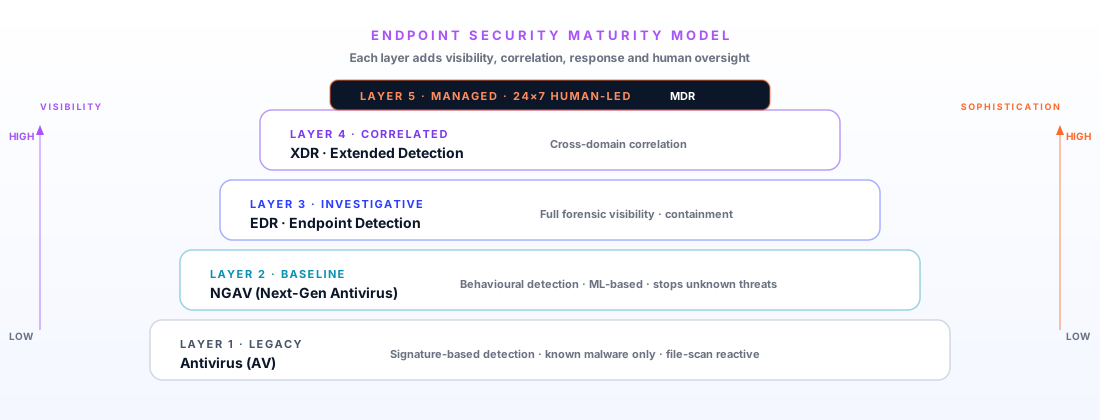
Next-generation AV (NGAV) uses machine learning models trained on billions of malware samples to identify and block malicious files — including zero-day malware with no prior signatures. Unlike legacy AV, ML-based prevention works offline, doesn't require signature updates, and catches polymorphic malware that rewrites itself to evade hash-based detection.
Endpoint Detection & Response (EDR)
EDR records a continuous, tamper-proof audit trail of every process, file write, registry change, network connection, and user action on every endpoint. When a threat is detected — or even investigated retrospectively — the complete attack chain is immediately visible, including the original entry point, every lateral movement step, and every file touched.
Autonomous Response
SentinelOne's Singularity platform can autonomously detect, contain, and remediate threats — including rolling back ransomware-encrypted files to their pre-attack state — without human intervention. Mean time to respond measured in seconds, not the hours or days required when humans are in the loop for every containment decision.
Extended Detection & Response (XDR)
XDR correlates telemetry from endpoints, network, cloud, identity, and email into unified incidents — eliminating the alert silos that exhaust SOC analysts. An endpoint compromise that pivots to cloud and then to email is visible as a single, correlated attack story — not three separate alerts in three different consoles.
Vulnerability & Patch Management
EDR platforms provide continuous asset inventory and vulnerability assessment across the entire endpoint estate — identifying unpatched CVEs, end-of-life software, and misconfigured settings. CrowdStrike Spotlight integrates vulnerability risk scores with exploit intelligence to prioritise patching by actual threat likelihood, not just CVSS score.
Threat Intelligence & Hunting
Built-in threat intelligence enriches every detection with adversary context — which threat actor, which campaign, which malware family, which MITRE ATT&CK technique. Custom threat hunting queries search the full 365-day telemetry history for indicators of compromise related to active campaigns targeting your industry.
Attacks EDR Stops That AV Misses
Ransomware Containment
- ✓Behavioural AI detects ransomware encryption behaviour within the first 10 files encrypted — before significant damage occurs
- ✓Automatic endpoint isolation cuts the compromised device from the network in under 1 second
- ✓SentinelOne's Rollback feature restores all encrypted files to their pre-attack state from volume shadow copies
- ✓Attack story shows the full kill chain — initial access vector, process tree, and every file modified
Living-off-the-Land (LotL) Attacks
- ✓Attackers use legitimate system tools (PowerShell, WMI, certutil, mshta) to avoid dropping malicious files
- ✓Fileless attacks leave no artefacts for signature-based AV to scan — EDR catches the behaviour, not the file
- ✓Script execution monitoring detects malicious PowerShell and WMI commands regardless of obfuscation
- ✓Memory scanning catches injected shellcode and reflective DLL loading that fileless attackers rely on
Supply Chain & Software Compromise
- ✓Compromised software updates (SolarWinds-style) are detected by behavioural anomalies in trusted processes
- ✓Process tree analysis identifies when a legitimate application spawns unexpected child processes
- ✓Network connection monitoring flags when trusted software phones home to unexpected C2 infrastructure
- ✓Threat intelligence correlates process hashes against known supply chain compromise indicators globally
Legacy System & Server Protection
- ✓Windows Server 2008, 2012, and other end-of-life systems remain protected even without OS security patches
- ✓Server workload protection monitors for web shell uploads, reverse shell spawning, and privilege escalation
- ✓EDR sensor operates at kernel level — cannot be killed or bypassed by attacker tools that run in user space
- ✓Immutable audit trail preserved even if attacker attempts to clear Windows Event Logs or tamper with EDR
CrowdStrike vs SentinelOne — Endpoint Capabilities
Both platforms are Gartner EPP/EDR Magic Quadrant Leaders. The choice depends on your priorities.
Endpoint Security Deployment
Endpoint Security Assessment
We audit your current endpoint protection coverage — identifying unmanaged devices, EDR sensor gaps, legacy AV exclusions, and misconfigured policies. A proof-of-value deployment demonstrates what your existing tools are missing.
Platform Selection & Deployment
We select CrowdStrike Falcon or SentinelOne Singularity based on your specific requirements — then deploy sensors silently across your endpoint estate via Group Policy, SCCM, Intune, or third-party tooling with zero user disruption.
Policy Tuning & Integration
Prevention policies are tuned for your environment — minimising false positives while maintaining maximum protection. Integration with your SIEM, ticketing system, and identity provider ensures alerts flow into your existing workflow.
Managed Detection or Self-Service
Choose self-managed with your own SOC team, or add CrowdStrike Falcon Complete or SentinelOne Vigilance MDR for 24/7 expert monitoring, threat hunting, and incident response on top of the EDR platform.
Is your current AV protecting you against fileless attacks?
A proof-of-value deployment demonstrates exactly what threats are currently operating in your environment that your existing tools are missing — at no risk and no disruption.
Explore the full Servnet cyber security stack
Defence in depth means stacking complementary controls — start here for the topics that pair with this one.
24/7 SOC analysts hunting threats across your environment.
Six-layer defence — prevent, detect, contain, recover without paying.
ZTNA and micro-segmentation — never trust, always verify.
Breach containment, forensic recovery and ICO notification support.
Continuous CVE scanning and risk-based patch prioritisation.
IAM, PAM and zero-trust identity — verify every user, every session.
Talk to a UK specialist
Get expert advice or a no-obligation quote — servers, storage, networking, maintenance, finance and cloud. We reply the same working day.