
The Six Pillars of Zero Trust
Based on NIST SP 800-207 and the NCSC Zero Trust Architecture design principles — a comprehensive framework covering every layer of your environment.
Identity Verification
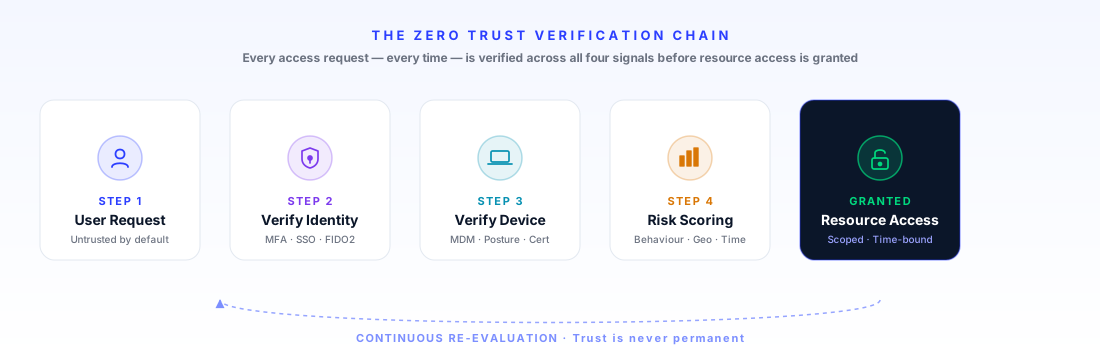
Every access request is authenticated and authorised regardless of network location. Phishing-resistant MFA (FIDO2/passkeys), SSO, and continuous re-authentication ensure only verified identities access resources — not just at login, but throughout the session.
Device Trust
Device health is assessed before granting access. MDM enrolment status, OS patch level, endpoint security posture, and certificate-based device identity are evaluated continuously — blocking access from compromised or unmanaged endpoints.
Least-Privilege Access
Users and workloads receive only the minimum permissions required, for only as long as needed. Just-in-time (JIT) elevation replaces standing privileges, and access is scoped to specific applications — not entire network segments.
Micro-segmentation
East-west traffic between workloads is restricted by policy, not by network topology. Applications are isolated into micro-perimeters so that a compromised workload cannot move laterally — dramatically reducing ransomware blast radius.
Continuous Monitoring
Trust is never assumed — it is continuously re-evaluated. Session behaviour analytics detect anomalies in real time. Risk scores are recalculated dynamically and access policies adapt automatically when behaviour deviates from baseline.
Data-Centric Protection
Data is classified, tagged, and protected with consistent controls regardless of where it lives. DLP policies, encryption in transit and at rest, and access logging ensure sensitive data is protected at every point in its lifecycle.
Where Zero Trust Eliminates Risk
From remote workforces to supply chain access and cloud migrations — Zero Trust removes implicit trust at every attack vector.
Remote & Hybrid Workforce
- ✓ZTNA replaces VPN — users access specific applications, never the full network
- ✓Device posture is checked on every connection; non-compliant devices are blocked or quarantined
- ✓Identity-aware proxy enforces MFA and conditional access for every SaaS and internal app
- ✓Split tunnelling is eliminated — all traffic passes through security inspection regardless of location
Supply Chain & Third-Party Access
- ✓Third-party contractors receive scoped, time-limited access to specific systems only
- ✓No VPN credentials to steal — access is identity-bound and expires automatically
- ✓Session recording and audit trails capture all third-party activity for compliance
- ✓Vendor compromise cannot pivot into your network — each access request is independently verified
Cloud & Multi-Cloud Security
- ✓Zero Trust policies span on-premises, AWS, Azure, and GCP without inconsistency
- ✓Cloud entitlements are governed centrally — over-privileged IAM roles are detected and removed
- ✓Workload-to-workload communication is authenticated with certificates, not network trust
- ✓CASB enforces DLP and access policies for SaaS applications used across the business
Privileged Access & Lateral Movement
- ✓Privileged accounts are vaulted and accessed via just-in-time elevation only
- ✓Lateral movement is blocked by micro-segmentation — even with stolen credentials
- ✓Privileged session recording provides forensic evidence for every administrative action
- ✓Pass-the-hash and pass-the-ticket attacks are neutralised by eliminating standing privileges
How We Implement Zero Trust
A phased approach that delivers security improvements at each stage — not a rip-and-replace project.
Zero Trust Readiness Assessment
We evaluate your current identity, device, network, and data controls against NIST 800-207 and NCSC Zero Trust principles — producing a gap analysis and prioritised roadmap.
Architecture Design
Our engineers design a phased Zero Trust architecture tailored to your environment — mapping identity providers, device management, ZTNA gateway, micro-segmentation zones, and monitoring integration.
Phased Implementation
Zero Trust is deployed incrementally — identity first, then device posture, then application access, then micro-segmentation — minimising disruption while delivering rapid security improvements at each phase.
Continuous Improvement
Post-deployment, we monitor policy effectiveness, review access anomalies, and iterate on segmentation policies as your environment evolves — ensuring Zero Trust posture matures continuously.
Best-of-Breed Zero Trust Vendors
We work with the leading Zero Trust technology providers — deploying the right combination of tools for your environment and maturity level.




Zero Trust supports your compliance obligations
Zero Trust Architecture directly satisfies controls across the major frameworks applicable to UK organisations — from NCSC Cyber Essentials Plus and ISO 27001 to NIS2 and UK GDPR Article 32 technical measures.
Ready to implement Zero Trust?
Our certified engineers will assess your environment against NIST 800-207, design a phased Zero Trust roadmap, and deploy the right technology to make it real — not just a policy document.
Explore the full Servnet cyber security stack
Defence in depth means stacking complementary controls — start here for the topics that pair with this one.
AI-native EDR/XDR replacing legacy antivirus on every endpoint.
Next-gen firewalls, micro-segmentation and IPS for the perimeter and east-west.
AI-powered email defence against BEC, phishing and credential theft.
CSPM, CASB, CWP and SASE — secure workloads across AWS, Azure and GCP.
IAM, PAM and zero-trust identity — verify every user, every session.
24/7 SOC analysts hunting threats across your environment.
Talk to a UK specialist
Get expert advice or a no-obligation quote — servers, storage, networking, maintenance, finance and cloud. We reply the same working day.