
🔀 FortiSwitch FS-524D vs Cisco Catalyst 9300L-48P
AI-powered analysis across 28 matched specifications
Performance Overview
Scores based on quantifiable specification values (1-10 scale)
Detailed Specifications
| Specification | FortiSwitch FS-524D Fortinet | Cisco Catalyst 9300L-48P Cisco |
|---|---|---|
| Key Metrics | ||
| Access port count | 24 × 1GbE RJ45 | 48 × 1GbE RJ45 |
| Uplink ports | 4 × 10GE SFP+, 2 × 40GE QSFP+ | 4 × 1G SFP |
| Switching capacity | 288 Gbps | 108 Gbps (4 × 1G uplink + 48 × 1G access, full duplex) |
| Forwarding rate | 428 Mpps | -- |
| PoE budget | None (non-PoE) | 505 W (PoE+ 802.3at) |
| Positioning | Campus aggregation / distribution | Enterprise access layer |
| Port Density & Uplinks | ||
| Access ports | 24 × 10/100/1000 RJ45 | 48 × 10/100/1000 RJ45 |
| 10G uplinks | 4 × SFP+ | None on this SKU (4G uplink model) |
| 40G uplinks | 2 × QSFP+ | None |
| PoE standard | Not supported | 802.3af / 802.3at (PoE+) |
| Stacking | -- | StackWise-160 (up to 8 switches) |
| Forwarding & Performance | ||
| Switching fabric | 288 Gbps | Up to 208 Gbps stack bandwidth via StackWise-160 |
| Throughput (Mpps) | 428 Mpps | -- |
| Latency class | Cut-through / low-latency aggregation | Store-and-forward access ASIC (UADP 2.0 Mini) |
| Jumbo frames | Yes (9216 bytes) | Yes (9198 bytes) |
| Layer 2 / Layer 3 Features | ||
| Layer 3 routing | Static, OSPF, BGP, VRRP | Static, OSPF, EIGRP, BGP (with Network Advantage) |
| MACsec | -- | Yes, line-rate hardware |
| Segmentation | VLAN, private VLAN | VLAN, SGT/TrustSec, VXLAN-EVPN (with Network Advantage) |
| Multicast | IGMP v1/v2/v3, PIM | IGMP v1/v2/v3, PIM-SM/SSM |
| Management & Ecosystem | ||
| Primary management | FortiLink via FortiGate, FortiSwitch Manager | Cisco IOS-XE CLI, Catalyst Center (DNA Center) |
| Cloud management | FortiCloud | Meraki Dashboard (with Meraki persona) / Catalyst Center cloud |
| Telemetry & automation | SNMP, sFlow, REST API | NETCONF/YANG, Model-Driven Telemetry, gNMI, Ansible |
| Security fabric integration | Native Fortinet Security Fabric (FortiGate, FortiAP) | Cisco ISE, TrustSec, SD-Access |
| Licensing model | Included with hardware | Network Essentials or Network Advantage (DNA subscription) |
| Power & Physical | ||
| Form factor | 1U rack | 1U rack |
| Redundant PSU | Optional / field-replaceable | Optional dual PSU |
| PoE per port | N/A | Up to 30 W (802.3at) |
| Operating role | Distribution / aggregation | Wiring-closet access |
Expert Analysis
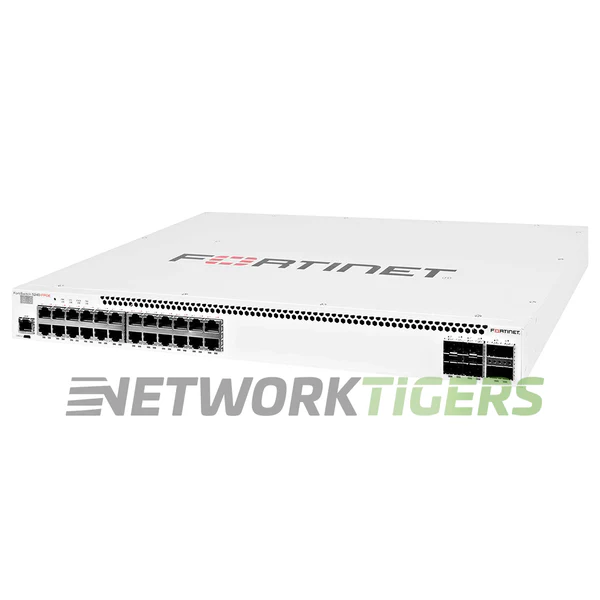
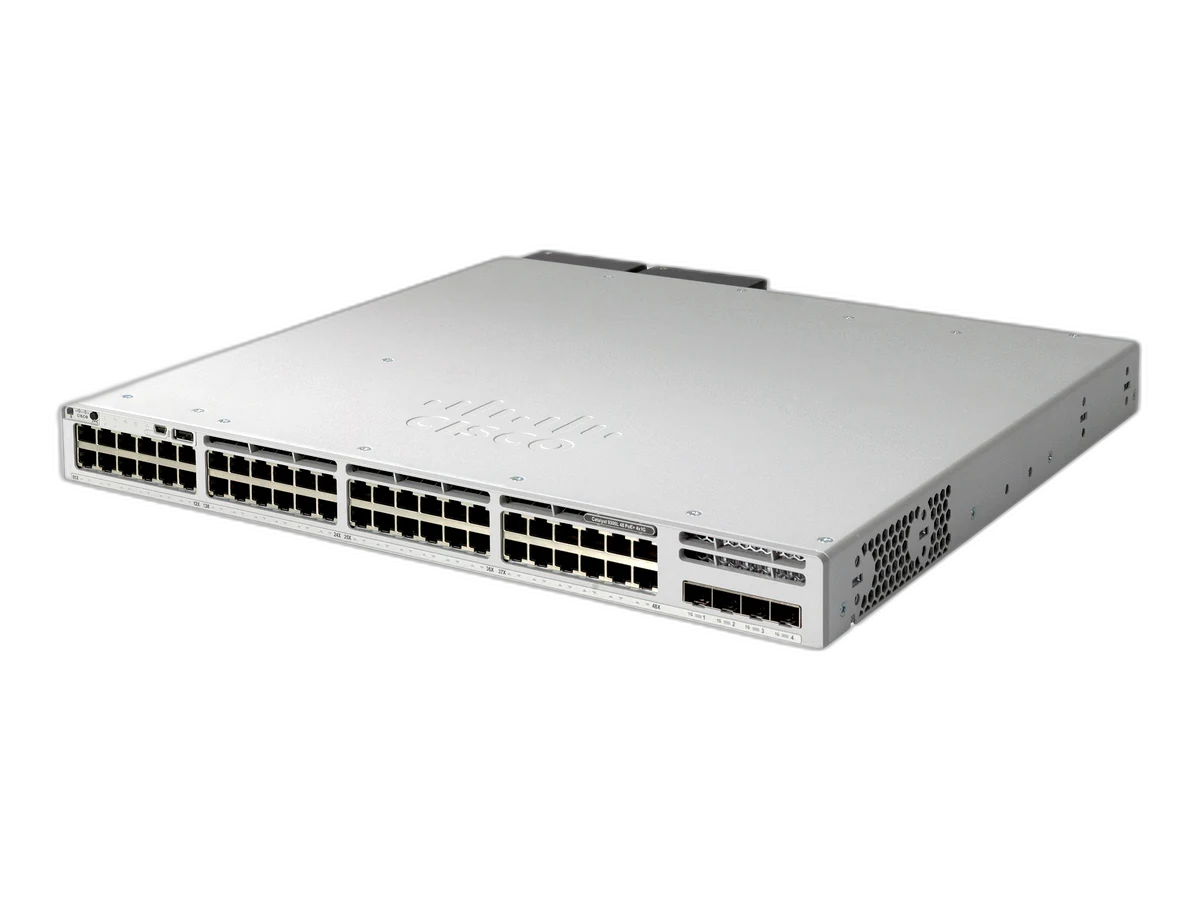
These two switches are aimed at different jobs in the campus, and that is the single most important thing to understand before comparing them. The FortiSwitch 524D is a 1G aggregation/distribution box with serious uplink density — 4 × 10GE SFP+ plus 2 × 40GE QSFP+ — and 288 Gbps of fabric. It has no PoE, so it is not a wiring-closet access switch; it is the layer above one. The Catalyst 9300L-48P is the opposite: 48 × 1G PoE+ access ports with only 4 × 1G uplinks, designed to land phones, APs and user endpoints in the closet and stack with peers via StackWise-160.
If you are buying for the wiring closet, the Cisco wins on merit: twice the access ports per RU, a 505 W PoE+ budget, MACsec at line rate, and IOS-XE with mature telemetry (NETCONF/YANG, gNMI, model-driven streaming) plus integration into ISE/TrustSec and Catalyst Center. The trade-off is licensing — Network Essentials gets you switching, but BGP, EVPN and the richer policy features sit behind Network Advantage and a DNA subscription, which materially changes the five-year cost.
If you are buying for distribution or for a Fortinet-led estate, the FortiSwitch 524D is the more rational choice. FortiLink lets a FortiGate manage the switch as a logical extension of the security fabric, which is genuinely useful for UK mid-market sites running Fortinet for SD-WAN and ZTNA already. You also get OSPF and BGP without a subscription tier, and 40GE uplinks that the 9300L-48P simply does not offer on this SKU. The weakness is the access-layer story: no PoE, only 24 copper ports, and a smaller third-party ecosystem than Cisco's.
Recommendation: pick the Catalyst 9300L-48P for PoE access stacks in NHS, education and enterprise sites already standardised on Cisco ISE or Catalyst Center, and budget for DNA licensing up front. Pick the FortiSwitch 524D where it actually belongs — as an aggregation switch above PoE access stacks (FortiSwitch or otherwise), particularly when the network is being managed from a FortiGate and you want 40G uplinks without paying for an advanced licence tier.
Ready to proceed?
Want to compare different products or add more to this comparison?
Open Interactive Comparison Tool →