
141 GB
HBM3e — H200 PCIe largest GPU memory capacity
4.8 TB/s
Memory bandwidth — NVIDIA H200 PCIe
FP8
Transformer Engine precision — H100 & H200 Hopper
3,958
TOPS FP8 — H200 with sparsity
MIG
Multi-Instance GPU — partition H100/H200 into 7 isolated GPUs
PCIe 5.0
Host interface — H100/H200 PCIe x16
GPU Add-In Cards
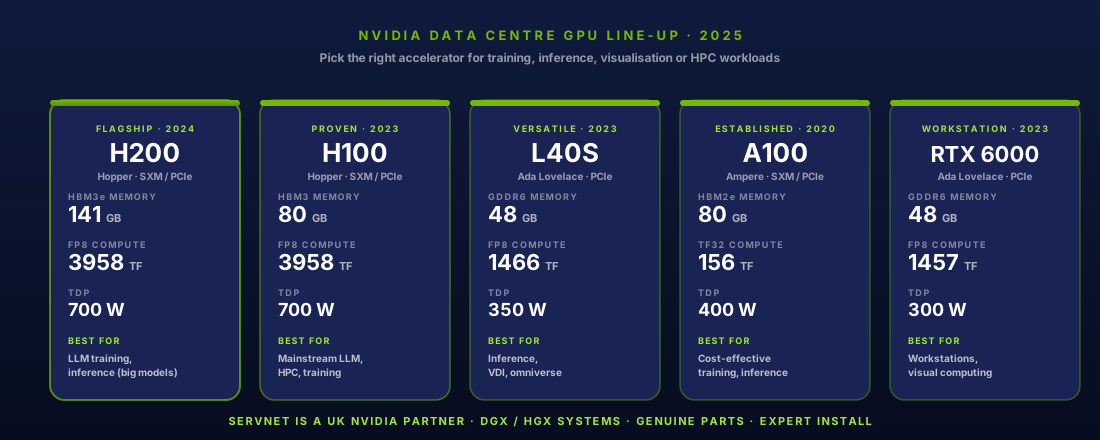
NVIDIA Data-Centre GPU Specifications
All performance figures from official NVIDIA datasheets. Tensor Core TFLOPS figures with sparsity assume 2:4 structured sparse activation pattern. All cards require adequate server PSU capacity and PCIe 4.0/5.0 x16 slot.
🎮
Hopper · GH100
H200 NVL PCIe
NVIDIA H200 PCIe 141GB
GPU ArchitectureNVIDIA Hopper (GH100)
VRAM141 GB HBM3e
Memory Bandwidth4.8 TB/s
FP8 (Sparsity)3,958 TOPS
FP16 Tensor Core1,979 TFLOPS (with sparsity)
FP32 (CUDA)67 TFLOPS
TDP350W (configurable)
Form FactorPCIe — dual-slot, full-height full-length
InterfacePCIe 5.0 x16
NVLink600 GB/s (H200 NVL — NVLink bridge between 2 cards)
Multi-Instance GPUUp to 7 MIGs at 14GB each
Use case: Largest capacity PCIe GPU available — 141GB HBM3e at 4.8 TB/s memory bandwidth enables LLM inference with models up to 70B parameters (Llama 2 70B, Mistral 70B) on a single card. Up to 5x better LLM inference performance versus A100 per NVIDIA testing.
View full specs →
🎮
Hopper · GH100
H100 PCIe
NVIDIA H100 PCIe 80GB
GPU ArchitectureNVIDIA Hopper (GH100)
VRAM80 GB HBM2e
Memory Bandwidth2 TB/s
FP8 (Sparsity)3,341 TOPS
FP16 Tensor Core1,671 TFLOPS (with sparsity)
FP32 (CUDA)51.2 TFLOPS
TDP350W (configurable 310W–350W)
Form FactorPCIe — dual-slot, full-height full-length
InterfacePCIe 5.0 x16
NVLink600 GB/s (NVLink bridge for 2× H100 NVL)
Multi-Instance GPUUp to 7 MIGs at 10GB each
Use case: Enterprise AI training and inference standard — Transformer Engine with FP8 precision delivers 30x faster large language model inference versus A100. Fourth-generation Tensor Cores accelerate GPT, BERT, diffusion, and scientific simulation workloads.
View full specs →
🎮
Ampere · GA100
A100 PCIe 80GB
NVIDIA A100 PCIe 80GB
GPU ArchitectureNVIDIA Ampere (GA100)
VRAM80 GB HBM2e
Memory Bandwidth1,935 GB/s (1.9 TB/s)
FP16 Tensor Core312 TFLOPS (without sparsity)
BF16 Tensor Core312 TFLOPS
FP32 (CUDA)19.5 TFLOPS
TDP300W
Form FactorPCIe — dual-slot, full-height full-length
InterfacePCIe 4.0 x16
NVLink600 GB/s (with NVLink Bridge)
Multi-Instance GPUUp to 7 MIGs at 10GB each
Use case: Previous-generation standard — A100 PCIe remains widely deployed for AI inference, HPC, and deep learning training where H100 lead times or budget constraints apply. BF16 and TF32 Tensor Cores with 80GB VRAM handle large-model inference efficiently.
View full specs →
🎮
Ada Lovelace · AD102
L40S
NVIDIA L40S 48GB
GPU ArchitectureNVIDIA Ada Lovelace (AD102)
VRAM48 GB GDDR6 ECC
Memory Bandwidth864 GB/s
FP8 (Sparsity)1,457 TOPS
FP32 (CUDA)91.6 TFLOPS
TF32 Tensor366 TFLOPS (without sparsity)
TDP350W
Form FactorPCIe — dual-slot, full-height full-length
InterfacePCIe 4.0 x16
OutputsNo display outputs (data centre headless)
RT Cores4th-generation (ray tracing + rasterisation)
Use case: Dual-purpose AI inference and professional visualisation — L40S handles generative AI workloads (image generation, video, text) alongside CAD, BIM, and VDI workloads on the same server. Ideal for creative industry studios and architects who need both compute and visual fidelity.
View full specs →
🎮
Ada Lovelace · AD102
RTX 6000 Ada
NVIDIA RTX 6000 Ada Generation
GPU ArchitectureNVIDIA Ada Lovelace (AD102)
VRAM48 GB GDDR6 ECC
Memory Bandwidth960 GB/s
FP32 (CUDA)91.1 TFLOPS
TF32 Tensor182.2 TFLOPS (without sparsity)
TDP300W
Form FactorPCIe — dual-slot, full-height full-length
InterfacePCIe 4.0 x16
Outputs4× DisplayPort 1.4a (workstation use)
CertificationISV-certified (Autodesk, Siemens, Dassault)
RT Cores4th-generation — real-time ray tracing
Use case: Professional workstation GPU — certified for Autodesk, SolidWorks, Siemens NX, and Dassault applications. 48GB GDDR6 ECC handles large scenes, complex simulations, and VR workflows that exceed the capacity of consumer-grade graphics cards.
View full specs →
🎮
Ampere · GA102
A40
NVIDIA A40 48GB
GPU ArchitectureNVIDIA Ampere (GA102)
VRAM48 GB GDDR6 ECC
Memory Bandwidth696 GB/s
FP32 (CUDA)37.4 TFLOPS
TF32 Tensor149.7 TFLOPS
TDP300W
Form FactorPCIe — dual-slot, passive (data centre)
InterfacePCIe 4.0 x16
OutputsNo display outputs (passive cooling)
Multi-Instance GPUNot supported (differs from A100)
Use casesVDI, AI inference, rendering, simulation
Use case: Previous-generation data centre GPU — A40 remains a cost-effective option for VDI (virtual desktop infrastructure), AI inference, and cloud graphics workloads where the GDDR6 memory footprint and lower cost per card are preferable to HBM-based alternatives.
View full specs →
PCIe Add-In Card vs SXM System: What is the Difference?
PCIe Add-In Card (this page)
- ✓Installs into any standard PCIe x16 server slot
- ✓H100 PCIe: 80GB HBM2e · 2 TB/s · 350W
- ✓H200 PCIe NVL: 141GB HBM3e · 4.8 TB/s · 350W
- ✓Lower memory bandwidth than SXM variant
- ✓Standard data-centre air-cooled servers
- ✓More accessible and easier to deploy in existing infrastructure
SXM Module (dedicated GPU servers)
- →Requires dedicated HGX board (Supermicro, DGX systems)
- →H100 SXM: 80GB HBM3 · 3.35 TB/s · up to 700W
- →H200 SXM: 141GB HBM3e · 4.8 TB/s · up to 700W
- →NVLink 4.0 between all GPUs on HGX board (900 GB/s)
- →Required for 8-GPU training at full bandwidth
- →Higher performance — preferred for LLM training at scale
Related Products & Platforms
Need a GPU for AI inference, training, or visualisation?
This section is provided for technical reference and comparison only. Servnet does not currently supply these GPUs.
Talk to a UK specialist
Get expert advice or a no-obligation quote — servers, storage, networking, maintenance, finance and cloud. We reply the same working day.