
💾 Dell PowerScale F710 vs Pure FlashBlade //S vs NetApp AFF C400
AI-powered analysis across 24 matched specifications
Performance Overview
Scores based on quantifiable specification values (1-10 scale)
Detailed Specifications
| Specification | Dell PowerScale F710 Dell Storage | FlashBlade//S Pure Storage | AFF C400 NetApp |
|---|---|---|---|
| Key Metrics | |||
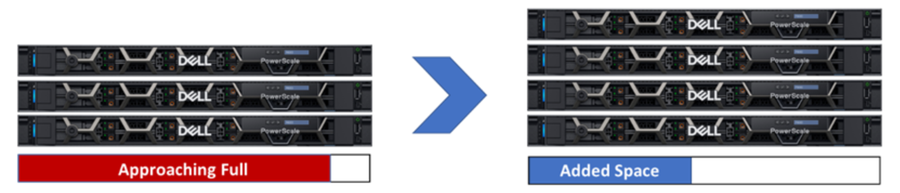
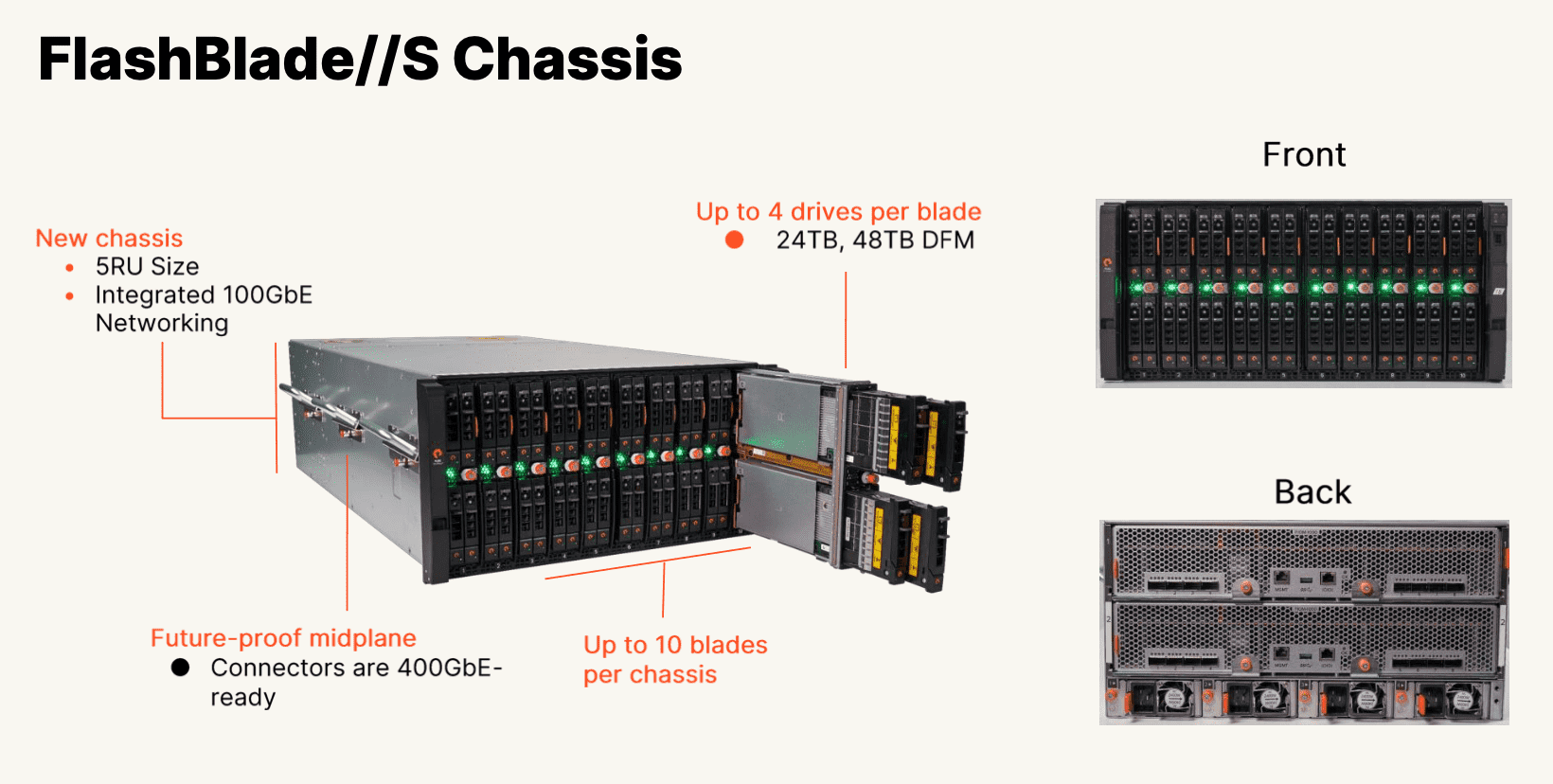
| Architecture | Scale-out NAS, 3–252 nodes, single namespace | Scale-out file & object, disaggregated compute/storage, up to 10 chassis | Dual-controller HA pair, scale-out to 24 nodes (12 HA pairs) |
| Maximum raw capacity | Up to 307 PB per cluster | Up to 1.2 PB per blade, multi-chassis scale | Up to 141 PB effective per system |
| Capacity per node/blade | 38 TB – 1.2 PB raw per node | Up to 1,200 TB per blade (DFM-based) | Up to 1,152 SSDs per system (QLC NVMe) |
| Flash media | NVMe QLC/TLC SSD | DirectFlash Modules (proprietary QLC) | NVMe QLC SSD |
| Primary protocols | NFS, SMB, HDFS, S3 | NFS, SMB, S3 | NFS, SMB, S3, iSCSI, FC, NVMe/TCP, NVMe/FC |
| Operating system | OneFS 9.7 | Purity//FB | ONTAP |
| Performance & Networking | |||
| Front-end networking per node/blade | 2 × 100GbE or 2 × 25GbE per node | Up to 16 × 400GbE per multi-chassis cluster | Up to 4 × 100GbE or 25GbE per controller (typical config) |
| Memory per node/controller | 512 GB per node | -- | -- |
| AI/ML workload focus | Strong — used in Dell AI Factory reference designs | Primary design target — 50% gen-on-gen uplift for AI/ML | Capacity-tier focus, less optimised for high-throughput AI |
| Scale model | Linear scale — compute and capacity together | Independent scale of compute and storage | Scale compute and capacity in HA pair increments |
| Data Services & Efficiency | |||
| Inline deduplication | SmartDedupe | Yes (always-on) | Yes (ONTAP inline dedupe) |
| Inline compression | SmartCompression | Yes (always-on) | Yes (ONTAP inline compression) |
| Tiering | SmartTiering to lower-cost nodes/cloud | Zero Move Tiering (logical, no data movement) | FabricPool tiering to object/cloud |
| Typical effective ratio | -- | -- | -- |
| Effective efficiency claim | -- | -- | ~4:1 typical |
| Multi-protocol single namespace | Yes — NFS, SMB, HDFS, S3 concurrent | Yes — NFS, SMB, S3 concurrent | Yes — file, block and object via ONTAP |
| Resilience & Data Protection | |||
| Availability | -- | -- | 99.9999% |
| Replication | SyncIQ — sync and async | Rapid Replicas (metadata-led), async replication | SnapMirror sync and async |
| Snapshots | SnapshotIQ | Native immutable snapshots (SafeMode) | ONTAP Snapshots + SnapLock WORM |
| Ransomware protection | Superna/Cyber Protect integration, anomaly detection | SafeMode immutable snapshots | Autonomous Ransomware Protection + Recovery Guarantee |
| Management & Commercial | |||
| Management plane | OneFS WebUI, CloudIQ, APEX AIOps | Pure1 cloud management | ONTAP System Manager, BlueXP (Cloud Manager) |
| Subscription / Evergreen | APEX subscription available | Evergreen//Forever — non-disruptive blade upgrades every 3 yrs | Keystone STaaS subscription available |
| Hybrid cloud | APEX File Storage in AWS/Azure | Pure Cloud Block Store / Portworx | ONTAP native in AWS, Azure, GCP (CVO/FSx) |
| Best-fit workload | Unstructured file, M&E, genomics, AI training datasets | AI/ML, modern apps, large-scale object + file | Capacity-tier consolidation, virtualisation, enterprise NAS |
Expert Analysis
These three platforms all carry the "all-flash, capacity-friendly" label but solve quite different problems. PowerScale F710 is a true scale-out NAS designed to grow as one namespace from a handful of nodes to hundreds of petabytes — it is the natural choice when a single filesystem must keep getting bigger without forklift events. FlashBlade//S is the most modern of the three architecturally: compute and storage scale independently, the DirectFlash Modules push very high throughput, and Evergreen//Forever removes most of the refresh anxiety. AFF C400 is the odd one out — it is a dual-controller capacity-optimised array running ONTAP, with the widest protocol set (block, file and object) and the deepest data services, but it does not scale to the same horizons as the other two.
For AI/ML and high-throughput unstructured workloads, FlashBlade//S has the cleanest story: 400GbE uplinks, disaggregated scale, and a Purity stack that has been tuned for billions of small files and objects. PowerScale F710 is a close competitor here and arguably wins on raw scale ceiling and on integration with Dell's broader AI Factory reference architectures — UK buyers already invested in PowerEdge and PowerScale will find it the lower-friction path. The AFF C400 is not the right answer for a 100GbE-per-node AI training cluster; its sweet spot is consolidating ageing FAS, mid-range SAN and general-purpose NAS onto QLC flash at sensible £/TB.
Where AFF C400 pulls ahead is data services depth and protocol breadth. ONTAP's SnapMirror, SnapLock, FabricPool, FlexGroup, NVMe/TCP and the Ransomware Recovery Guarantee are genuinely useful for regulated UK workloads — financial services, NHS trusts handling DSPT-scoped data, and any environment that needs WORM for FCA or ICO retention. It is also the only one of the three that natively spans file, block and object in a single chassis, which matters for virtualisation and database consolidation alongside file.
Pick PowerScale F710 if your problem is a single, ever-growing filesystem and you value linear scale-out above all else. Pick FlashBlade//S if you are building an AI/ML or modern-apps platform and want disaggregated scale plus a subscription that absorbs future hardware refreshes. Pick AFF C400 if you are consolidating mixed enterprise workloads — file, block, VMware, and capacity tiers — and want ONTAP's data services and ransomware tooling at QLC pricing. The three rarely compete head-to-head once the workload is properly defined.
Ready to proceed?
Want to compare different products or add more to this comparison?
Open Interactive Comparison Tool →