
🔀 Cisco Catalyst 9200L-48P vs 9300L-48P
Cisco Catalyst 9200L-48P vs Cisco Catalyst 9300L-48P compared across 30 matched specifications — scores, the full spec table and a verdict.
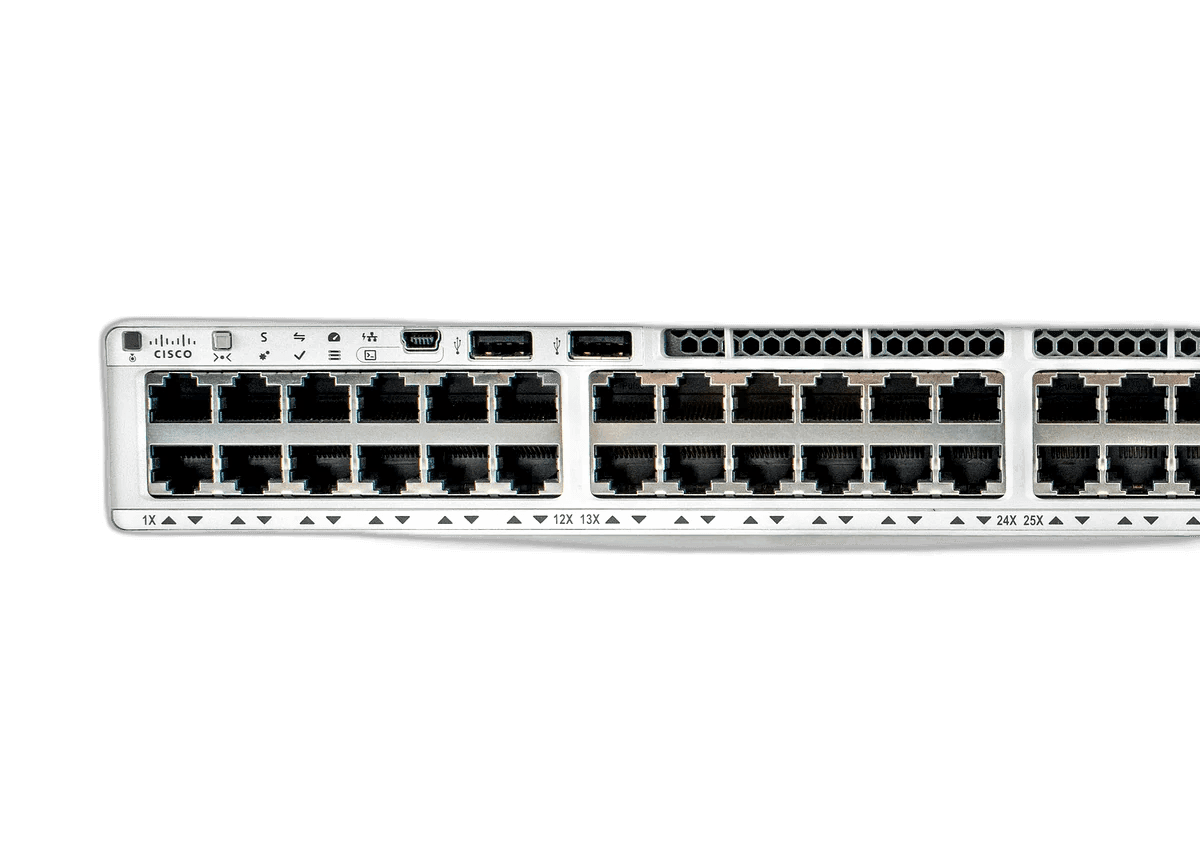
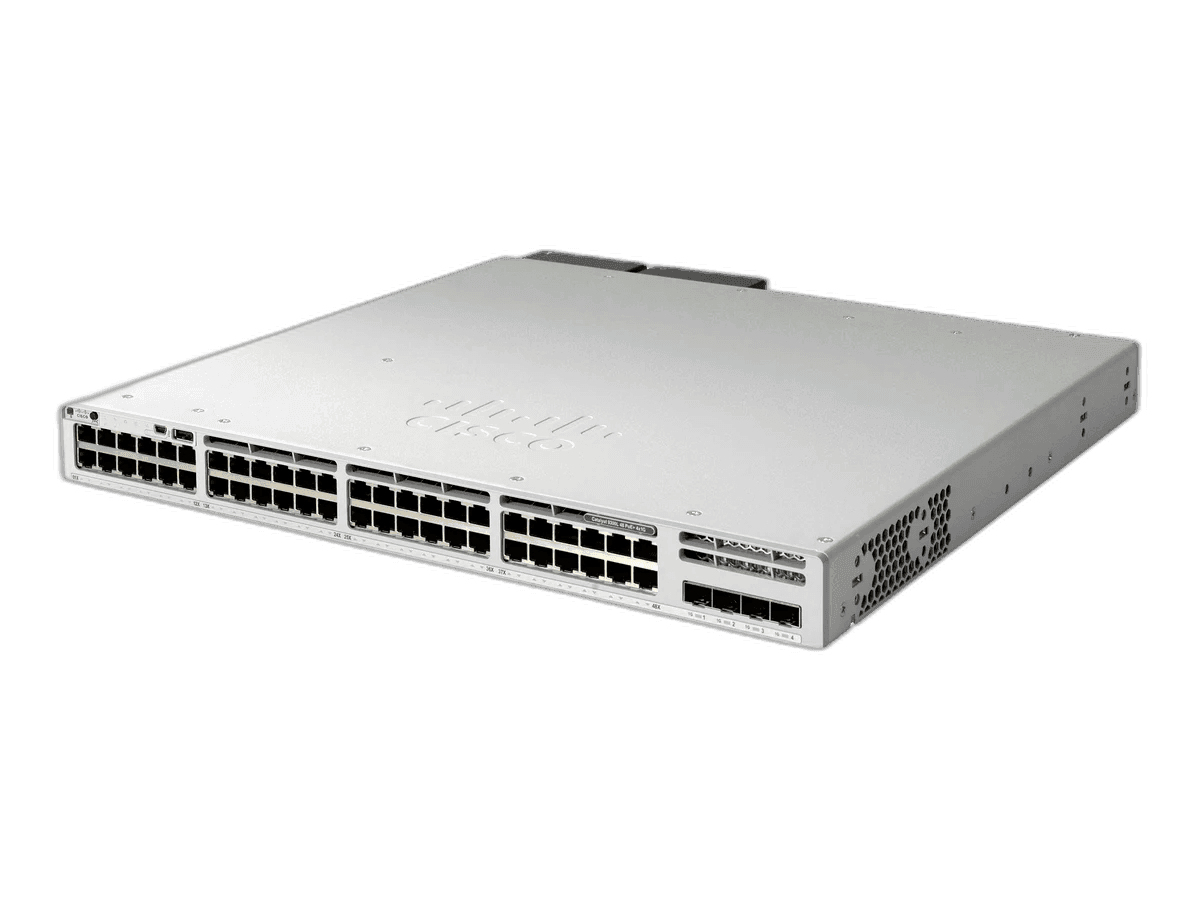
Cisco Catalyst 9200L-48P vs 9300L-48P: performance overview
Scores based on quantifiable specification values (1-10 scale)
Detailed Specifications
| Specification | Cisco Catalyst 9200L-48P Cisco | Cisco Catalyst 9300L-48P Cisco |
|---|---|---|
| Key Metrics | ||
| Access ports | 48 × 1GbE RJ45 PoE+ | 48 × 1GbE RJ45 PoE+ |
| Uplinks | 4 × 1G SFP | 4 × 1G SFP |
| PoE budget | 740W | 505W |
| Stacking | Optional module, up to 8 switches | StackWise-160, up to 8 switches |
| Switching tier | Enterprise access | Full-feature access / small distribution |
| MACsec | MACsec-128 (AES-128) | MACsec-256 (AES-256) hardware |
| Forwarding & Performance | ||
| ASIC | Cisco proprietary (9200 series) | UADP 2.0 Mini |
| Stacking bandwidth | 80 Gbps (optional module) | 160 Gbps (StackWise-160) |
| Switching capacity (typical) | 176 Gbps | 208 Gbps |
| Forwarding rate (typical) | 130.94 Mpps | 154.76 Mpps |
| Packet buffer | 6 MB shared | 16 MB shared |
| PoE & Power | ||
| PoE standard | 802.3af / 802.3at (PoE+) | 802.3af / 802.3at (PoE+) |
| Total PoE budget | 740W | 505W |
| Per-port PoE+ max | 30W | 30W |
| Power supply | 1000W AC (fixed on -48P) | 715W AC (field-replaceable, redundant option) |
| Redundant PSU | No (fixed PSU) | Yes (dual FRU PSU slots) |
| Security & Services | ||
| MACsec encryption | MACsec-128 | MACsec-256 (line-rate hardware) |
| TrustSec / SGT | Supported | Supported (full enforcement) |
| Encrypted Traffic Analytics (ETA) | No | Yes |
| Flexible NetFlow | Sampled NetFlow | Full Flexible NetFlow |
| Application Visibility (AVC) | Limited | Supported |
| Management & Software | ||
| Operating system | Cisco IOS-XE Lite | Cisco IOS-XE (full) |
| DNA Center / Catalyst Center | Supported (DNA Essentials/Advantage) | Supported (DNA Essentials/Advantage) |
| SD-Access role | Edge node (limited) | Full fabric edge node |
| Programmability | NETCONF/YANG, RESTCONF | NETCONF/YANG, RESTCONF, Python/Guest Shell |
| Telemetry | SNMP, syslog, sampled NetFlow | Model-driven streaming telemetry, full NetFlow |
| Physical & Warranty | ||
| Form factor | 1U rack | 1U rack |
| Cooling | Fixed fans | Field-replaceable fan tray |
| Warranty | Enhanced Limited Lifetime | Enhanced Limited Lifetime |
| Typical UK street price | ~£3,500–£4,500 | ~£6,500–£8,500 |
Expert Analysis
The headline difference is not the port count — both switches give you 48 × 1GbE PoE+ with 4 × 1G SFP uplinks — it is the platform tier underneath. The 9200L-48P is Cisco's enterprise access switch with a cut-down IOS-XE feature set, a fixed power supply and an optional stacking module. The 9300L-48P sits one tier higher on the UADP 2.0 Mini ASIC with native StackWise-160, dual field-replaceable PSUs, line-rate MACsec-256 and the full IOS-XE software stack used across the Catalyst 9300 family.
Where the 9200L genuinely wins is PoE budget and price. At 740W it powers more 802.3at devices per switch than the 505W on the 9300L-48P (you would need the higher-priced -48UXM or upgraded PSU on the 9300 family to match it), and UK street pricing is roughly half. For a wiring closet that mostly does wired client access, VoIP and a sprinkling of APs, that is a meaningful saving with no functional loss. The trade-off is the fixed PSU — there is no PSU redundancy on the 9200L, which matters in any closet you cannot afford to lose.
The 9300L earns its premium on three fronts: resilience (dual hot-swap PSUs and FRU fan tray), security depth (MACsec-256, Encrypted Traffic Analytics, full TrustSec enforcement, richer NetFlow) and SD-Access readiness as a full fabric edge node. If you are running Catalyst Center / DNA Center with assurance, ETA and segmentation, or you need StackWise-160 for a resilient closet stack, the 9300L is the right tool. The 9200L can join SD-Access but with feature caveats.
Recommendation framework: choose the 9200L-48P where budget per port and PoE headroom matter more than software depth — standard office floors, education sites, retail back-of-house. Choose the 9300L-48P where the switch underpins a Zero Trust or SD-Access design, where PSU redundancy is required (finance, healthcare, any site under NIS2/DSPT scrutiny), or where you want one platform consistent with your distribution layer. Mixing the two — 9300L in the core closets, 9200L on the floors — is a common and defensible UK deployment pattern.
Ready to proceed?
Not sure which one fits your environment?
Our UK specialists will recommend the right option for your workload and send itemised pricing — vendor-neutral, no obligation.
Response within 4 business hours · 20+ yr UK reseller
Want to compare different products or add more to this comparison?
Open Interactive Comparison Tool →Made your choice? Spread the cost.
Whichever you choose, you don't have to pay for it all upfront — finance your new hardware from £172/mo ex VAT on hire purchase or lease. Compare monthly payments and terms in seconds.
See finance from £172/mo →Indicative estimate · subject to change · no credit check at this stage · hire purchase, lease & subscription for UK businesses
Indicative illustration only. Servnet Limited is not authorised or regulated by the FCA and does not provide financial advice or arrange finance. All finance opportunities are referred to Number Eight Business Finance. Finance policy
Related comparisons
Other head-to-heads featuring these models — useful if you’re still shortlisting.
Talk to a UK specialist
Get expert advice or a no-obligation quote — servers, storage, networking, maintenance, finance and cloud. We reply the same working day.