
What Is DHCP? Scopes, Reservations and Why It Fails
DHCP (Dynamic Host Configuration Protocol) automatically hands a device an IP address and the settings it needs to reach the internet — on a typical office router at 192.168.1.1 with a pool of 192.168…
Quishing Explained: QR Code Phishing in 2026 (UK Guide)
Quishing is phishing hidden inside a QR code. It is increasingly used in emails and physical locations such as car parks, and scanning can move the interaction to a mobile device where an organisation…
2.5GbE vs 10GbE in 2026: Multi-Gig Ethernet Explained
A 1GbE access layer can bottleneck modern Wi-Fi 7 access points and fast storage, especially where several clients share an uplink. The IEEE 802.3bz NBASE-T standard exists for exactly this gap: 2.5Gb…
Layer 2 vs Layer 3 Switch: UK 2026 Enterprise Buying Guide
When assessing a network refresh, enterprise designs often use Layer 3 switching at distribution or core, but smaller or low-traffic sites may be better served by Layer 2 access switches plus external…
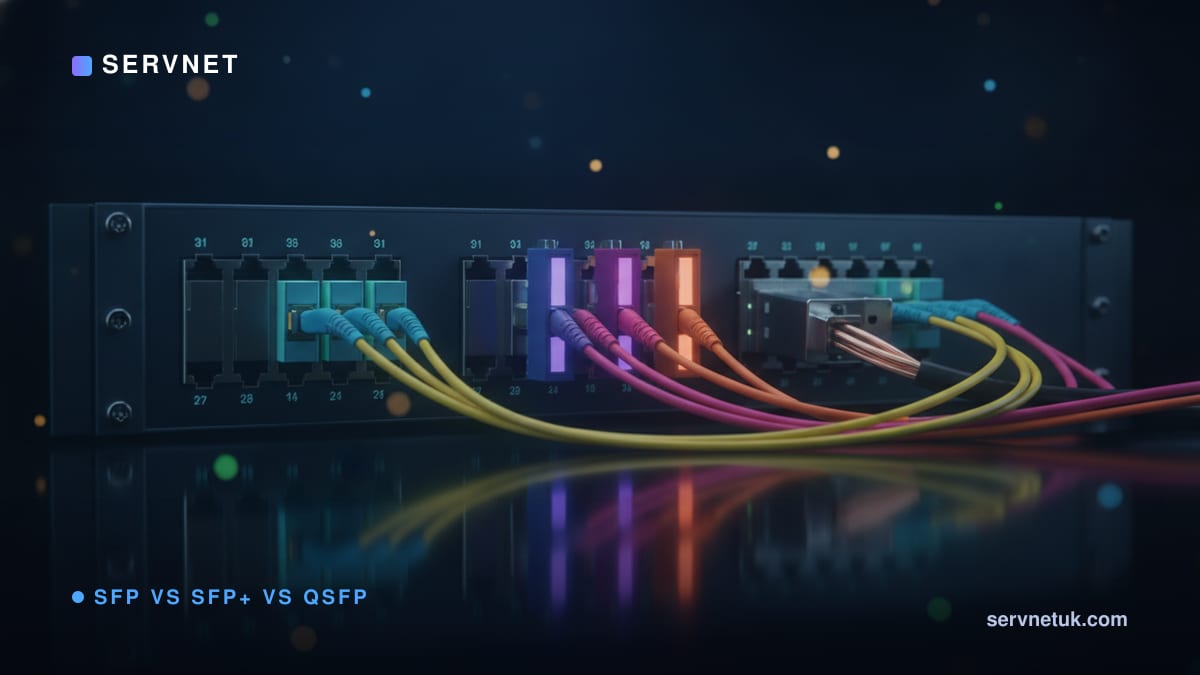
SFP vs SFP+ vs QSFP Transceivers Explained: 2026 Guide
Choosing between SFP, SFP+ and QSFP transceivers means navigating a multi-generational form-factor ladder while balancing physical reach against platform support policies. In 2026, network infrastruct…
What Is ITAM? IT Asset Management Explained (UK 2026)
IT asset management (ITAM) is the discipline of tracking technology assets across their full lifecycle, ensuring organisations know what they own, what it costs and who is using it. In the UK, that re…
Grey Market IT Hardware Explained: UK Procurement Risks
Grey-market hardware is not automatically illegal — it is genuine equipment sold outside the manufacturer's authorised channel. Counterfeit hardware is different: it is fake, relabelled or cloned prod…
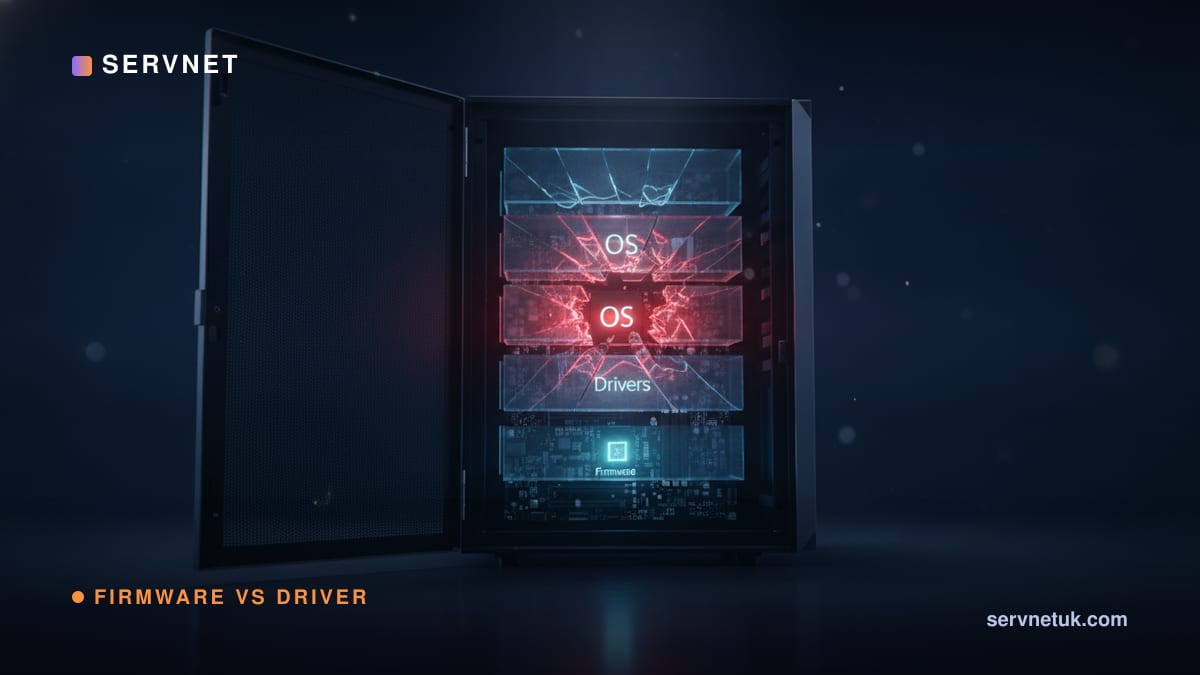
Firmware vs Driver vs BIOS Explained: What to Update
Firmware is embedded code operating below the operating system to initialise hardware, whereas a driver runs inside the operating system to translate commands between the OS and physical devices. That…
SMART Drive Status Explained: Reading Warnings in 2026
A passing smart hard drive status from an operating system utility offers false comfort if you rely solely on generic health indicators. Enterprise fleet telemetry shows that drives frequently degrade…
What is SASE? Secure Access Service Edge Decoded (2026)
Secure Access Service Edge (SASE) is generally understood as an architectural model that combines Software-Defined Wide Area Networking (SD-WAN) with a cloud-delivered security stack—typically framed …
CVSS Score Explained: CVE, CVSS 4.0 and KEV in 2026
A CVSS score of 9.8 looks like an emergency. Often it isn't. CVSS v4.0 — the version FIRST officially published on 1 November 2023 and still the current standard in 2026 — measures how bad a flaw coul…
What Is DNS Filtering? Protective DNS Mechanics & UK Guide
DNS filtering is an architectural control that evaluates domain name queries against policy rules before an IP connection opens, allowing organisations to drop malware command-and-control callbacks an…
SIEM vs SOC vs MDR Explained: 2026 UK Cyber Defence
Security marketing often blurs the boundaries between technology, operational teams, and managed contracts, which can leave IT leaders unclear where software ends and accountability begins. To make de…
Hot, Warm and Cold DR Sites Explained (2026)
Disaster recovery planning in 2026 still commonly uses the foundational taxonomy of hot, warm, and cold sites, even though the underlying infrastructure has shifted decisively toward replicated coloca…
DR Testing Types: Tabletop to Full Failover Explained
Testing disaster recovery procedures is the only way to establish whether an organisation can survive severe disruption, yet selecting the wrong test tier routinely exposes live environments to unforc…
Business Continuity vs Disaster Recovery Explained
Business continuity and disaster recovery are frequently conflated in enterprise IT planning, yet they represent two fundamentally different operational responsibilities. Business continuity (BC) focu…
Bare Metal Recovery Explained: Architecture, Drivers & UK Rules
Bare metal recovery (BMR) reconstructs an entire physical or virtual machine directly from bare hardware without relying on an already-installed operating system, partition map, or driver stack on tha…
Grandfather-Father-Son Backup: GFS Retention Explained
Grandfather-Father-Son (GFS) backup is an established hierarchical rotation scheme designed to balance granular, immediate recovery points with long-term data archiving while controlling storage consu…

Full vs Incremental vs Differential Backup Explained (2026)
Incremental backups minimise ingestion time and network bandwidth by capturing only modified blocks, but create dependent restore chains; differential backups cost more repository capacity as daily de…

SMB vs NFS in 2026: Which File Protocol Wins?
Despite what headline comparisons promise, modern enterprise storage architecture rejects the idea of a single protocol winner. The real decision is structural: On current Windows 11 24H2 Enterprise/P…
Raw vs Usable Capacity Explained: Where Your TB Went
When buying storage, the headline figure printed on a drive or vendor quote is never the space your operating system can write to. The gap between raw capacity and real-world provisioning is driven by…
Software-Defined Storage Explained: SDS Architecture and Costs
Software-defined storage (SDS) decouples data management, volume presentation, and protection logic from specific hardware appliances, running as a software layer that virtualises storage and can pool…
Data Deduplication Explained: Real Ratios vs Vendor Guarantees
Enterprise storage marketing commonly advertises headline **4:1 or 5:1 data reduction ratios** in flash array materials—figures that vary by vendor and rarely survive contact with real workloads. This…
Thin Provisioning Explained: Mechanism, Risks & Alerts
Thin provisioning allows enterprise storage arrays and hypervisors to promise more logical capacity to host operating systems than physically exists in backing drive pools. While this overcommit model…
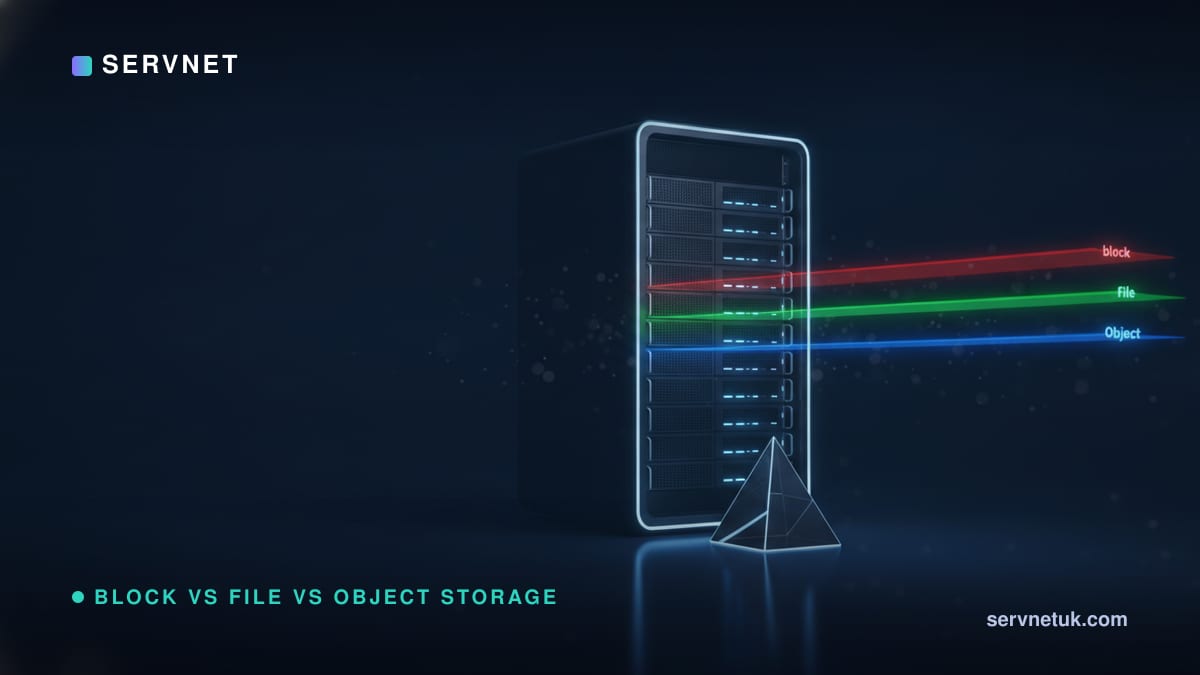
Block vs File vs Object Storage Explained for UK IT Buyers
Choosing between block, file, and object storage is fundamentally a choice of access model, not physical media. While public cloud providers frequently frame this decision around proprietary managed s…
SMR vs CMR Hard Drives Explained: 2026 Guide
Choosing between SMR vs CMR hard drives is one of the most critical decisions in storage architecture, where an unverified SKU can turn a routine maintenance window into a multi-day array outage. Whil…
U.2 vs U.3 SSD Form Factors: 2.5-Inch vs EDSFF in 2026
Navigating the transition from traditional 2.5-inch enterprise storage to next-generation server architectures hinges on understanding the critical divide between U.2 vs U.3 interfaces and emerging ED…
What is VDI? How Virtual Desktops Work in 2026
Virtual desktop infrastructure (VDI) hosts desktop environments as centrally managed virtual machines on host servers, created from OS-and-application images and delivered across a network on demand r…
SQL Server Licensing Explained: Cores, CALs & Editions
Navigating sql server licensing is one of the most consequential procurement decisions an IT team will make, where a misunderstanding of licence metrics can easily double an infrastructure budget or t…
How Does vMotion Work? VM Live Migration Explained
How does vMotion work? VM live migration relocates an active virtual machine between physical hypervisor hosts with no planned downtime, typically avoiding user-visible disconnections when stun time s…
vGPU vs GPU Passthrough: Virtualisation Guide
Deploying graphics and compute acceleration within modern hypervisors forces IT leaders to resolve a fundamental architectural trade-off: full GPU passthrough versus virtual GPU (vGPU) slicing. While …
OCP NIC 3.0 Explained: Server Network Slots Decoded
Modern enterprise servers increasingly complement traditional motherboard-integrated Ethernet with dedicated, open-standard mezzanine bays such as OCP NIC 3.0. Governed by the Open Compute Project, wh…
What Is a BOSS Card? Server Boot Drives & OS Mirroring
A BOSS card (commonly expanded as Boot Optimized Storage Solution) is Dell's branded dedicated boot RAID device designed to host and protect a server's operating system on mirrored M.2 solid-state dri…
Hot-Swap Server Components Explained: What You Can Pull Live
Modern enterprise server platforms treat hot-swapping as a chassis-level engineering discipline rather than a blanket hardware feature. While field engineers often assume drive bays and modular power …
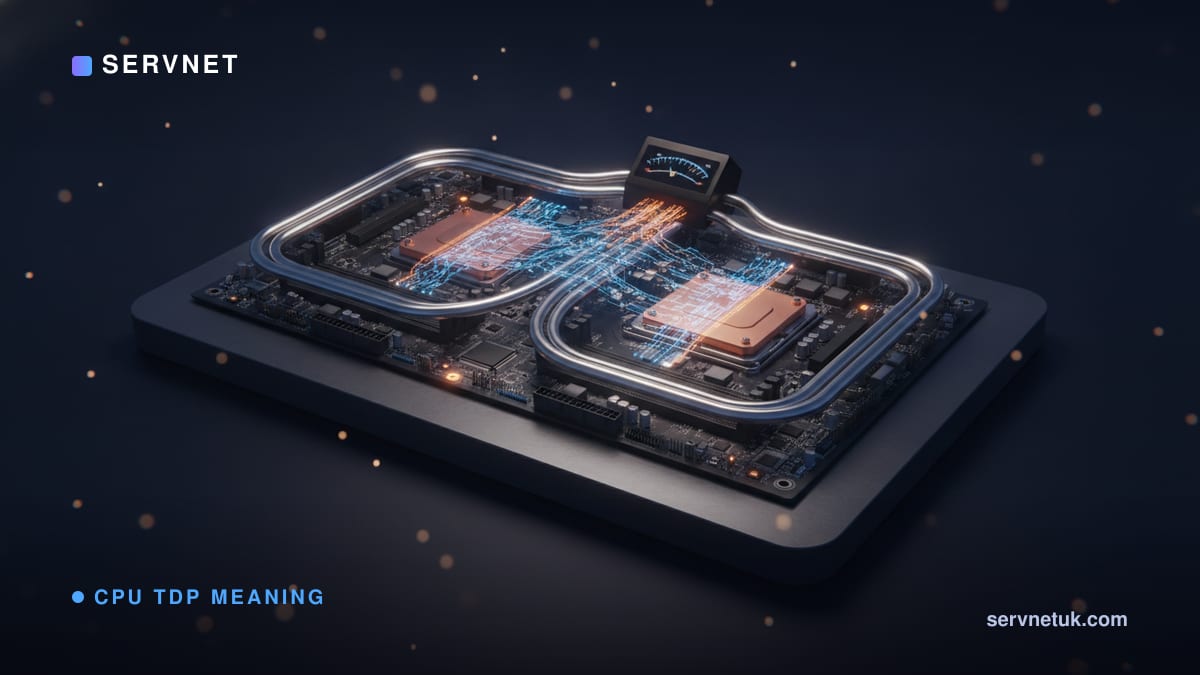
Server CPU TDP Explained: Watts, Turbo and Real Draw
Thermal Design Power (TDP) is the maximum continuous heat, measured in watts, that a server CPU's cooling system must dissipate under sustained reference workloads. It is an engineering target for coo…
What Is a Vector Database? Embeddings & Search
To answer what is a vector database, one must look past marketing hype to the underlying data structures: systems engineered to store, index, and query mathematical representations of meaning called e…
MLPerf Benchmark Explained: How to Read Vendor AI Claims
Evaluating enterprise hardware claims has become a core challenge for infrastructure teams, making a technical MLPerf benchmark explained guide vital for navigating vendor marketing. MLPerf, run by ML…
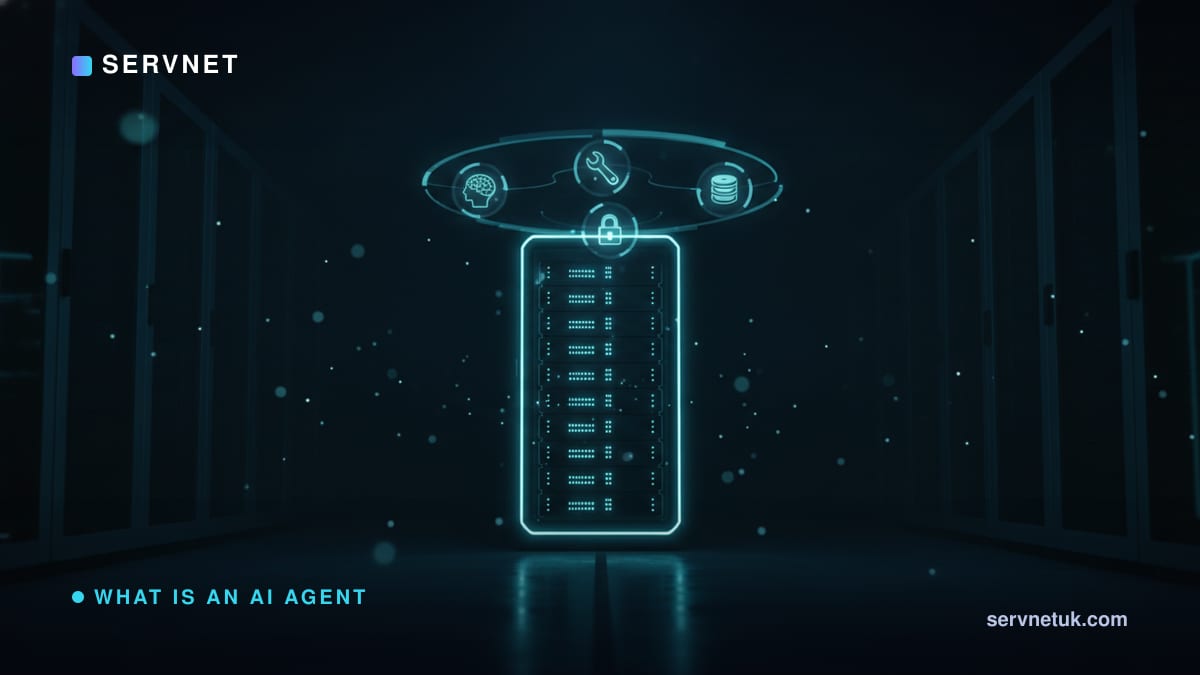
What Is an AI Agent? Agentic AI Explained (2026)
Ask ten vendors what an AI agent is and you'll get ten pitches. Strip away the marketing and the technical answer is precise: an agent is a loop — a model that reasons, calls tools, reads and writes m…
RAG Explained 2026: What Is Retrieval-Augmented Generation?
RAG is a standard architecture for grounding production LLM applications in 2026, and it is far less GPU-hungry than the marketing suggests. IBM defines RAG as a pattern that pairs retrieval from exte…
KV Cache Explained 2026: Why Long Chats Eat GPU Memory
A single long chat can quietly outweigh the model itself in GPU memory. In one published worked example, a 64-layer model with 8 KV heads, 128-dimension heads and FP16 precision needs roughly 256 KB o…
What Is a Token in an LLM? Context Windows Explained (2026)
A token is the unit an LLM actually counts, and by mid-2026 that unit has become an infrastructure line item, not just a language quirk. Claude Opus 5, Opus 4.8, Opus 4.7, Opus 4.6, Sonnet 5 and Sonne…
CUDA Cores vs Tensor Cores Explained (2026 Guide)
A Volta-era Nvidia Tesla V100 shipped with 640 Tensor Cores and was rated by Nvidia at 112 TFLOPS of Tensor performance. A single Blackwell GPU, in Nvidia's highest published configuration, is now rat…
VRAM vs RAM 2026: GPU Memory for AI Workloads
Ask a gamer about VRAM and you'll get an answer about frame rates. Ask an infrastructure buyer in 2026 and the stakes are different: whether an AI model runs at all. NVIDIA's H200 accelerator carries …
Circular IT Explained: Reuse & Server Remanufacturing 2026
A remanufactured server producing 858.3 kg CO2-eq versus 3,077.2 kg CO2-eq for a newly built equivalent — a difference of 2,218.9 kg CO2-eq per unit, even after allowing for the remanufactured machine…
WEEE E-Waste Compliance Explained: UK IT Rules for 2026
Retiring a server rack or a fleet of laptops in the UK is not a housekeeping task — it is a regulated waste transaction. Get it wrong and the exposure is twofold: WEEE non-compliance is a criminal off…
FRU Spare Parts Explained: Sourcing for 2026 UK Buyers
A field-replaceable unit (FRU) is any circuit board or part that a technician can pull and swap on-site, rather than shipping the whole system back to a repair facility, per TechTarget's definition of…
Server Refresh Cycle Explained: When to Replace in 2026
For a decade, replacing servers on a fixed schedule made obvious sense because each new CPU generation delivered a huge leap in performance for the same power draw. That assumption no longer holds. Up…
Server Warranty vs Maintenance SLA Explained (UK 2026)
An OEM server warranty is a promise to repair or replace defective hardware within a set period — commonly 1-3 years — not a commitment to keep your server running. The clause that actually bounds a U…
Secure Data Destruction Explained: NIST 800-88 (2026 Guide)
A retired drive isn't automatically safe just because it's been "wiped". NIST SP 800-88 defines three distinct sanitisation tiers — Clear, Purge, and Destroy — and the standard is explicit that organi…
Attack Surface Management Explained (2026 UK Guide)
Most UK security teams can list their servers. Far fewer can list every internet-facing asset a determined attacker could find in an afternoon. That gap is why attack surface management (ASM) has move…
Ransomware Kill Chain Explained: 2026 Attack Stages
Ransomware is rarely a single explosion of encrypted files — it is a sequence of deliberate steps, and Proofpoint's ransomware attack chain runs to eight distinct stages, from reconnaissance through t…
Hardware Root of Trust Explained: Secure Boot, TPM 2.0 (2026)
Before a single line of your operating system runs, a server's silicon is already deciding whether to trust its own firmware. Microsoft's November 2025 guidance is blunt about the stakes: a hardware-b…
Microsegmentation Explained: Shrinking the Blast Radius (2026)
A single compromised laptop should never mean the whole network is at risk—yet on flat, unsegmented UK networks, that's exactly what happens. Microsegmentation closes that gap by confining east-west t…
Phishing-Resistant MFA Explained: Passkeys & FIDO2 2026
Every SMS code, app-generated OTP and push approval shares one fatal flaw: the secret can be typed, copied or relayed straight into a fake login page. Phishing-resistant MFA closes that gap by cryptog…
Backup vs Replication vs Snapshot Explained (2026 UK Guide)
Backup, replication and snapshot copies are not interchangeable, yet UK IT teams routinely treat them as one thing: a copy of data that keeps the business safe. They are not. Replication and snapshots…
Ransomware Recovery Explained: Clean-Room Restores in 2026
On 18 March 2026, Rackspace Technology and Rubrik switched on the UK Sovereign Cyber Recovery Cloud — a clean-room recovery environment built to stay entirely within UK borders, disconnected from the …
DRaaS Explained 2026: Cloud Failover as a DR Site Alternative
Disaster recovery as a service (DRaaS) replaces the traditional second data centre with a cloud standby that a provider only switches on when you declare a failover. Veeam says DRaaS can cut downtime …
RTO vs RPO Explained (2026): Downtime and Data Loss Targets
Two numbers decide how much downtime and how much data loss a business can survive — and most teams inherit them from whatever a backup tool defaults to, rather than setting them deliberately. RTO is …
The 3-2-1-1-0 Backup Rule Explained (2026 UK Guide)
For a decade, 3-2-1 was the whole conversation: three copies of your data, on two different media, with one copy offsite. Then ransomware operators started doing something the original rule never anti…
Immutable Backups Explained: Object Lock & WORM 2026
Ransomware crews now go after the backup copy before they touch production data — because a clean restore point is the one thing that lets a business refuse to pay. Immutability is the answer built in…
IOPS, Throughput & Latency Explained (2026 UK Guide)
Every storage datasheet leads with a big number, but IOPS is meaningless without a latency figure sitting alongside it, because the number of operations a device completes each second depends entirely…
Erasure Coding vs RAID Explained (2026): Real Trade-offs
Once hard drives pass the 20TB mark, the arithmetic behind data protection changes. A RAID rebuild can take hours, and every one of those hours is a window in which a second failure means data loss. T…
Storage Tiering Explained 2026: Hot, Warm, Cold Data
Storage tiering is the practice of matching data to the storage media its access pattern actually deserves — fast, expensive flash for data used daily, and progressively cheaper media for data nobody …
NVMe Explained (2026): Why It Beats SATA and SAS
NVMe's biggest advantage over SATA and SAS isn't clock speed — it's concurrency. Where SATA/AHCI is limited to a single command queue holding 32 requests, NVMe's queueing model supports up to 65,535 s…
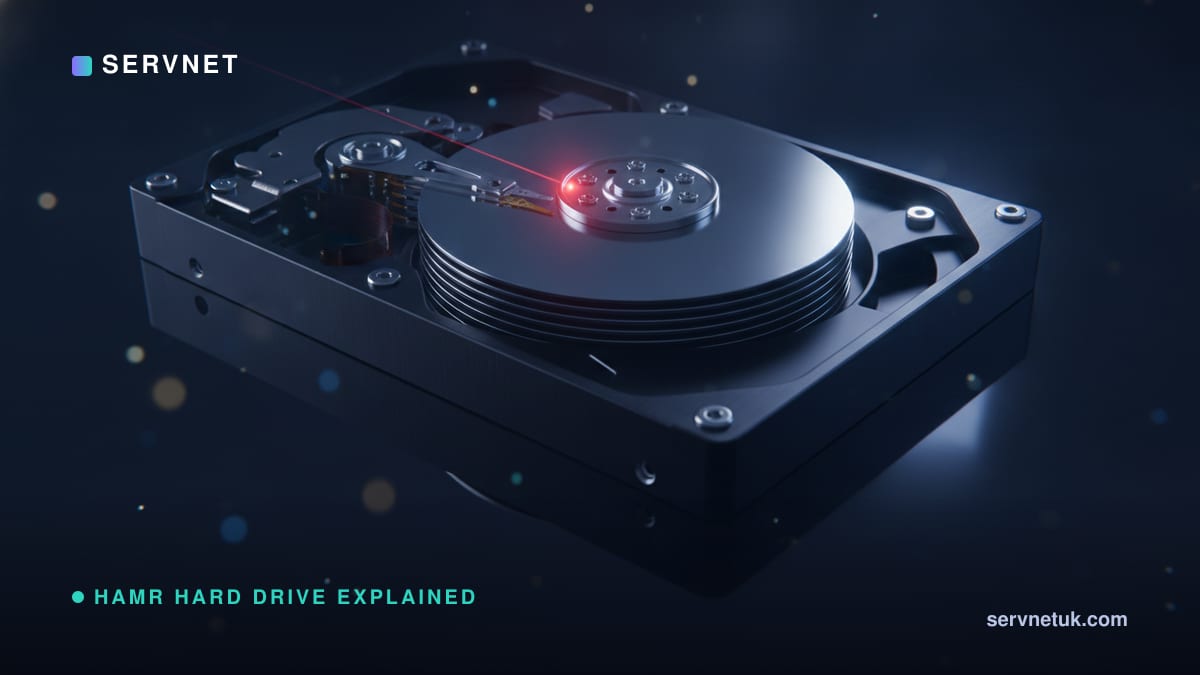
HAMR Explained: How Laser-Assisted HDDs Reach 40TB
Heat-assisted magnetic recording (HAMR) sounds exotic, but it solves a very old problem: how to pack more data onto a spinning disk without the bits becoming magnetically unstable. The trick is a lase…
SSD Endurance 2026: DWPD, TBW and Over-Provisioning Explained
Every enterprise SSD datasheet carries two endurance numbers — DWPD and TBW — and buyers routinely pay for more of both than their workload will ever use. The two figures describe the same wear budget…
Server Power Supply Explained: Redundancy, Titanium, Sizing
Buy a server with two power supplies and it's tempting to assume you've bought resilience and headroom in one line item. You haven't necessarily bought either. Dell's own PowerEdge documentation lists…
Bare Metal vs VM vs Container Explained (2026 UK Guide)
Ask three engineers to define a server in 2026 and you'll get three different isolation boundaries: a dedicated chassis, a hypervisor-carved virtual machine, or a kernel-sharing container. The distinc…
BMC Out-of-Band Management Explained: iDRAC, iLO, XCC 2026
Every server sold today contains a second, much smaller computer that most admins never think about until something goes wrong. This is the Baseboard Management Controller (BMC) — sold under the names…
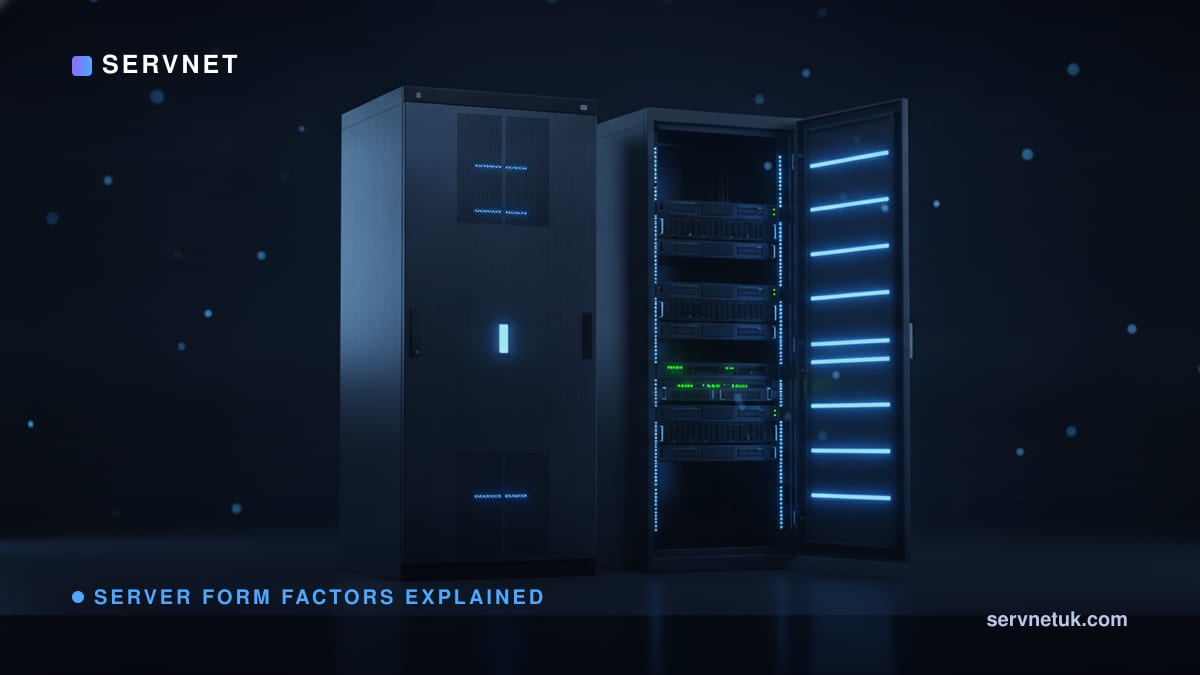
Server Form Factors Explained 2026: Rack vs Tower vs Blade
A single 42U rack cabinet can hold 35-40 individual 1U servers in roughly 0.6 square metres of floor space — a density that explains why choosing between tower, rack, blade and multi-node form factors…
PCIe Lanes and Slots Explained: Gen5, Gen6, Bifurcation
Every GPU, NIC and NVMe drive draws from the same finite pool of CPU lanes — and that pool is smaller than most configuration tools admit. A single Gen5 x16 GPU alone occupies all 16 lanes of a full-w…
Xeon 6 vs EPYC Turin Explained: Server CPU Naming Decoded
AMD's 192-core EPYC 9965 (Turin) lists at $14,913, against $17,800 for Intel's own 128-core Xeon 6980P (Granite Rapids) — a snapshot recorded in late 2025 that still shapes how UK buyers read 2026 quo…
Confidential Computing Explained: Intel TDX vs AMD SEV-SNP 2026
Encryption at rest and in transit is now standard practice, but data sitting in RAM has traditionally been plaintext — visible to the hypervisor, the cloud operator, even a malicious admin. Confidenti…
Server CPU Cores, Threads & Chiplets Explained (2026)
Intel's next flagship server chip, Xeon 7 Diamond Rapids (due in 2027), will come in 192- and 256-core versions, but open the package and you'll find stacks of 16-core chiplets bonded with Foveros Dir…
Immersion Cooling Explained: Single-Phase vs Two-Phase
Immersion cooling submerges servers directly in a dielectric liquid, and the difference it makes to efficiency is stark: a typical traditional data centre ran at roughly 1.58 PUE in 2022, while single…
DPU vs SmartNIC Explained: The Third Processor in 2026
A DPU – Data Processing Unit, sometimes badged SmartNIC or IPU – is becoming a genuine emerging line item on UK server quotes in 2026, sitting alongside the CPU and GPU as a third specialised processo…
GPU Partitioning MIG Explained: MIG vs Time-Slicing (UK 2026)
Enterprise GPUs now cost more than ever, yet average utilisation across 23,000 production Kubernetes clusters sits at just 5% in 2026 — meaning most paid-for compute idles while workloads queue. For a…
NVLink vs. InfiniBand vs. Ethernet: GPU Fabrics Explained (2026)
In the rapidly evolving landscape of AI and High-Performance Computing (HPC), the choice of GPU interconnect fabric is paramount for achieving optimal performance and efficiency. As of mid-2026, UK bu…
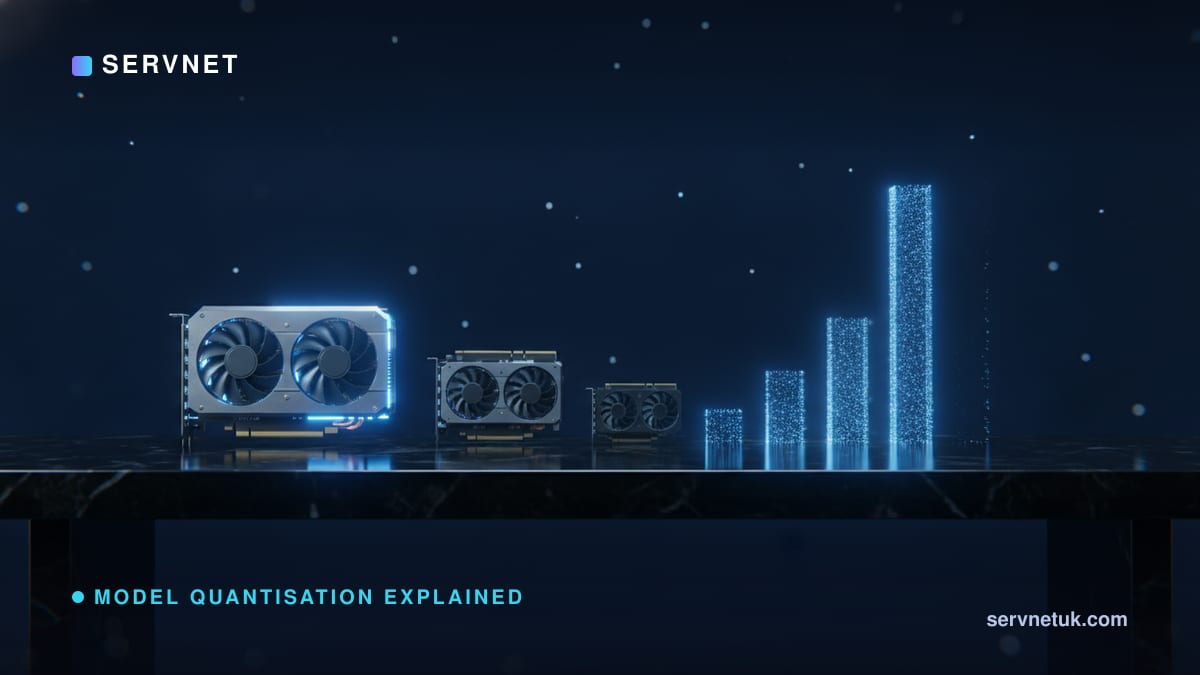
Model Quantisation Explained: FP16, FP8, INT8, FP4 (2026)
Model quantisation is the single biggest lever a UK buyer has against surging GPU prices in 2026: shrinking a model's numbers from FP16 down to FP8 or FP4 cuts VRAM for a 70-billion-parameter model fr…
On-Premise AI Inference Explained: The Private LLM Stack
By mid-2026, on-premise AI inference has stopped being a pilot project and become core infrastructure: 78% of organisations now run their own inference stack rather than depending solely on public mod…
Inference Server Explained: Training vs Inference 2026
UK businesses routinely buy training-grade hardware to do an inference job — and pay for it twice over. An inference server is a lean, latency-tuned machine built to run an already-trained model effic…
Direct-to-Chip Liquid Cooling Explained (2026 UK Guide)
In 2026, the number that ends the air-cooling debate is blunt: NVIDIA's B200 GPU already draws 1,000W of thermal design power, with the coming B300 and AMD MI355X projected at 1,400W — loads no fan ar…
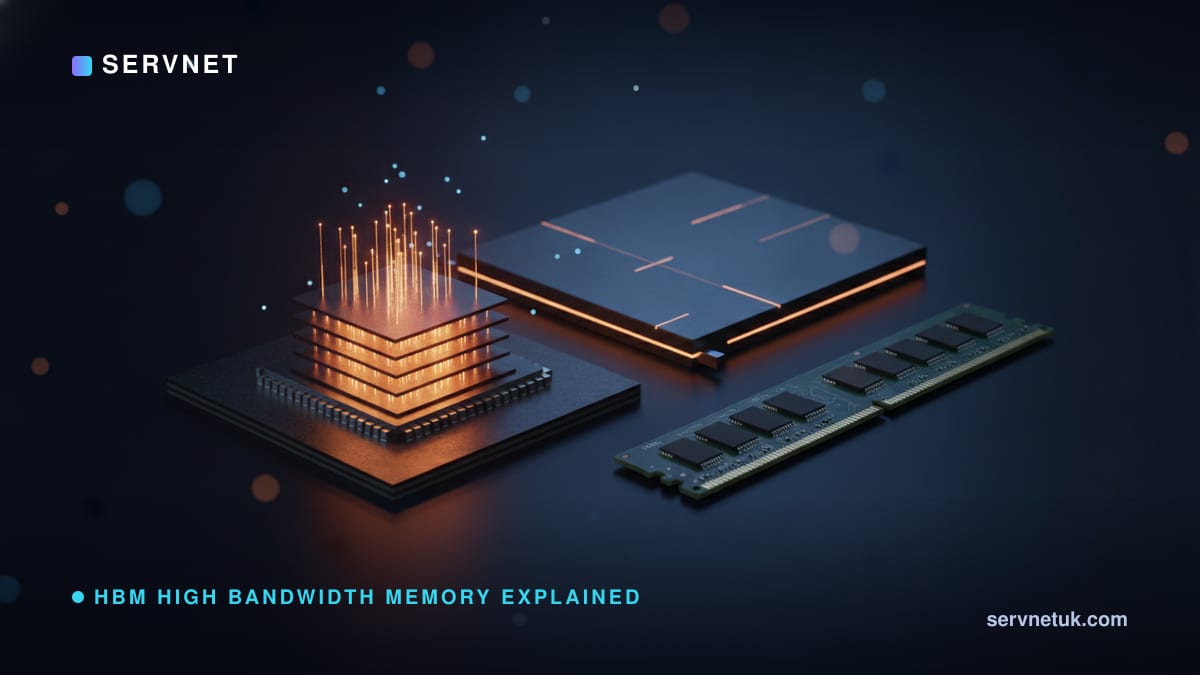
HBM Explained: Why AI Memory Prices Soared in 2026
High Bandwidth Memory (HBM) sounds like a niche chip spec, but in 2026 it is the reason your next server or laptop refresh costs more. HBM stacks DRAM dies vertically and wires them together with micr…
Rack Power Density Explained: Why AI Racks Hit 120kW
A single NVIDIA GB200 NVL72 rack draws roughly 120-132 kW - about as much electricity as an entire row of the enterprise cabinets it will sit beside. This guide has rack power density explained in the…
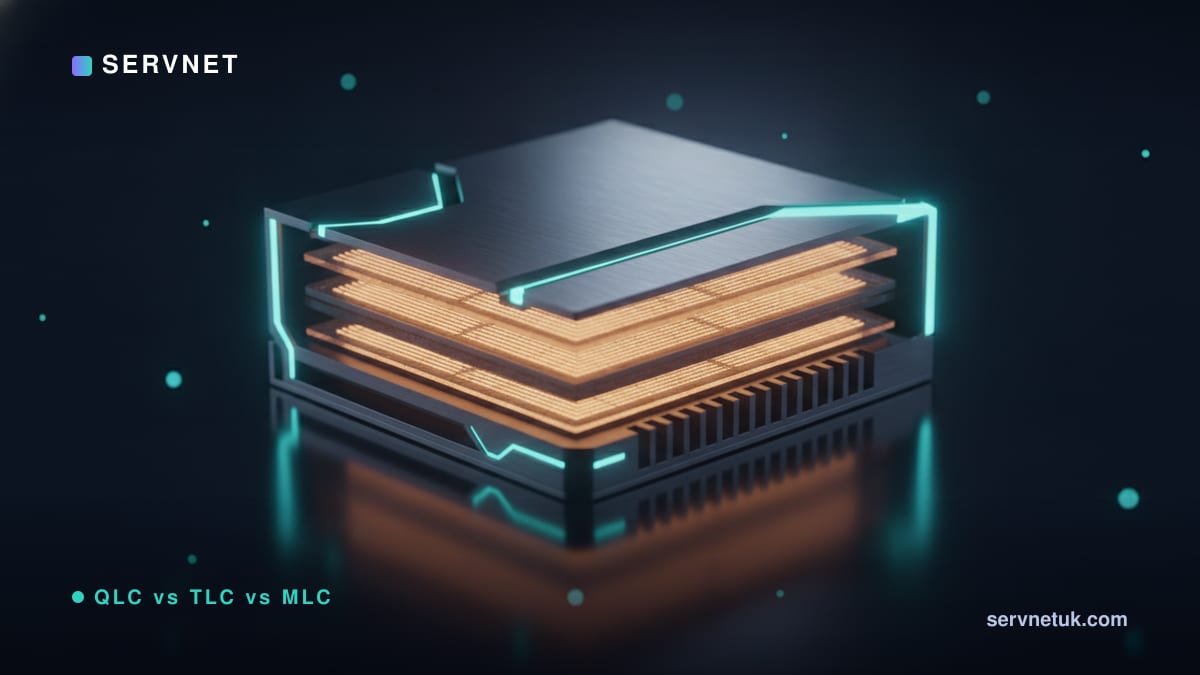
QLC vs TLC vs MLC NAND Flash Explained
Every SSD in your estate stores data as electrical charge trapped in microscopic cells, and the single biggest lever on price, capacity and lifespan is how many bits each cell holds. This guide explai…
ITAD Explained: Secure IT Asset Disposition
ITAD — IT asset disposition — is the governed, documented retirement of end-of-life hardware so that data is provably destroyed, custody is unbroken from rack to certificate, and residual value is rec…
OEM End-of-Support Jargon Decoded: EOSL, LDoS & More
Every hardware vendor uses a different phrase for the same moment: the day they stop supporting your kit. This neutral glossary decodes the OEM end-of-support jargon term by term — EOSL, LDoS, Sustain…

Can a new business finance IT? Credit, guarantees and deposits explained
A company trading for eight months, filing its first set of abbreviated accounts, wants to equip a growing team without draining the bank - and hits the same worry every time: will a funder even look …
VAT on IT equipment: lease vs hire purchase vs buying outright
The headline price of a server or a fleet of laptops is one number, but VAT decides when that money actually leaves your account - and that timing changes completely depending on whether you buy outri…
What is a rental factor? How IT finance monthly payments are calculated
Ask what the rate is on an IT finance deal and you often will not get an APR back - you will get a rental factor. It is the number asset-finance funders actually quote, and once you understand it the …
What is a managed service provider (MSP), and is one right for you?
Somewhere between hiring your own IT person and calling someone only when things break, there is a third option a lot of UK businesses end up choosing: a managed service provider. The term gets used l…
Windows 10 end of life: what your UK business must do now (2026)
Microsoft stopped issuing free security updates for Windows 10 on 14 October 2025. If your business is still running it on even a handful of machines, those devices are no longer getting the monthly p…
What is edge computing, and why businesses are talking about it (UK 2026)
After a decade of moving everything to the cloud, the conversation is quietly swinging the other way. Edge computing means processing data close to where it is created, on a device or a small server o…
Cloud repatriation: why some UK firms are moving back on-prem (2026)
After years of one-way traffic into the public cloud, a quiet counter-movement has become impossible to ignore. Businesses are selectively moving certain workloads back out of the cloud and onto their…
AI PCs and the NPU: genuine business value or marketing hype? (2026)
Walk into any laptop conversation in 2026 and you will be sold an 'AI PC' within the first minute. Every vendor has a sticker, a logo and a claim about a Neural Processing Unit, or NPU, that supposedl…

Active Directory vs Entra ID: explained for business (UK 2026)
If your business runs on Microsoft, two names keep coming up and they are easy to confuse: Active Directory and Entra ID, the service Microsoft used to call Azure AD. They sound like the same thing an…
Zero trust security, explained without the jargon (UK 2026)
Zero trust is one of the most talked-about and most misunderstood ideas in security. Vendors sell it as a product, which it is not, and the name makes it sound like distrusting your own staff, which i…
Is the on-prem server dead? Cloud vs on-prem in 2026
For a decade the received wisdom was simple: cloud is the future, on-prem is legacy, and any business still buying its own servers is behind the times. In 2026 that story has matured into something mo…
Refurbished vs new business laptops: the honest take (2026)
Refurbished business laptops are having a moment, and for good reason: a well-chosen refurb can deliver genuinely premium hardware for half the price of new, and it is the greener choice too. But 'ref…
Sustainability and e-waste in business IT: WEEE explained (UK 2026)
Electronic waste is the fastest-growing waste stream in the world, and a surprising amount of it starts life in an office cupboard full of retired laptops nobody got round to dealing with. For a UK bu…
What actually happens in a data breach: a UK business view (2026)
Most people picture a data breach as a single dramatic moment: a hacker, a progress bar, an alarm. The reality for a UK business is slower, messier and more procedural than that, and understanding the…

The real cost of IT downtime for a small business (2026)
Ask a small-business owner what an hour of IT downtime costs and most will shrug. That shrug is the problem. Downtime feels like an occasional nuisance, a slow morning while something gets fixed, rath…
What is ransomware, and how UK businesses really get hit (2026)
Ransomware is the cyber threat that turns a quiet Tuesday into an existential crisis: you arrive to find every file scrambled, a ransom note on the screen, and a business that cannot operate. For UK S…
Leasing vs buying business IT hardware: which is smarter in 2026?
Every few years the same question lands on a finance director's desk: do we buy this batch of laptops and servers outright, or spread the cost and lease them? It is rarely a purely financial decision,…
What is phishing, and how to train staff to spot it (UK 2026)
Most successful cyber attacks on UK businesses do not begin with a genius hacker breaking through a firewall. They begin with an ordinary email, a convincing message, and one busy person clicking befo…
Wi-Fi 7 explained: should your UK business upgrade in 2026?
Wi-Fi 7 is the headline on every new access point and a fair few laptops, promising eye-watering speeds and lower lag. The marketing is loud; the real-world question for a business is quieter and more…
EDR vs antivirus in 2026: what changed, and why it matters
For twenty years, antivirus was the answer to the question "how do we protect our computers?" You installed it, it scanned files, it caught known viruses, and that was largely that. Then attacks chang…
Public vs private vs hybrid cloud, explained simply (UK 2026)
Almost every UK business now runs on some kind of cloud, but the word covers three quite different things. Public cloud is renting computing from a giant shared provider. Private cloud is the same fle…
Should your SME outsource IT or hire in-house? (2026 guide)
At some point every growing business hits the same fork: keep muddling through with whoever is most technical, or get serious about IT support. And getting serious means a choice between hiring someon…
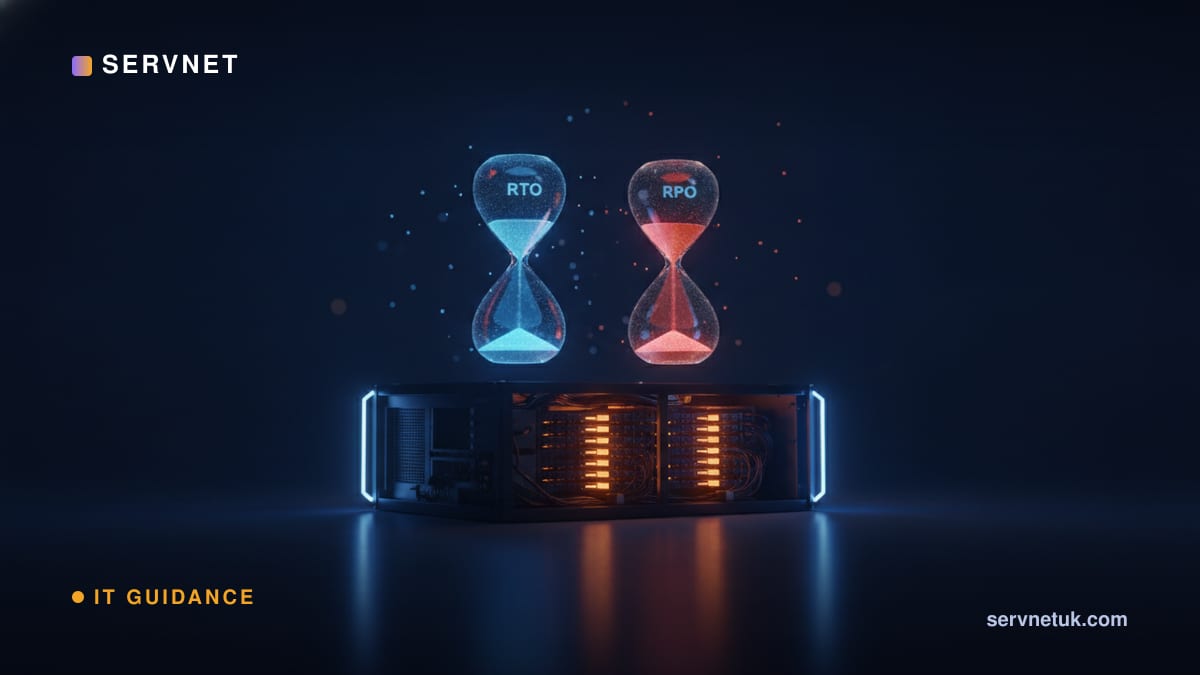
Disaster recovery explained: RTO vs RPO for non-techies (2026)
Two short acronyms decide how badly a disaster hurts your business, and most owners have never had them explained properly. RTO and RPO are the difference between an incident that costs you an afterno…
The hidden cost of cheap business laptops (2026)
A 350-pound laptop and a 950-pound laptop both turn on, open a browser and run your email. So why would any sensible business pay nearly three times as much? The honest answer is that the cheap one is…
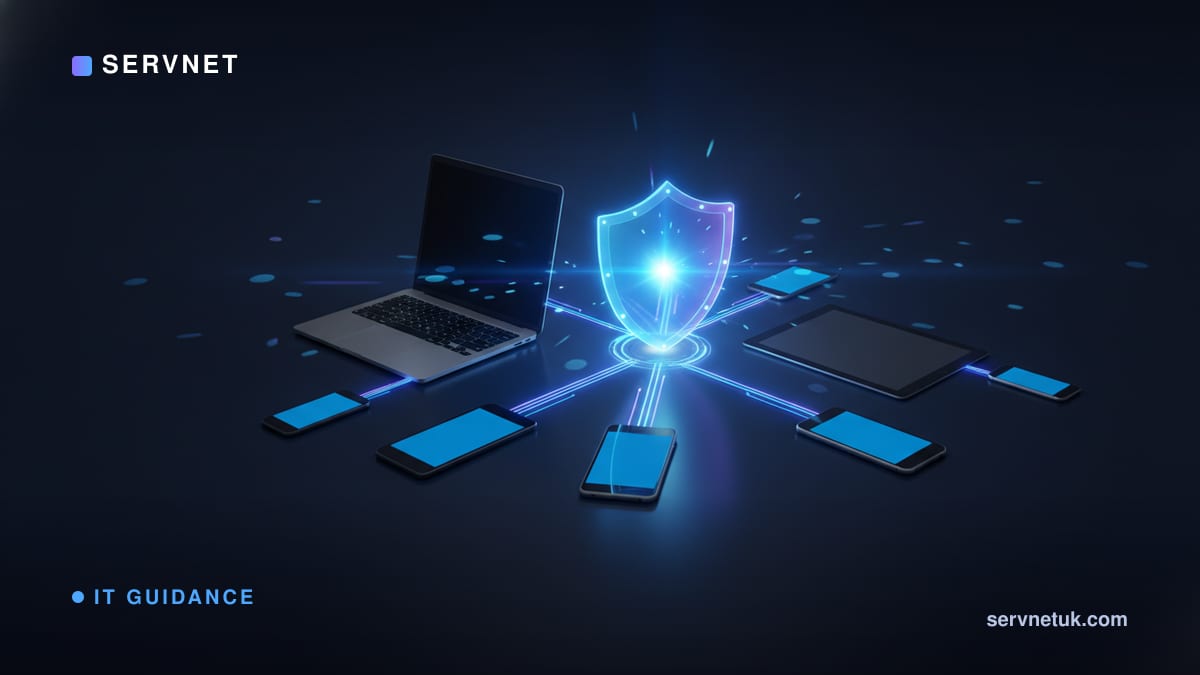
What is MDM (mobile device management) and why fleets need it (2026)
Picture trying to keep twenty, fifty or two hundred laptops and phones secure, up to date and configured the same way - by visiting each one in turn. That is the problem mobile device management solve…
Microsoft 365 vs Office 2024: subscription or one-off? (UK 2026)
Word, Excel, Outlook and PowerPoint come two ways, and the choice trips up a lot of UK businesses. Microsoft 365 is a subscription you pay for monthly or yearly, with the apps plus cloud services that…
USB-C vs Thunderbolt: ending the cable confusion in 2026
Few things in modern IT cause as much quiet frustration as the humble USB-C port. The connector is wonderfully universal - the same oval plug charges your phone, drives your monitor and connects your …
What is MFA, and why passwords alone are no longer enough (UK 2026)
If a single stolen password can let a stranger into your email, your files and your finances, then your business is one phishing email or one reused login away from a very bad day. That is the reality…
Bandwidth vs throughput vs latency: what slow internet really means
When the internet feels slow, almost everyone reaches for the same fix: pay for more megabits. Sometimes that helps. Often it changes nothing, because 'slow' is three different problems wearing the sa…
Best UPS for a small office or server cupboard: how to size and choose one
A UPS - an uninterruptible power supply - is a battery that keeps your kit running through a power cut or, more usefully, through the split-second dips and surges that quietly corrupt data and shorten…
Monitor size and resolution explained for work
Monitors are the one piece of kit your staff stare at all day, yet they are usually the afterthought in a PC order - whatever is cheapest, or whatever was on the shelf. That is a false economy, becaus…
What is SSO (single sign-on) and why staff will thank you (2026)
Count the number of separate logins your staff juggle in a normal week - email, the CRM, the finance system, the HR portal, half a dozen web apps - and you start to see why password fatigue is real, a…
What is PoE (Power over Ethernet), and where it quietly saves money
Power over Ethernet sounds like deep electrical territory, but it is one of the most genuinely money-saving ideas in office networking - and most owners have never had it explained. In one line: it se…
Wired vs Wi-Fi for business: when each one wins (UK 2026)
Modern Wi-Fi is so good that it is easy to assume cables are obsolete, right up until a video call drops in a packed meeting room or a backup crawls overnight. The truth is that wired and wireless are…
How much RAM does a business laptop really need? (the spec myths)
Walk into any laptop purchase and someone will tell you that more RAM is always better, that 8GB is dead, or that you should max it out to future-proof. Some of that is true; a lot of it is sales nois…
Microsoft 365 sign-in problems: how to fix them
When Microsoft 365 will not let you sign in, almost everything stops at once - email, Teams, files and the apps your business runs on. It is a heart-sink moment, but the causes are a short, well-worn …

How to plan an IT budget for a small business (without guessing)
For many small business owners, the IT budget is whatever last year cost plus a nervous guess - until something breaks expensively and blows the whole plan apart. It does not have to be that way. A se…
Do you still need a firewall in a cloud world? An honest answer
Do you still need a firewall? Every few years someone declares it dead, and the logic sounds reasonable: your data lives in the cloud, your staff work from cafes and kitchens, and the office network i…
SaaS vs PaaS vs IaaS: the cloud acronyms decoded (UK 2026)
SaaS, PaaS and IaaS are three acronyms that get thrown around as if everyone agrees what they mean. They are simply three levels of how much of the technology stack you rent versus run yourself. SaaS …
Best video conferencing kit for meeting rooms: a practical buyer's guide
Hybrid working has made the meeting room a video studio, and most rooms are terrible at it - a laptop propped on the table, a tinny mic, half the room out of shot and unheard. The fix is not expensive…
When should you replace business computers? Signs and timing
'If it still turns on, keep it' feels thrifty - and it is one of the most expensive habits in business IT. An ageing PC does not announce its true cost; it leaks it quietly through lost minutes, suppo…
What is a network switch (and managed vs unmanaged)?
A network switch is the most quietly important box in your office that nobody can describe. It is the device every wired thing plugs into - PCs, printers, phones, Wi-Fi points, cameras - and it decide…
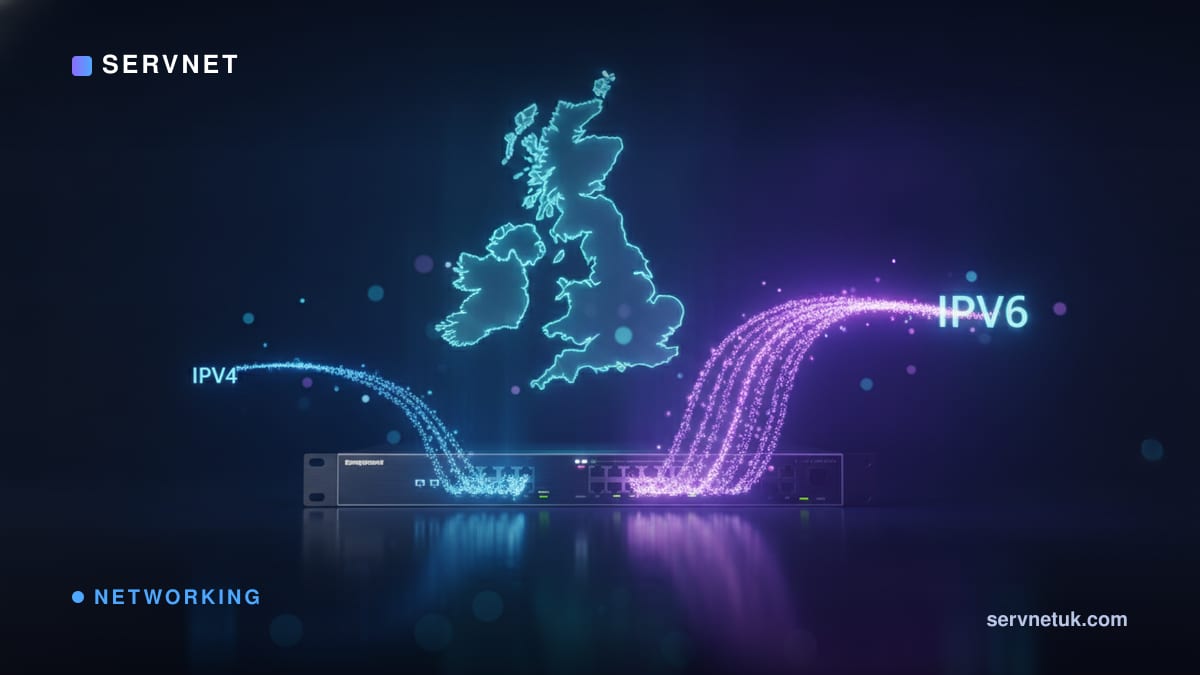
IPv4 vs IPv6: what UK businesses actually need to know in 2026
IPv6 has been the future of the internet for so long that it is tempting to assume it will never actually arrive. In reality your business almost certainly already uses it, often without anyone decidi…
Containers and Docker in plain English (UK 2026)
Containers and Docker come up constantly once software gets involved, and they sound far more intimidating than they are. A container is just a tidy, self-contained package that holds an application t…
SD-WAN in plain English for UK business owners
SD-WAN is one of the most over-jargoned terms in business IT, usually explained by people who seem keen for you not to understand it. Strip away the acronyms and it is a simple idea: software that dec…
What is Microsoft Intune? Endpoint management in plain English
Microsoft Intune is one of those tools your IT provider mentions and you nod along to, without quite knowing what it does or why it appears on your bill. In plain English, it is how a business manages…
What is an immutable backup, and why ransomware made it essential
There is a brutal lesson that too many UK businesses have learned the hard way: having backups is not the same as being able to recover. Ransomware gangs worked out years ago that the backup is the th…
Mesh Wi-Fi vs business access points: which is right for your office?
When office Wi-Fi gets flaky, two very different fixes get suggested in the same breath: 'just get a mesh system' or 'put in proper access points'. They are not the same thing, they do not cost the sa…
What is colocation, and is it right for your business? (UK 2026)
Colocation sits in the blind spot between owning a server cupboard and renting cloud, and it quietly powers a huge amount of UK business IT. The idea is simple: you still own your servers, but instead…
Best business broadband options explained: which connection fits your office
Business internet has never had more options - or more confusing names. Full fibre, FTTC, leased lines, SoGEA, 5G: the labels multiply while the real question stays simple. What does your office actua…

How much should a business PC cost? A sensible UK guide
Ask what a business PC should cost and you will get answers from a couple of hundred pounds to several thousand - all technically correct, because they answer different questions. The useful version i…

What is SaaS sprawl, and how do you get it back under control?
Ask a typical UK business how many cloud apps it pays for and you will get a confident answer that is wildly wrong - usually a fraction of the truth. Somewhere between the design tool one team signed …
Do Macs get viruses? Separating myth from reality in 2026
"Macs don't get viruses" is one of the most stubborn beliefs in computing. It was never quite true, and in 2026 it is comfortably out of date, yet it still shapes how a lot of UK businesses protect, o…
SSD vs HDD: which makes sense for your business in 2026?
Solid-state drives have all but won the argument for laptops and PCs, yet the old spinning hard disk is far from dead - it still quietly stores most of the world's data because it is so cheap by the t…
What is DNS, and why it is usually why the internet breaks (UK 2026)
When a colleague says the internet is down, there is a good chance the internet is fine and DNS is the thing that has actually broken. DNS is the quiet system that turns a name you can remember, like …
Printer shows offline on the office network: fixes
Few IT irritations are as universal as a network printer that insists it is 'offline' while sitting there, powered on and ready. It is the classic office gremlin - but behind the frustration is a shor…
What is patch management, and why it matters more than you think?
Patch management is the unglamorous, deeply important business of keeping all your software and devices up to date with the fixes their makers release. Those updates close security holes, squash bugs …
What is TPM, and why Windows 11 insists on it
When businesses started moving to Windows 11, one requirement caused more confusion than any other: a thing called TPM 2.0. Plenty of perfectly good PCs were suddenly declared 'not supported', and few…
How to set up a safe guest Wi-Fi network
Offering visitors Wi-Fi is normal courtesy - but handing them the same network your staff, servers and till run on is a quiet, common, entirely avoidable mistake. A safe guest network gives clients, c…
Why you still need to back up Microsoft 365 (the myth that bites businesses)
'It's in the cloud, so Microsoft backs it up' is one of the most expensive misunderstandings in UK business IT. It feels obviously true - your email, files and Teams chats live in Microsoft's data cen…
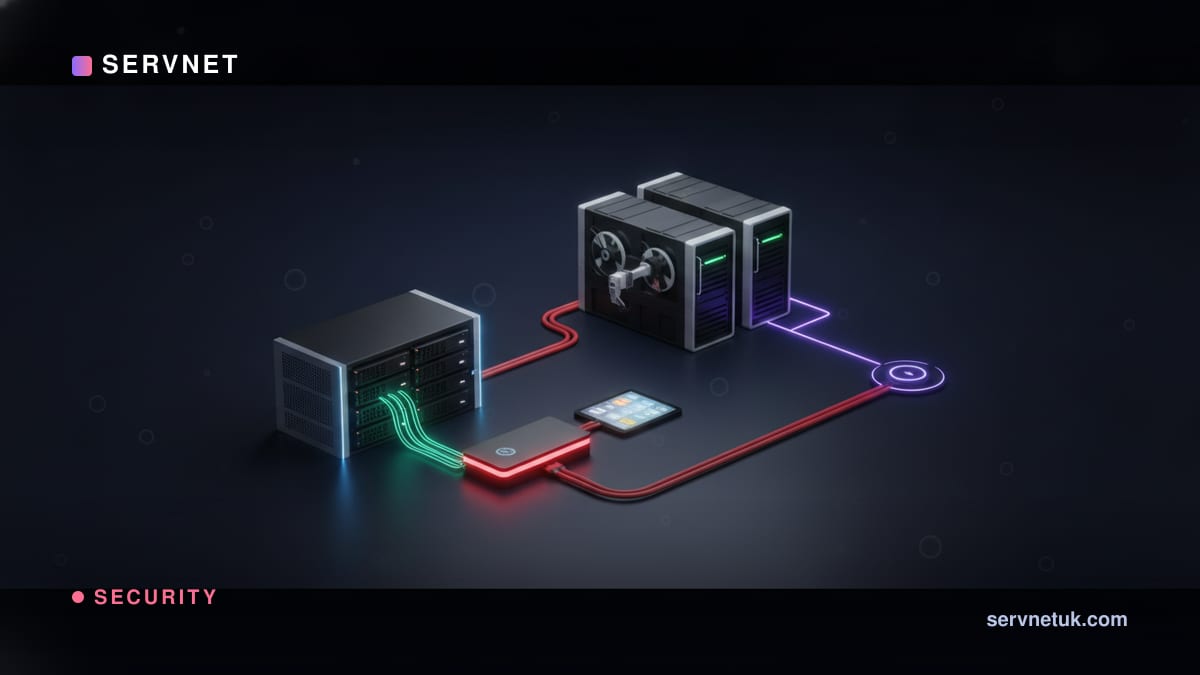
The 3-2-1 backup rule explained, with real examples
The 3-2-1 rule is the oldest, simplest and most useful piece of backup advice in existence, and most data-loss disasters are simply stories of someone not following it. It fits on a beer mat: three co…
What is CRM software (and does your SME actually need one)?
CRM software takes its name from Customer Relationship Management, a grand name for a simple idea: one organised place to keep track of your customers, your conversations and your sales - instead of s…
What is a VLAN, and why it quietly matters for your office network
Most small offices run on one flat network: every laptop, printer, phone, CCTV camera and guest device shares the same digital room and can, in principle, talk to everything else. A VLAN is how you pu…
Virtualisation explained for non-techies (UK 2026)
Virtualisation is the quiet technology behind almost everything modern in IT, from the cloud to the servers in your own building, yet it is rarely explained in plain terms. At its heart it is a simple…
Best docking stations for business laptops: how to choose the right one
A docking station turns a laptop into a desktop with one cable: arrive at your desk, plug in once, and your screens, keyboard, network and charger all connect. Get it right and hot-desking and hybrid …
All-in-one PCs for business: the real pros and cons
An all-in-one PC hides the whole computer inside the monitor, leaving a single tidy screen and one power cable on the desk. They look fantastic in a reception or a clean open-plan office - and for the…

Password managers for business: what they are and why to deploy one
Weak and reused passwords are behind a remarkable share of real business breaches, and yet most organisations still rely on staff to invent, remember and protect dozens of them by sheer willpower. It …
How to dispose of old business IT securely (WEEE)
That cupboard of dead laptops, the stack of retired PCs in the corner, the old server humming pointlessly in the comms room - getting rid of old IT feels like a job you can put off forever. You cannot…
Shared/network drive not showing: how to fix it
When the shared drive vanishes, a whole team can be stopped at once - the files everyone works from are suddenly unreachable. It is alarming, but it is rarely lost data; far more often it is a connect…
What is a VPN, and does your UK business actually need one in 2026?
A VPN is one of those three-letter terms everyone has heard and almost nobody can explain. The short version: it builds a private, encrypted tunnel across the public internet so two points can talk as…
What is a NAS, and does your small business actually need one?
If your team still shares files by emailing attachments back and forth, or by passing round a USB stick, a NAS is probably the upgrade you have been circling without naming. It is one of the most usef…

Leased line vs FTTP for business broadband: which does your firm need?
Upgrading your business internet throws up two serious options that look similar on a price comparison and behave completely differently in real life: full-fibre broadband (FTTP) and a leased line. On…
Docking stations explained: do you actually need one?
The modern business laptop has shed almost all its ports in the name of staying thin - which is lovely until you reach your desk and want two monitors, a wired keyboard, an ethernet cable and a charge…
How to roll out MFA across your business without the chaos
Multi-factor authentication is the highest-value security upgrade most businesses can make - and the one most often delayed, because owners picture help-desk meltdown, locked-out staff and a week of c…
Xero vs QuickBooks vs Sage: accounting software for UK small business
Choosing accounting software feels low-stakes until you are two years in, your accountant hates your choice, and switching means re-keying history. For UK small businesses the field really comes down …
Why your work computer is slow (and how to speed it up)
A slow work computer is a quiet tax on every business: staff wait, tempers fray, and the lost minutes add up across the team. Before anyone writes it off as 'too old', it is worth knowing that most sl…
Best monitors for business and the home office: what to buy
Monitors are the most overlooked productivity upgrade in business IT. Firms agonise over which laptop to buy, then plug it into a decade-old 1080p screen that quietly slows everyone down. A good monit…
What Is a Workstation PC? (And Who Actually Needs One)
'Workstation' gets used to mean anything from a fancy desktop to wherever you happen to sit. In computing it has a specific meaning - and a specific, often hefty, price tag. Understanding what genuine…
What is XDR, and how does it differ from EDR?
Security marketing loves a three-letter acronym, and XDR is the one currently on every vendor's slide. It sounds like EDR with a fancier first letter, and the temptation is to assume it is the same th…
What is an SLA (service level agreement), and what should be in yours?
An SLA - service level agreement - is the part of a contract that puts numbers on a promise. Instead of a supplier vaguely agreeing to 'fix things quickly', an SLA says exactly how quickly, how often …
Teams vs Slack vs Zoom: which does your business actually need?
Teams, Slack and Zoom get lumped together as 'the chat-and-video apps', and that is exactly why businesses end up paying for two or three of them at once. They overlap, but each was built to be best a…
How to migrate business email to Microsoft 365
Moving your business email to Microsoft 365 is one of those projects that feels terrifying and turns out to be very doable - provided you plan it rather than wing it. Email is the lifeblood of most fi…

What is Cyber Essentials, and should your UK business get certified?
Cyber Essentials is a UK government-backed scheme that proves your business has the basic cyber-security controls in place to fend off the vast majority of common attacks. Think of it as a recognised …
Email security explained: SPF, DKIM and DMARC in plain English
Three cryptic acronyms - SPF, DKIM and DMARC - decide whether your emails land in inboxes or spam, and whether criminals can send fake emails pretending to be you. Most UK businesses have heard of non…
Outlook not syncing: the common fixes
When Outlook stops syncing, work quietly grinds to a halt: emails sit unsent, replies never arrive, and the calendar shows yesterday's version. Because Outlook is the front door to most businesses, it…
Best firewall for a small business: a plain-English buyer's guide
Every small business has a firewall of sorts - usually the box your broadband provider posted you, doing the bare minimum. The question is whether that is enough, and if not, what to buy instead witho…
Mini PC vs tower PC for the office: which makes sense?
Walk into a modern office and the chunky beige tower has quietly vanished, replaced by a palm-sized box clipped behind the monitor. Mini PCs are now the default desktop for most businesses - but not a…
What is BYOD (bring your own device), and is it right for your business?
BYOD - bring your own device - is the simple-sounding idea that staff use their own phones, tablets and sometimes laptops for work instead of company-issued kit. For a small business it can mean lower…
VPN vs zero trust network access (ZTNA): what changed, and what to do
For twenty years, giving staff remote access meant one thing: a VPN. It still works, millions of businesses still rely on it, and there is nothing inherently broken about the idea of an encrypted tunn…
How to secure remote and hybrid workers
Hybrid working is now normal, but most security setups were built for a world where everyone sat behind one office firewall. The moment work spreads to kitchen tables, coffee shops and home routers, t…
What is SharePoint, and should your business actually use it?
SharePoint is the part of Microsoft 365 that everyone has and almost nobody understands. It quietly powers your Teams files, your company intranet and your shared documents - yet ask ten business owne…
Laptop won't connect to Wi-Fi: fixes that work
A laptop that refuses to join the Wi-Fi is one of the most common and most stressful faults for staff, usually striking five minutes before a meeting. The good news: the cause is almost always one of …
How to back up business data so you never lose it
Almost every business owner believes they are backed up. A worrying number find out, on the worst possible day, that they were not - the backup had silently failed months ago, or it was sitting on a d…
Microsoft 365 vs Google Workspace: which suits your business?
Pick one productivity suite and you live with it for years - it shapes how your team writes, meets, shares files and logs in every single day. Microsoft 365 and Google Workspace are the two serious co…
Best NAS for a small business: how to choose (and what to ignore)
A NAS - a network-attached storage box - is the quiet workhorse of a small office: a shared drive everyone reaches, a place backups land, somewhere the CCTV records. The trouble is the buying advice o…
Why your business Wi-Fi is slow (and how to fix it)
Slow office Wi-Fi is the complaint every business owner hears and almost nobody diagnoses properly. The instinct is to blame the broadband and pay for a faster line - which fixes nothing roughly half …
Desktop vs laptop for business: which should you buy?
It is the most common kit question we get, and the honest answer is not 'whichever is cheaper'. A desktop and a laptop solve different problems, and buying the wrong one quietly costs you for years - …
What is shadow IT, and why it is a quiet risk to your business?
Shadow IT is the term for any technology your staff use to do their jobs that the business never approved, never bought and often does not even know exists - the free file-sharing site, the personal D…
Cloud storage vs a NAS for business: which should you actually buy?
When a UK business outgrows scattered files on laptops and a shared Dropbox folder, the same fork in the road appears: rent space in the cloud, or buy a NAS box that lives in your own office. Both sto…
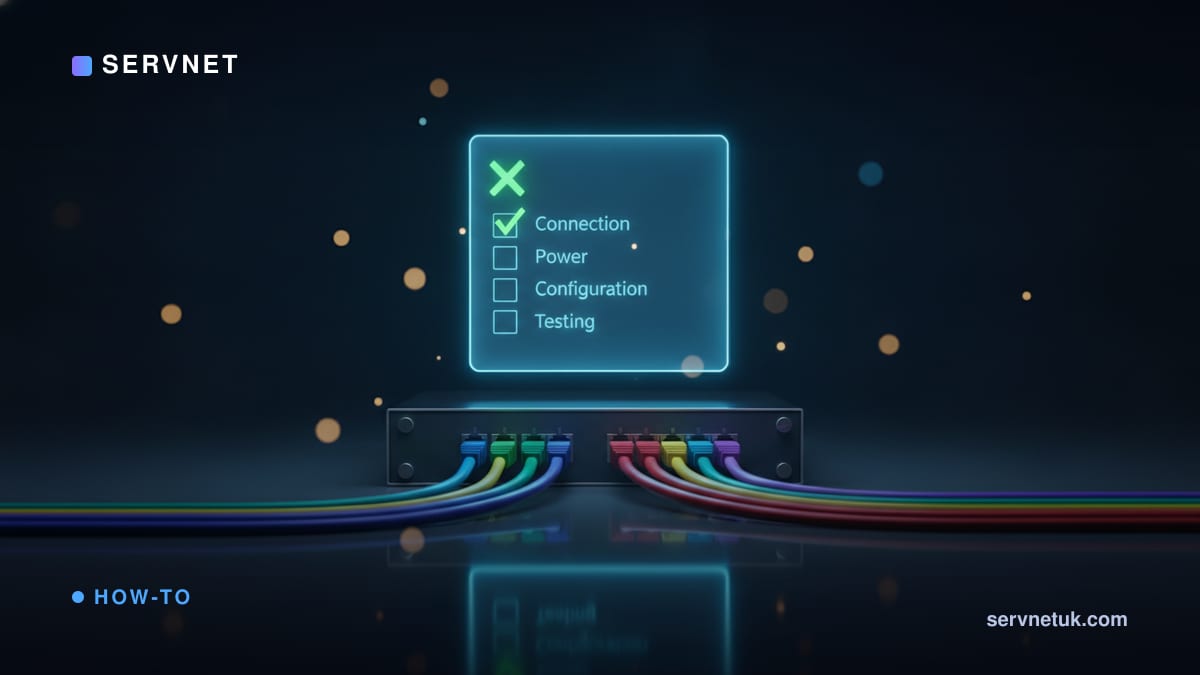
How to set up a small business network (the right way)
Plenty of small UK businesses still run on a network that grew by accident: a broadband router from the provider, a cheap switch someone bought online, and Wi-Fi that drops every time the office fills…
Microsoft 365 business plans explained, without the spreadsheet headache
Microsoft sells its 365 plans the way airlines sell fares: a wall of near-identical names, each a few pounds apart, each hiding one feature that turns out to be the one you needed. Business Basic, Bus…
GDPR for small business: a plain-English guide to getting it right
GDPR has a fearsome reputation, and for a small business that can be paralysing - it sounds like a project that needs a lawyer and a six-figure budget. The reality is far more manageable. UK GDPR is m…
Learn is one of the four article libraries in the Servnet Hub. The others are Insights (long-form technical guides), News (same-day analysis) and Research (original data studies).
Talk to a UK specialist
Get expert advice or a no-obligation quote — servers, storage, networking, maintenance, finance and cloud. We reply the same working day.