
Intel's next flagship server chip, Xeon 7 Diamond Rapids (due in 2027), will come in 192- and 256-core versions, but open the package and you'll find stacks of 16-core chiplets bonded with Foveros Direct 3D and linked over UCIe-S rather than EMIB — not one giant slab of silicon. Just as strikingly, Intel has dropped Hyper-Threading (SMT) from this chip entirely, so 192 physical cores now deliver exactly 192 threads — a fundamental change from prior SMT-enabled Xeon generations, where thread count ran well ahead of physical core count. For UK buyers used to reading cores and threads as two different numbers on a spec sheet, that's a fundamental shift — one that how many CPU cores a server needs calculations, licensing math and vCPU planning all need to account for. This piece explains what's actually inside a 2026 server CPU, and what the chiplet reality means when you're reading one.
View the data behind this chart
| AMD EPYC 8005 | Diamond Rapids | AmpereOne | Clearwater Forest | |
|---|---|---|---|---|
| Physical cores | cores84 | cores256 | cores192 | cores288 |
The 192-core conundrum: why spec sheets lie by omission
A server CPU spec sheet will happily print '192 cores' or '256 cores' as a single, clean number. What it won't show you is that Intel's Diamond Rapids (Xeon 7, due in 2027) reaches those figures with compute chiplets of up to 16 P-cores each — 16 of them in the 256-core flagship — stacked onto four base tiles with Foveros Direct 3D and linked to two fabric hub tiles over UCIe-S rather than Intel's EMIB bridges. It isn't one die — it's up to 22 chiplets, wired together to behave like one.
At the same time, Intel has quietly removed Simultaneous Multithreading (SMT, better known as Hyper-Threading) from this generation. That means 192 physical cores now produce exactly 192 threads — no logical-core bonus.
Cores vs threads: the 2026 reality
A physical core is a complete execution unit capable of running instructions independently. A thread, in the SMT/Hyper-Threading sense, is a second logical execution context sharing that same physical core's resources — useful for filling idle execution slots, but not a second full core.
Prior-generation Xeons (2023-era Sapphire Rapids leaks put a 56-core part at 112 threads) relied on SMT to roughly double the thread count a hypervisor or scheduler could see. Diamond Rapids abandons that entirely: 192 cores, 192 threads, full stop. For lightly-threaded applications this means no more 'free' thread doubling — every thread scheduled is a genuine physical core with no contended sibling, which is good for predictable latency but changes how you count available capacity.
How a 'single' CPU is actually many chiplets
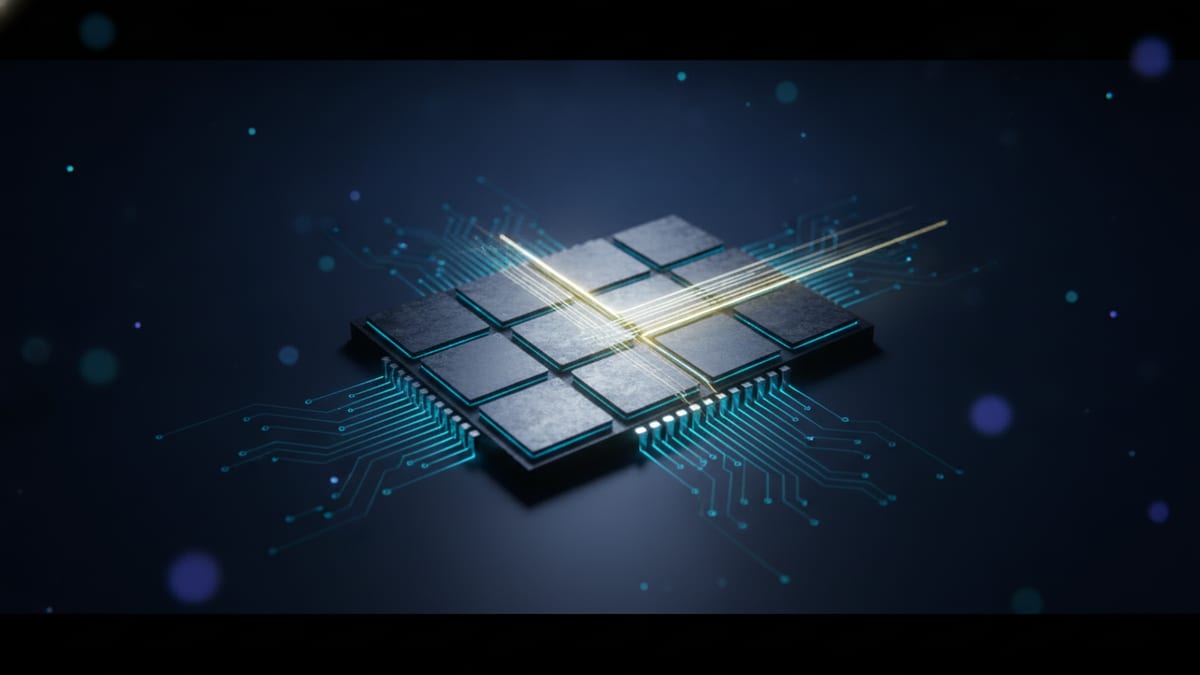
Chiplet (or MCM — multi-chip module) design means a vendor builds several smaller dies rather than one enormous monolithic die, then connects them with a high-bandwidth on-package interconnect. Diamond Rapids uses compute chiplets of up to 16 P-cores each — 16 of them in the 256-core flagship — stacked on four base tiles with Foveros Direct 3D and connected to two fabric hub tiles over UCIe-S rather than EMIB.
The upside, per SemiAnalysis's analysis of the datacentre CPU market, is manufacturing yield: smaller dies fail less often during fabrication than one giant die, which is what makes 150+ core packages economically viable at all. The downside is that communication between chiplets is not free — it introduces latency that a genuinely monolithic die wouldn't have. TechSpot's coverage of the current chiplet trend flags this as a real concern for tightly coupled workloads, and it behaves much like the cross-node penalties familiar from NUMA server topology, except now happening inside a single socket.
P-cores, E-cores and Intel's split personality
Diamond Rapids' 192 cores are all P-cores (Performance cores) — large, fast, few. Intel's 2026 flagship, meanwhile, takes the opposite route entirely: Xeon 6+ Clearwater Forest packs 288 Darkmont E-cores (efficiency cores) per socket on the new 18A process node, sharing a huge 576 MB of L3 cache, with no P-cores in the mix at all.
P-cores suit workloads that need raw single-thread speed and low latency per operation. E-cores trade some per-core performance for far greater parallel density and efficiency — good for scale-out, containerised, throughput-heavy work. Comparing '192' against '288' as if they were the same currency is a mistake: they're different core types built for different jobs. Clearwater Forest systems are already available in the UK through Dell, HPE, Lenovo and Supermicro as of June 2026, so this isn't a future roadmap item — it's buyable now. See our deeper look at Intel Xeon 6 processors for the full family context.
Matching the architecture to the workload
For latency-sensitive, tightly coupled workloads — transactional databases in finance or health, where UK regulators expect predictable response times — chiplet-hopping latency matters.
For scale-out web tiers, microservices and container-dense estates, Clearwater Forest's 288 E-cores and 576 MB shared L3 are built for exactly this pattern: many light, parallel threads rather than a few heavy ones.
For AI inference and memory-bound HPC work, Diamond Rapids' 16-channel DDR5 design, up to 1.6 TB/s of memory bandwidth per socket, and PCIe 6.0 support matter more than the headline core count — you need the plumbing to feed the cores.
For smaller, cost-conscious single-socket builds, AMD's EPYC 8005 'Sorano' line offers up to 84 cores in a 70–225 W TDP envelope on a chiplet design of its own — a genuinely different scale of decision, and one worth weighing against single vs dual socket servers before assuming more sockets automatically means more performance.
View the data behind this chart
| GB/s per socket | Granite Rapids-AP | Diamond Rapids (min) | Diamond Rapids (max) |
|---|---|---|---|
| Memory bandwidth (GB/s) | 614 | 818 | 1600 |
Beyond raw counts: cache, bandwidth and I/O
More cores need more data flowing to them, or they simply sit idle. Diamond Rapids abandons Intel's earlier 8-channel memory plan entirely in favour of a 16-channel DDR5 design, built to approach 1.6 TB/s of bandwidth per socket with second-generation MRDIMMs at up to 12,800 MT/s. Intel pitches the platform as doubling Granite Rapids' memory bandwidth, against the 614 GB/s quoted for the previous Granite Rapids-AP generation with standard DDR5-6400 memory.
Clearwater Forest solves the same 'how do I feed 288 cores' problem differently: a 576 MB shared L3 cache keeps far more working data on-die, reducing trips out to main memory for many workloads. Neither approach makes core count meaningless, but both prove that a bare core-count figure without matching bandwidth and cache context tells you very little about real throughput.
Translating cores and threads into vCPUs
The old virtualisation rule of thumb — assume roughly two schedulable threads per physical core thanks to SMT — no longer applies to SMT-less chips. On Diamond Rapids, 192 threads is a hard ceiling equal to the physical core count, not a doubled figure a hypervisor can lean on for overcommit.
This matters for UK estates running mixed hardware generations: an SMT-enabled part still behaves like the older assumption (the 56-core/112-thread Sapphire Rapids-era figure is one such data point, though it's a 2023-generation part, not a current 2026 SKU), while an SMT-less 2026 chip does not. Blanket vCPU-to-core ratios across a mixed estate will misallocate capacity on one side or the other — each generation needs validating on its own terms before you size a virtualisation host.
Software licensing is where this shift bites hardest for UK budgets. Many enterprise workloads — databases, virtualisation platforms and other per-core-licensed applications — are priced against physical core count, not thread count. With Diamond Rapids' 192 P-cores producing exactly 192 threads and no SMT uplift, buyers can no longer assume a given licensed core count will serve the doubled thread throughput that older SMT-enabled generations delivered from the same physical footprint. Core type compounds this: a straightforward per-core licence doesn't distinguish between a P-core and an E-core, so Clearwater Forest's 288 Darkmont E-cores and Diamond Rapids' 192 P-cores would each be billed as 288 or 192 licensable units respectively, despite very different per-core performance — meaning the chip with more cores isn't automatically the cheaper one to licence.
Cost, power and the UK buying decision
Diamond Rapids is not due until 2027 and has no published pricing, so there is no like-for-like per-socket price comparison with Xeon 6+ Clearwater Forest yet; compare quoted system prices rather than headline core counts. The right answer depends on whether your workload actually benefits from many E-cores or fewer, faster P-cores.
Power matters too: Intel's refined 18A-P process, which Diamond Rapids will use, delivers 9% higher performance at the same power draw, or an 18% power reduction at the same performance level, versus the 18A node used in Clearwater Forest — a meaningful lever against UK datacentre efficiency targets. Ultimately, the headline core number on a 2026 spec sheet is a starting point, not the answer: chiplet count, core type, cache, and memory bandwidth together decide whether that number translates into real performance for your workload. If you're speccing new hardware, it's worth working through options via the Dell server configurator, HPE server configurator or Lenovo server configurator before committing to a core count on paper alone.
Sources
Every figure in this article traces to the sources below.
- •The Register — Diamond Rapids 192-core design and SMT removal
- •TechSpot — Xeon 6+ Clearwater Forest launch, cache, bandwidth and 18A node data
- •TechTimes — Clearwater Forest UK availability via Dell, HPE, Lenovo, Supermicro
- •Intel Xeon Diamond Rapids announcement — chiplet count, memory and PCIe details
- •AMD — EPYC 8005 Sorano core count and TDP range
- •Tom's Hardware / The Register — Diamond Rapids Hot Chips 2026 disclosures (256-core flagship, 16-core chiplets, UCIe-S, 2027 launch)
- •SemiAnalysis — chiplet yield, latency and market trend analysis
View the data behind this chart
| Physical cores | Threads | Notes | |
|---|---|---|---|
| Sapphire Rapids (2023) | 56 cores | 112 threads (SMT) | 2023 baseline |
| Diamond Rapids (2027) | 192 cores | 192 (no SMT) | 16-core chiplets |
| Clearwater Forest (2026) | 288 E-cores | 288 (no P-cores) | 18A, 576MB L3 |