
A DPU – Data Processing Unit, sometimes badged SmartNIC or IPU – is becoming a genuine emerging line item on UK server quotes in 2026, sitting alongside the CPU and GPU as a third specialised processor. Its job: pull networking, storage and security work off the host CPU and onto its own silicon. One widely cited industry estimate puts the toll at up to 30% of CPU processing power consumed simply by networking and storage functions before a DPU is ever fitted — capacity buyers are paying for and then losing. This explainer sets out precisely what a DPU is, what moves off the CPU and onto the card, how it differs from a plain SmartNIC or an Intel IPU, and what the European adoption numbers mean for anyone speccing a 2026 server build.
View the data behind this chart
| Compute model | Typical offloads | Host isolation | |
|---|---|---|---|
| Standard NIC | Host CPU handles all | None — passthrough only | No isolation |
| SmartNIC | Fixed-function offload | Basic offload only | Limited isolation |
| DPU | Arm cores + accelerators | Net, storage, security | Own kernel, root trust |
| IPU (Intel) | Virtualised infra ctrl | Net/storage virtualised | Lower host overhead |
What Is a DPU? The Third Processor After CPU and GPU
A DPU is a specialised processor designed to offload networking, storage and security tasks from the host CPU, accelerating data transfer and infrastructure services in the process, according to Google Cloud's own definition of the category. It is not a faster network card in the traditional sense — it is a small, self-contained computer bolted onto the network interface, built to do the infrastructure plumbing that the main CPU would otherwise have to run in software.
That framing matters for buyers because DPUs are increasingly appearing as their own line on quotes for AI, cloud and virtualisation-heavy builds, distinct from the CPU and GPU lines above them. Understanding what a DPU actually does — rather than treating it as a generic 'smart' upgrade — is the difference between paying for genuinely useful offload and paying for a card that duplicates work the host already does well.
DPU vs SmartNIC vs IPU: Same Slot, Different Ambitions
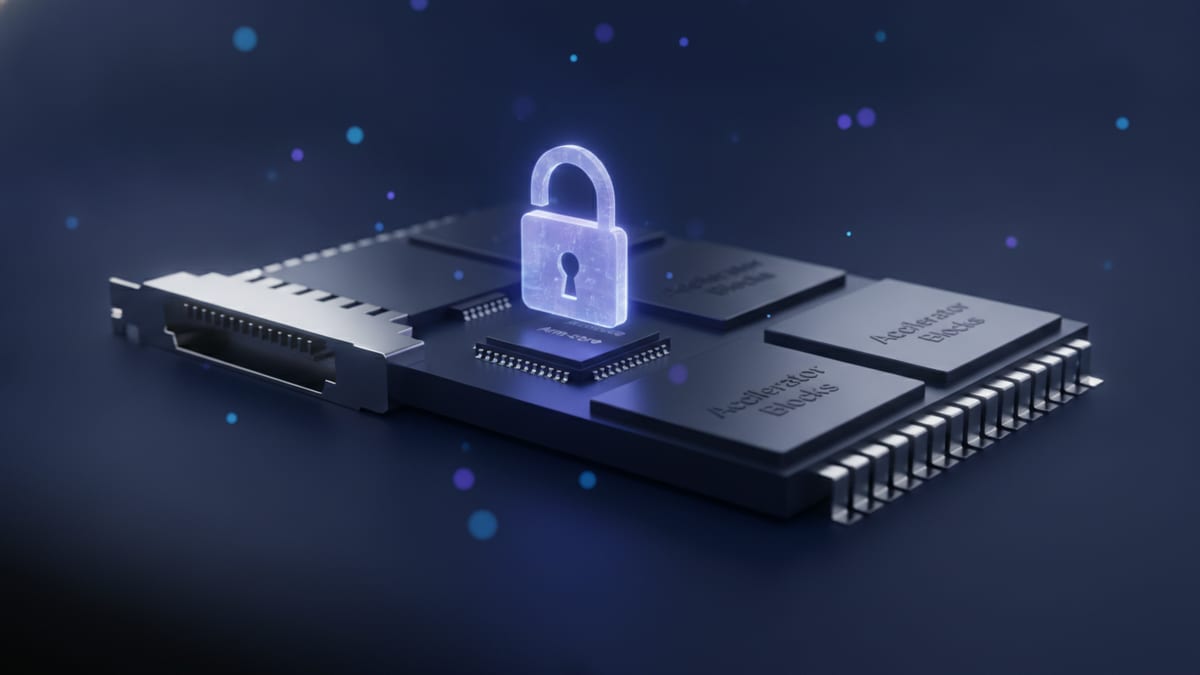
SmartNIC is the older, broader umbrella term for any network card with onboard processing beyond basic packet forwarding. A DPU is the more capable evolution of that idea: analysts at simplyblock describe it as three things bundled into one device — a high-performance NIC, dedicated compute cores (typically Arm-based), and a set of accelerators purpose-built for infrastructure functions. That combination is what lets a DPU run entire services, not just speed up individual packets.
Intel's answer to the category is branded an IPU (Infrastructure Processing Unit), positioned specifically to deliver virtualised network and storage functionality with lower overhead on the host CPU, competing directly with NVIDIA's DPU line. The naming differs by vendor, but the underlying pitch — take infrastructure work off the CPU and isolate it on dedicated silicon — is consistent across the category, as the comparison below shows.
Inside the Card: Architecture and the Isolated Control Plane
Structurally, a DPU has the high-speed NIC silicon that talks to the network, a bank of Arm compute cores that run control-plane software, and dedicated accelerator blocks for jobs like crypto, compression and erasure coding. Sitting underneath all three is a management layer that is genuinely separate from the server's main operating system.
Recent reporting on DPU deployments confirms that the card runs its own Linux kernel, its own management plane, and its own attestation root of trust — completely isolated from the host CPU. In practice this means the DPU's security policies, network state and crypto keys are not visible to, or reachable from, whatever is running on the host, even if that host operating system is compromised.
What Actually Moves Off the CPU
The offload list is longer and more specific than 'faster networking'. On the networking side, DPUs take over packet steering, virtual switching, policy enforcement, overlay handling for protocols like VXLAN and Geneve, load balancing and congestion control — all jobs that would otherwise run as CPU software.
On storage, DPUs handle NVMe-oF initiator and target processing, the associated TCP/IP work, inline crypto for TLS and IPsec, compression, erasure coding and data-integrity checks. On security specifically, offloaded functions include IPsec, TLS termination and MACsec crypto, firewalling, deep packet inspection, zero-trust microsegmentation and data isolation. DPUs also take over hypervisor-adjacent functions, accelerating virtual networks and strengthening isolation between tenants in virtualisation and private cloud environments.
The scale of what's at stake is why one commonly cited estimate — that up to 30% of CPU processing power can be consumed by networking and storage functions — gets repeated across the industry. It is the reason DPUs are pitched as freeing capacity rather than adding it: the CPU cycles were always available, they were just being spent on infrastructure plumbing instead of applications.
Zero Trust by Design: Why This Matters for UK Security Postures
Because the DPU's kernel, management plane and root of trust sit outside the host's control, security functions running on the card cannot be tampered with by anything running on the server itself — including a compromised guest VM or a compromised host OS. That is a structural improvement over software firewalls and microsegmentation running on the same CPU they are supposed to protect, and it underpins genuine enhanced network security architecture rather than a bolt-on policy layer.
For UK enterprises building multi-tenant infrastructure — shared cloud platforms, managed hosting, or internal platforms serving multiple business units — this isolation directly supports zero-trust design: network policy, encryption and inspection continue to be enforced even if a workload on the host is compromised, because enforcement never depended on the host's integrity in the first place.
View the data behind this chart
| Layer | Detail |
|---|---|
| High-performance NIC silicon | Packet steering, virtual switching, overlays |
| Arm compute cores | General-purpose cores for control-plane software |
| Accelerator engines | Crypto, compression, erasure coding, NVMe-oF |
| Isolated management plane | Own Linux kernel and attestation root of trust |
Worked Example: An AI Inference Pipeline and BlueField-4 STX
Consider a GPU cluster running agentic AI inference, where large models repeatedly pull context and data from storage between generation steps. Without a DPU, the host CPU handles NVMe-oF traffic, TLS termination and network policy for every one of those storage round-trips — work that competes for the same CPU cycles and PCIe bandwidth the GPUs need to stay fed. DPUs are positioned specifically to prevent this: by offloading data movement and security tasks, they keep the GPU focused purely on computation rather than infrastructure housekeeping.
NVIDIA's BlueField-4 STX storage architecture, announced at GTC 2026, was built directly to address this bottleneck for agentic AI inference, and is designed to deliver up to five times the token throughput compared with handling that same data-access load without dedicated DPU-class storage acceleration. In a cluster where GPUs are linked by NVLink or InfiniBand interconnects, the DPU sits at the storage and network edge of that fabric, clearing the path so the expensive interconnect and GPU time isn't spent waiting on infrastructure work that never needed the GPU in the first place.
UK and European Market Context: Sizing the Line Item
Europe holds a 28% share of the global DPU market in 2026, against a 39.40% share for North America recorded in 2025 — different years, different regions, but both pointing to the same trend: DPU adoption is no longer a hyperscaler-only story. Within the market, data centre applications account for 65% of DPU deployment in 2026, and 100G-class DPUs alone represent 55% of the market the same year, reflecting where most enterprise and cloud buying is actually concentrated.
Specific GBP pricing for DPU line items isn't yet widely published, but the direction of travel aligns with broader European priorities around secure cloud computing and green data-centre strategy — offloading infrastructure work to a low-power dedicated card is, in principle, a more efficient use of rack power than running the same work as CPU software. Buyers sizing budgets should also treat headline market figures with some caution: Global Growth Insights values the global DPU market at USD 4,502.6 million for 2026, while Fortune Business Insights puts the same year's market at USD 2.63 billion — a reminder that market-sizing methodology varies significantly between analysts, and neither figure should be read as a precise, agreed total.
What's Next: Beyond 2026
Fortune Business Insights projects a 29.8% CAGR for the global DPU market between 2026 and 2034, a growth rate consistent with DPUs becoming a standard rather than optional component in AI and cloud infrastructure. A related but distinct segment — FPGA-based SmartNICs — is separately valued at USD 1.1 billion to 1.8 billion in 2026, underlining that programmable, FPGA-flavoured offload cards remain a meaningful sub-market alongside fixed Arm-core DPU designs.
BlueField-4 STX's focus on agentic AI inference throughput signals where vendor R&D is heading next: storage-side acceleration built specifically for AI data-access patterns, not just generic networking offload. UK buyers evaluating 2026 and 2027 server builds should expect DPU capability to increasingly be discussed alongside other fabric decisions, including Ultra Ethernet and UALink for AI interconnect choices, as infrastructure acceleration becomes a whole-fabric design question rather than a single add-in card.
Sources
Every figure in this article traces to the sources below.
- •Google Cloud — DPU definition and role
- •simplyblock — DPU architecture (NIC + Arm cores + accelerators) and Intel IPU positioning
- •simplyblock / Servermall / LINK-PP / Internet Pros — storage and security offload details
- •Servermall / LINK-PP / Platform9 / simplyblock — virtualisation and multi-tenant isolation
- •Internet Pros / Network-Switch.com — isolated kernel, management plane, attestation root of trust
- •Tom's Hardware — NVIDIA BlueField-4 STX architecture, GTC 2026
- •Premio Inc — up to 30% of CPU power consumed by networking/storage functions
- •Global Growth Insights — Europe/100G/data centre DPU market share, global market size (2026)
- •Fortune Business Insights — global DPU market size, CAGR 2026–2034, North America share
- •HDIN Research — FPGA SmartNIC market valuation 2026
View the data behind this chart
| North America 2025 | Europe 2026 | 100G DPUs 2026 | Data centres 2026 | |
|---|---|---|---|---|
| Market share | %39.4 | %28 | %55 | %65 |