
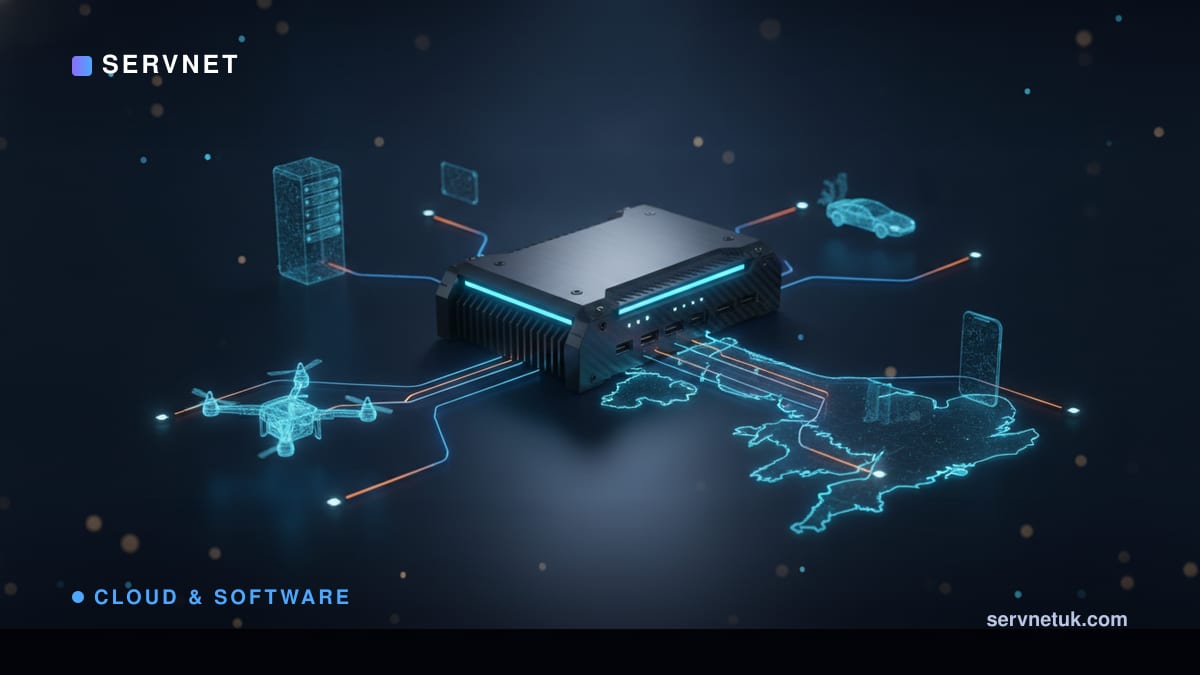
After a decade of moving everything to the cloud, the conversation is quietly swinging the other way. Edge computing means processing data close to where it is created, on a device or a small server on-site, rather than sending it all to a distant data centre first. It sounds like a step backwards, but it is a sensible response to a world with cameras, sensors and machines generating more data than it makes sense to ship anywhere. This piece explains what edge computing is, why it is suddenly everywhere in 2026, where it genuinely helps a UK business, and how it works alongside, not against, the cloud.
Edge computing in plain terms
For years the model was simple: data was created somewhere, sent to the cloud or a central data centre to be processed, and the answer came back. That works beautifully for email and spreadsheets, but it starts to strain when the data is huge, constant or time-critical. Edge computing flips the order by doing the processing where the data is born, on the device itself or on a small server in the same building, and only sending onward what truly needs to travel.
The edge simply means the outer reaches of your network, away from the central core, the shop floor, the retail till, the camera, the factory machine. Putting a little computing power out there, rather than hauling every byte back to a central location, is the whole idea. It is less a replacement for the cloud than a redistribution of where the thinking happens.
Why everyone is talking about it now
The timing is not an accident. Three forces have converged to push processing back towards the edge, and together they explain why it has moved from niche to mainstream conversation in 2026.
What changed:
- •An explosion of connected devices, cameras and sensors generating far more data than is worth sending anywhere
- •Practical on-device AI that needs to react in real time, where a round trip to the cloud is too slow
- •Cheaper, more capable small and rugged servers that can run real workloads outside a data centre
- •Rising awareness of data-transfer costs and the privacy benefits of keeping sensitive data local
Where edge genuinely helps
Edge computing earns its place wherever distance to a data centre causes a real problem. The clearest case is speed: a safety system, a production line or a checkout cannot wait for a round trip to the cloud, and processing on-site gives an instant answer. The next is the sheer volume of raw data, where it is far smarter to analyse a camera feed locally and send only the useful summary than to stream everything.
Two more drivers matter for UK businesses in particular:
- •Reliability: an on-site system keeps working through an internet outage, instead of stopping dead
- •Cost: filtering data locally slashes how much you transfer and store centrally
- •Privacy and residency: sensitive data can be processed and kept on-site rather than leaving the premises
- •Real-time response: machines, tills and safety systems react immediately, with no network round trip
Edge and cloud are partners, not rivals
It is tempting to frame edge as the cloud's replacement, but that misreads it. The two work as a team: the edge handles the immediate, local, time-sensitive processing, while the cloud or a central data centre still does the heavy lifting that benefits from scale, long-term storage, big-picture analysis and coordinating many sites at once. A typical pattern processes data at the edge for an instant local reaction, then sends a distilled summary up to the cloud for reporting and trends.
This is really an extension of the hybrid cloud mindset, just stretched out to the very edge of your network. The skill is deciding what belongs where, the same per-workload thinking that runs through every cloud decision. Hardware vendors have responded with purpose-built kit for these locations, such as the rugged systems covered on our HPE Edgeline page.
Is edge computing relevant to you?
Edge becomes relevant the moment your business generates data away from a central location and either needs to act on it fast, produces too much of it to ship economically, or must keep working when the connection drops. Retail with smart cameras and tills, manufacturing with sensor-laden machines, logistics, healthcare sites and anywhere with branch operations are the obvious candidates.
If none of that describes you, edge may simply not be your concern yet, and that is fine; it is a tool for a specific shape of problem, not a mandate. If it does, the practical question is what hardware sits at each location and how you manage and protect it remotely. That is a sizing and resilience conversation, and the right starting points are our server configuration service and the guide to rugged edge compute.