
In 2026, the number that ends the air-cooling debate is blunt: NVIDIA's B200 GPU already draws 1,000W of thermal design power, with the coming B300 and AMD MI355X projected at 1,400W — loads no fan array can shift efficiently. Direct-to-chip liquid cooling routes coolant through channels machined into a cold plate bolted to the die, pulling heat away with 10-20 times the efficiency of air. For UK operators weighing their first GPU node, understanding the cold-plate loop, the CDU sat between server and facility water, and where the pipework actually goes is now a procurement decision with a measurable ROI, not engineering trivia.
View the data behind this chart
| Air-Cool | Direct-t | |
|---|---|---|
| Low-end kW | kW15 | kW50 |
| High-end kW | kW35 | kW100 |
Why 2026 is the year plumbing beats fans
Chip power has outrun air's physics. NVIDIA's B200 sits at 1,000W of thermal design power, and the next generation — B300 and AMD's MI355X — is projected to reach 1,400W per chip. Air cooling was already struggling at 15-35 kW per rack; direct-to-chip liquid cooling routinely supports 50-100 kW per rack, which is the density band most serious AI clusters now live in.
Because a single direct-to-chip rack at 50-100 kW can replace roughly three to seven air-cooled racks each capped at 15-35 kW for the same aggregate power, operators can consolidate compute into a smaller physical footprint or pack significantly more capacity into an existing hall — a meaningful lever where UK data centre floor space and expansion permissions are hard to come by.
This isn't a niche upgrade anymore. The global data centre liquid cooling market is projected to grow from USD 4.07 billion in 2026 to USD 27.65 billion by 2033, a 31.5% CAGR, with CoolIT Systems, Vertiv, Schneider Electric, Asetek and ZutaCore among the vendors building it out. If your roadmap includes GPU accelerators at this power class, the plumbing question arrives whether you plan for it or not.
How the cold-plate loop actually works
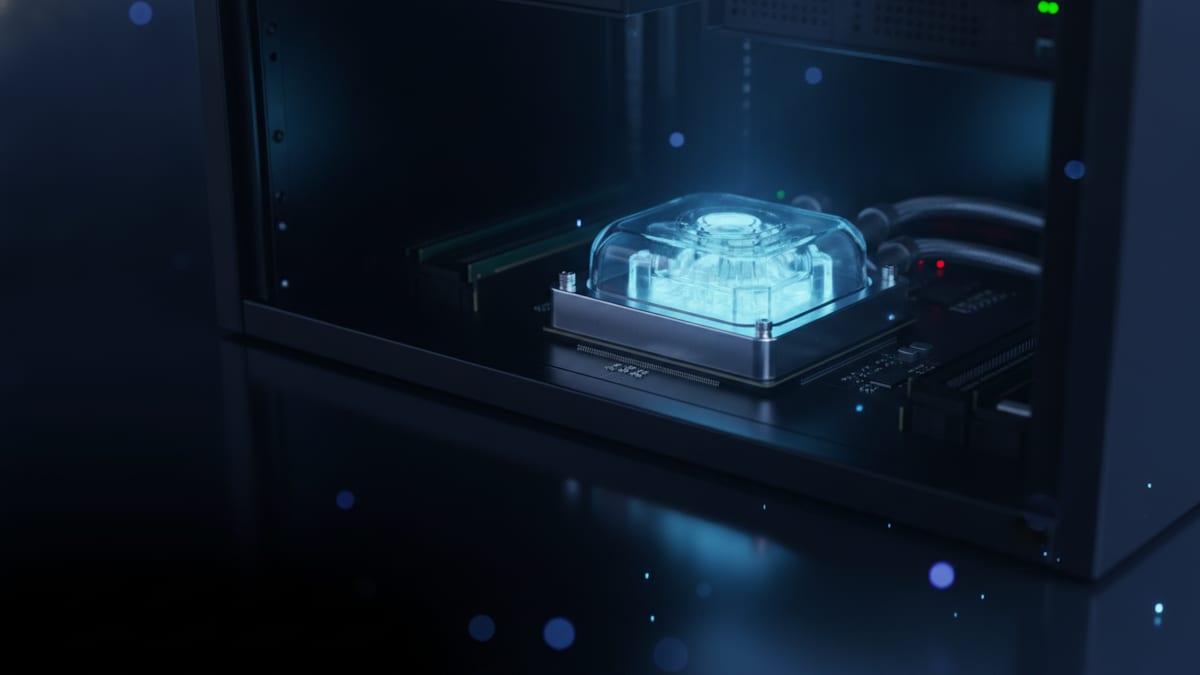
A cold plate is a metal block, machined with internal micro-channels, bolted directly onto the CPU or GPU package in place of a heatsink. A dielectric fluid or specialised liquid coolant is pumped through those channels and absorbs heat directly from the chip surface — this direct contact is why the heat-transfer efficiency is 10-20 times higher than blowing air across a heatsink fin.
A pump or circulator then pushes that now-heated coolant out of the server and into a coolant distribution unit (CDU). As of mid-2026, single-phase operation — where the coolant stays liquid throughout the entire cycle — is the dominant architecture for AI clusters, according to Dell'Oro Group. Two-phase designs, where the fluid changes from liquid to vapour and back, absorb more heat per litre but add mechanical complexity, so they're reserved for the most extreme heat-density cases rather than general deployment.
Inside the CDU: the component most buyers overlook
The CDU is the unglamorous heart of the system. It's a heat exchanger that separates two loops: the secondary loop, which is the closed circuit running through the servers and cold plates, and the primary loop, which is the facility's main cooling water. Keeping them separate matters — it stops facility-side water quality, pressure or contaminants from ever touching the electronics.
CDUs come in two flavours. Liquid-to-liquid (L2L) units exchange heat with the building's chilled water system directly. Liquid-to-air (L2A) units instead dump that heat into the data hall air, which lets a liquid-cooled GPU node sit inside an otherwise air-cooled facility — a genuinely useful bridge for UK sites not ready to run chilled water pipework to the rack. From there, the facility water system rejects the heat outside via cooling towers or dry coolers. Worth noting: NVIDIA's HGX platforms often ship with factory cold-plate options built in, whereas retrofitting older air-cooled GPU nodes typically needs third-party integration.
Coolant types and how to choose
Two decisions sit inside "liquid cooling": what fluid, and how many phases. Single-phase coolant remains liquid end-to-end — simpler pumps, simpler CDUs, easier to service, and it's why single-phase is the default choice for standard AI GPU racks today. Two-phase systems trade that simplicity for greater heat-absorption capacity by letting the fluid boil and condense, which suits specialised extreme-density workloads but demands more careful pressure and leak management.
The practical selection criteria for a UK buyer are workload density, facility readiness, and appetite for engineering complexity. If you're deploying standard 8-GPU nodes, single-phase with an L2A or L2L CDU is the well-trodden path. Two-phase is a conversation for teams pushing well beyond typical rack densities, not a default starting point.
The hard numbers: PUE, throughput and ROI
Efficiency is where direct-to-chip earns its keep. System-level PUE for liquid-cooled deployments runs 1.05-1.30, against 1.5-1.8 for traditional air-cooled facilities — a facility-level metric covering total power divided by IT power. Separately, at facility level, significant cooling system energy consumption reductions, often cited by industry sources in the range of 30-50% versus typical air-cooled operations, have been reported. This contributes to the overall PUE improvements, which themselves indicate total facility power savings of approximately 28-30% when moving from air-cooled PUEs of 1.8 to liquid-cooled PUEs of 1.3. At node level, an 8x NVIDIA HGX GPU system cooled with direct-to-chip uses roughly 1 kW less power — a 16% reduction — than its air-cooled equivalent; that's a distinct, smaller-scope figure from the facility number and shouldn't be conflated with it.
There's a performance dividend too: liquid-cooled GPUs run at 46-54°C versus 55-71°C for air-cooled units, and Supermicro reports this translates into up to 17% higher computational throughput — cooler silicon simply clocks faster for longer. On cost, the CAPEX premium for direct-to-chip versus air is USD 2,500-4,500 per kW, covering cold plates, CDUs and pipework. Against that, five-year TCO savings of 22-35% have been modelled, with payback in 24-36 months for facilities paying above $0.12/kWh for electricity. Specific GBP figures for UK deployments aren't published in current market data, but UK commercial electricity pricing sits well within the range where that payback window applies, which is why rack power density planning now routinely includes a cooling-loop line item.
View the data behind this chart
| Single-Phase D2C | Two-Phase D2C | Immersion | |
|---|---|---|---|
| Market status mid-2026 | Dominant for AI | Niche/specialised | Emerging option |
| System complexity | Lower | Higher | Highest |
| Best-fit scenario | Standard GPU racks | Extreme density chips | New-build liquid-first |
| Integration into air | Easy via L2A CDU | Moderate | Major overhaul |
Implementation realities: leaks, retrofit and phased adoption
Fluid management and leak detection are treated as core engineering disciplines for high-density AI deployments, not afterthoughts — sensors, quick-disconnect fittings and drip trays are standard practice in modern designs rather than optional extras. The realistic failure points to plan around are connector leaks at the cold plate, pump wear in the secondary loop, and CDU heat-exchanger fouling over time; all three are addressed through routine service contracts and redundant pumping in serious deployments.
For UK sites not ready to rip out air handling, the L2A CDU is the practical bridge: it lets a liquid-cooled GPU rack sit inside an existing air-cooled hall without a facility-wide chilled-water retrofit. A sensible phased path is to pilot one liquid-cooled rack with an L2A CDU, validate leak-detection and service procedures, then move to L2L and facility water once the density of the wider estate justifies it. Our server room cooling calculator is a reasonable starting point for sizing that first pilot.
Direct-to-chip vs immersion cooling: an honest comparison
Direct-to-chip only cools the components generating the most heat — CPUs and GPUs — leaving the rest of the server in air, which is why it integrates more easily into existing rooms via an L2A CDU. Immersion cooling instead submerges the entire server in dielectric fluid, which is a more radical infrastructure change but can suit facilities designed around it from the outset.
Neither is universally "better" — the right choice depends on whether you're retrofitting an existing air-cooled hall (favouring direct-to-chip's lighter integration footprint) or building new capacity around a liquid-first design (where immersion becomes a genuine option). For a deeper technical breakdown of the trade-offs, see our separate piece on liquid vs immersion cooling, and for the broader question of whether you need liquid at all, our guide to air vs liquid cooling covers the decision point before you commit to either.
Decision framework: does your first GPU node need plumbing?
The trigger point is straightforward: if your GPU generation sits at or above the 1,000W-per-chip TDP of NVIDIA's B200, or your target rack density exceeds the roughly 35 kW ceiling of air cooling, direct-to-chip stops being optional. Below that, air remains a legitimate choice for now.
Weigh the USD 2,500-4,500 per kW CAPEX premium against your electricity price and expected utilisation — the 24-36 month payback figure quoted for sites above $0.12/kWh is a useful sanity check for UK commercial rates. Beyond direct cost, lower PUE supports UK sustainability reporting, and the CDU's separation of secondary and primary loops opens the door to waste-heat reuse initiatives some UK sites are exploring alongside net-zero commitments. Start with a single L2A-CDU pilot rack, prove the leak-detection and service process, then scale to L2L as density demands it.
Sources
Every figure in this article traces to the sources below.
- •Park Place Technologies — cold plate mechanics and two-phase complexity
- •Wecent — heat transfer efficiency, PUE range, rack density, TCO savings
- •Trane Commercial HVAC — CDU function and L2L/L2A architecture
- •SLYD — GPU TDP figures for B200, B300 and MI355X
- •Supermicro — node-level power savings and GPU temperature/throughput data
- •Dell'Oro Group — single-phase as dominant AI cluster architecture
- •XD Thermal — leak detection and fluid management engineering practice
- •Astute Analytica — key vendors in direct-to-chip liquid cooling
- •Data Center Cooling 2026: Liquid Immersion vs Air — CAPEX premium, HGX cold plate options
- •Data Center Liquid Cooling Market Report 2026-2033 — market size and CAGR