
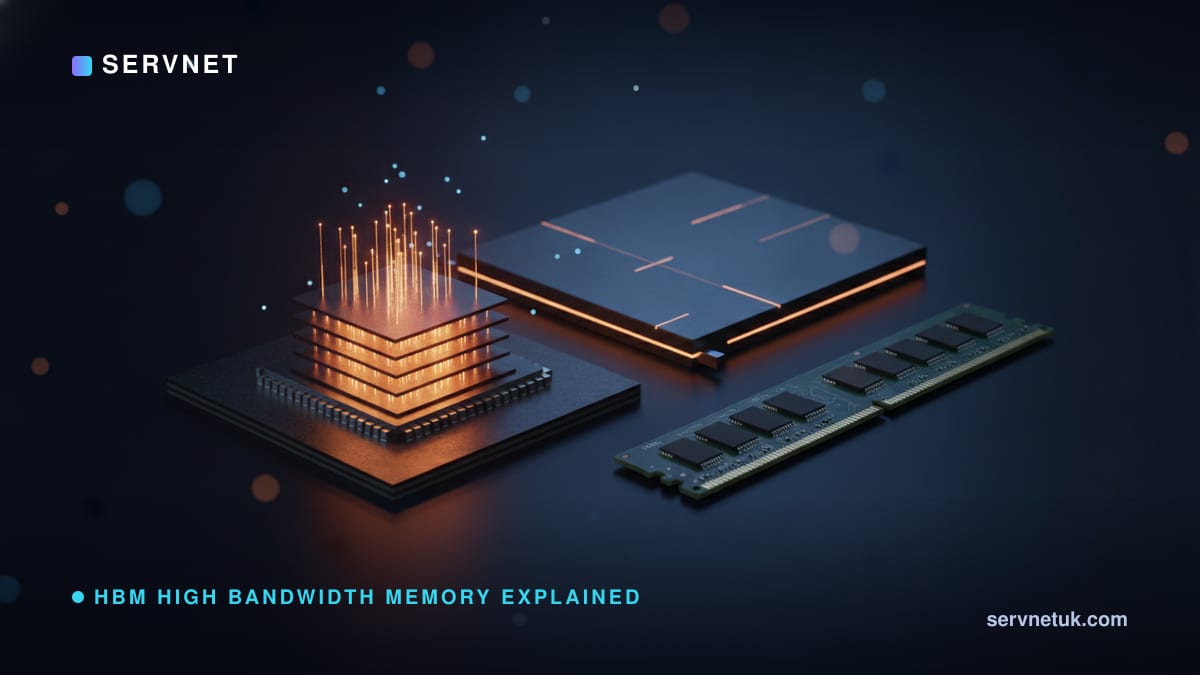
High Bandwidth Memory (HBM) sounds like a niche chip spec, but in 2026 it is the reason your next server or laptop refresh costs more. HBM stacks DRAM dies vertically and wires them together with microscopic Through-Silicon Vias, so an AI accelerator can pull data at bandwidths conventional DDR5 cannot approach. Demand from hyperscale AI buildouts is so intense that conventional DRAM contract prices jumped 90-95% quarter-on-quarter in Q1 2026, according to TrendForce, largely because HBM production consumes roughly three times the wafer capacity of a standard DDR5 chip — starving the rest of the memory market. This explainer sets out precisely what HBM is, how the physics work, what it costs against DDR5, and what UK IT buyers should do about a memory market that isn't easing before 2027.
View the data behind this chart
| Q1 2026 | Q2 2026 | Q3 2026 | |
|---|---|---|---|
| Low end of range | %90 | %58 | %13 |
| High end of range | %95 | %63 | %18 |
What HBM actually is
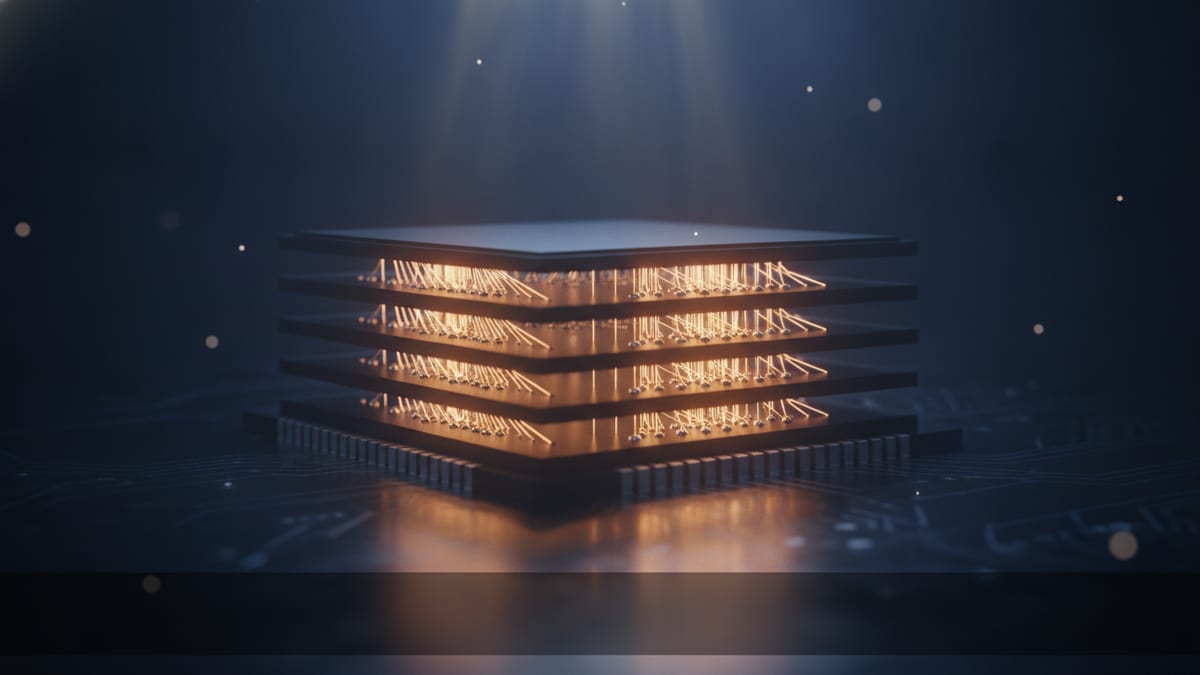
High Bandwidth Memory is a 3D-stacked synchronous DRAM interface, originally developed jointly by Samsung, AMD and SK Hynix. Instead of mounting individual memory chips flat on a circuit board the way DDR5 modules do, HBM stacks multiple DRAM dies directly on top of one another — current HBM3 designs go up to 16 layers — and links every layer using Through-Silicon Vias and microbumps: microscopic vertical wires drilled straight through the silicon.
That stack then sits on a silicon interposer immediately next to the GPU or accelerator die, rather than several centimetres away across a motherboard. The payoff is bus width. HBM1 launched with a 1024-bit interface; HBM4 is pushing that to 2048 bits. A DDR5 module, by contrast, communicates over a comparatively narrow, longer path. Wider bus, shorter distance, more layers stacked in parallel — that combination is the entire reason HBM exists.
The memory wall — and how the stack attacks it
For years, processor compute capability has outpaced the rate at which memory can feed it data — the classic 'memory wall'. A GPU with idle compute cores waiting on data is a GPU wasting power and money. HBM's answer is architectural rather than purely electrical: a very wide interface, physical proximity to the compute die, and 3D stacking of DRAM layers combine to increase bandwidth, cut latency, improve power efficiency and shrink footprint relative to older memory types like DDR4 or GDDR5.
For AI training and inference this matters directly: faster data access and retrieval keeps GPU utilisation consistent during machine learning training rather than letting expensive accelerator silicon sit idle between batches. That is why every serious AI accelerator on the market now specifies HBM rather than conventional DRAM, and why anyone sizing a cluster with our AI GPU sizing calculator will see memory bandwidth, not just core count, drive the recommendation.
HBM3, HBM3E and HBM4 compared
The generational story in 2026 is a handover in progress. HBM3E is expected to account for roughly two-thirds of total HBM shipments in 2026 — the volume workhorse — while HBM4 gradually takes share. HBM4's 2048-bit interface and expected 1.5-2 TB/s of bandwidth per stack mark a genuine step up, and TrendForce expects it to become mainstream in the second half of 2026, with platform validation completing around Q2 2026.
None of this comes cheap. HBM carries a 5-6x cost premium over equivalent DDR5 capacity, and that gap is not narrowing — HBM prices overall are up 20-40% year-over-year, with HBM3E supply contracts raised by nearly 20% in late 2025 specifically for 2026 delivery. The table below sets out what's verified for each generation.
Why HBM is genuinely hard to manufacture
Stacking sixteen dies and wiring them with TSVs is not a simple scaling exercise. It requires wafer thinning, precision via drilling and die-to-die alignment tolerances far tighter than conventional DRAM production, and yields currently run at 50-60% — meaningfully below standard DRAM yields. Every HBM stack that comes off the line has already 'cost' more silicon than a working DDR5 chip of equivalent output.
Worse for the rest of the market, HBM production is what one industry analyst bluntly calls a 'wafer hog': it requires roughly three times the wafer space of a standard DDR5 chip. Every fab cycle a manufacturer dedicates to HBM is capacity it isn't spending on general-purpose DRAM. Demand is currently growing faster than supply can respond, and expanding fab capacity takes 12-18 months of lead time — which is precisely why SK Hynix has reported its HBM, DRAM and NAND capacity sold out through the end of 2026.
Supply itself is concentrated: SK Hynix, Samsung and Micron collectively control over 95% of global HBM output, an oligopoly with SK Hynix alone holding 62% share of HBM shipments as of Q2 2025, driven by early NVIDIA platform qualification and its head start in HBM3E production. The available data shows no meaningfully sized alternative supplier or open standard positioned to challenge that concentration in the near term — buyers are, for now, price-takers in a three-vendor market.
The 2026 price crunch, in numbers
HBM demand is forecast to grow 70% year-over-year in 2026, pushing the total HBM market to an estimated $54.6 billion in revenue. Hyperscale cloud providers — spending approaching $600 billion on AI infrastructure in 2026 — sit first in line for allocation, frequently locking in multi-year supply agreements that push everyone else further down the queue.
That squeeze has spilt over into conventional memory pricing. Conventional DRAM contract prices rose 90-95% quarter-on-quarter in Q1 2026, then a further 58-63% in Q2 2026. NAND Flash contract prices are forecast to rise 70-75% quarter-on-quarter in Q2 2026. Analysts expect the pace to ease in Q3 2026 — DRAM contract prices forecast at 13-18% QoQ, NAND at 10-15% QoQ — but pricing is expected to stay elevated through 2027.
View the data behind this chart
| Layer | Detail |
|---|---|
| Silicon Interposer | Wide bus: 1024-bit (HBM1) to 2048-bit (HBM4) |
| TSV + Microbump Interconnect | Vertical wiring through stacked silicon dies |
| DRAM Layers (up to 16, HBM3) | Connected via microscopic TSVs and microbumps |
| Logic Base Die | Interfaces to GPU/accelerator via interposer |
Worked example: sizing a UK AI cluster in this market
Picture a UK research team specifying an 8-GPU training server, each accelerator fitted with HBM4 stacks delivering 1.5-2 TB/s of bandwidth. Run that spec through our AI GPU sizing calculator alongside a hypothetical DDR5-only equivalent and the memory line item alone comes out 5-6 times higher for the HBM configuration — before even factoring in that every HBM wafer used has displaced roughly three DDR5 wafers' worth of general fab capacity, capacity the rest of the market is now fighting over amid a 90-95% quarter-on-quarter DRAM price jump.
That is precisely why NVIDIA DGX and comparable systems command such a premium, and why anyone finalising a server configuration in mid-2026 needs to model the memory bill separately from the compute bill rather than assuming historical DDR5-based pricing still applies.
What this means beyond the data centre
European enterprise IT buyers are facing compounding double-digit price increases for laptops and desktops throughout 2026, a direct consequence of HBM diverting fab capacity away from general-purpose DRAM. That is likely to delay hardware refresh cycles and slow adoption of AI PCs across UK organisations. Laptop RAM and SSD costs are rising in step, and many 2026 laptop models are arriving either more expensive or less generously specified than their predecessors.
The sharpest risk sits with premium laptops that use soldered memory: choosing an insufficient RAM configuration at purchase can lock in a limitation for the device's entire working life, because there is no upgrade path afterwards. Finance and procurement teams should be running refresh decisions through our IT finance calculator now, rather than assuming 2025-era pricing when budgeting 2026 and 2027 replacement cycles.
Where this settles, and what to do now
The trajectory that's verified: HBM3E remains the 2026 volume workhorse at roughly two-thirds of shipments, HBM4 becomes mainstream from the second half of 2026, and price growth is expected to moderate somewhat in Q3 2026 without disappearing — strong pricing is expected to persist through 2027. Because HBM sits soldered onto the accelerator package rather than in a modular DIMM slot, capacity decisions made at procurement time are effectively permanent for that hardware's service life, unlike a DDR5 server where memory can be added later.
Given a supply chain controlled by three vendors, with SK Hynix's HBM, DRAM and NAND capacity reported sold out through the end of 2026 and strong demand expected to persist into 2027, and no alternative technology currently visible in the data to disrupt that concentration, the practical move for UK buyers is to size generously the first time and to model total cost of ownership — power, cooling, footprint, and the memory premium itself — before committing. If you're weighing an HBM-heavy AI build against a more conservative DDR5-based estate, or reassessing your virtualisation stack amid the wider cost pressure following the Broadcom VMware licensing changes, it's worth a conversation before you sign a purchase order — talk to a Servnet engineer.
Sources
Every figure in this article traces to the sources below.
- •Lam Research Newsroom — HBM definition, TSV/stacking architecture, and bandwidth/latency/power benefits vs DDR4/GDDR5
- •Abhik Sarkar — HBM bus width evolution (1024-bit to 2048-bit)
- •Mordor Intelligence — HBM manufacturer oligopoly, >95% collective share
- •Counterpoint Research — SK Hynix 62% HBM share, Q2 2025
- •SK hynix — HBM3E ~2/3 of 2026 shipments; HBM market $54.6bn revenue
- •TrendForce — HBM4 spec, validation and mainstream timing
- •Unibetter — HBM yields (50-60%) and wafer-space consumption (3x DDR5)
- •Silicon Analysts — HBM demand/supply gap, cost premium, price growth trajectory
- •CSSI Technologies LLC — SK Hynix capacity sold out through 2026; hyperscaler capex ~$600bn
- •TrendForce — conventional DRAM contract price rises, Q1-Q2 2026