
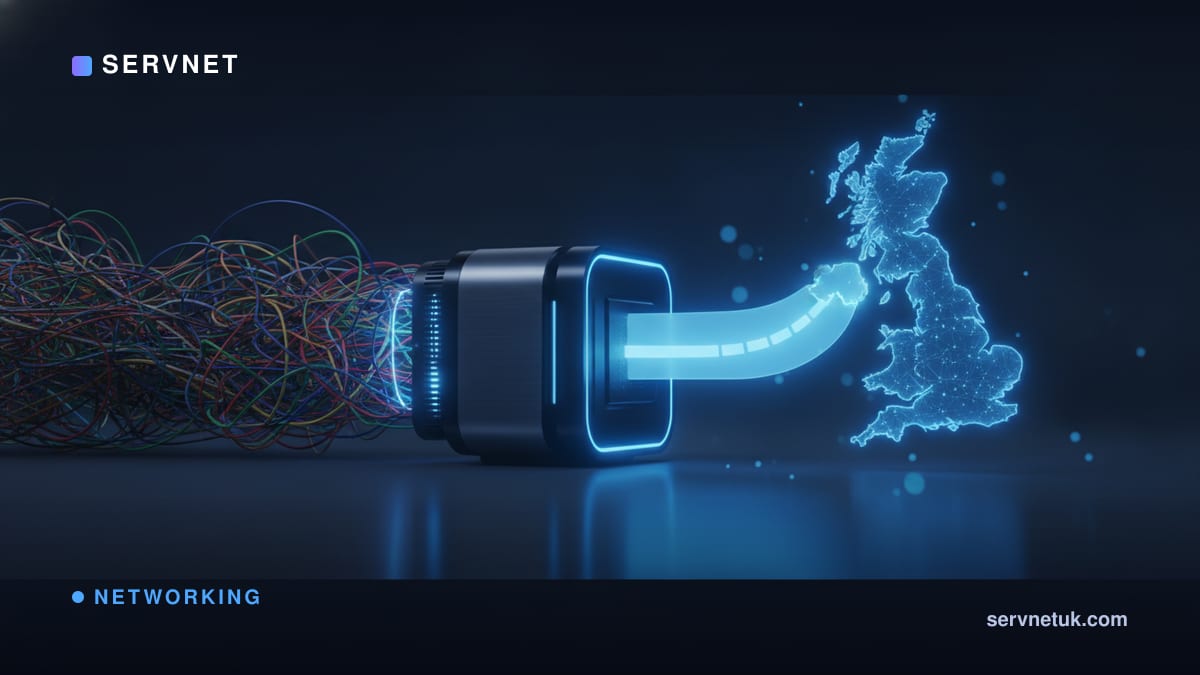
SD-WAN is one of the most over-jargoned terms in business IT, usually explained by people who seem keen for you not to understand it. Strip away the acronyms and it is a simple idea: software that decides, second by second, the smartest way to send your traffic across whatever internet connections you have - so multiple sites stay fast, resilient and cheaper to run. If your firm has more than one location, this is worth ten minutes.
First, what is a WAN?
A LAN - local area network - is the network inside one building. A WAN - wide area network - is what links your buildings together: head office, branches, the warehouse, maybe staff working from home. For decades, joining sites meant renting expensive private circuits (you may have heard 'MPLS') from a telecoms provider.
Those private lines were reliable but pricey and slow to change. Want to open a new branch? Wait weeks for a circuit. SD-WAN is the modern answer to that frustration, and the 'SD' simply means software-defined.
The core idea, with an analogy
Imagine a delivery dispatcher with several routes between two towns: a motorway, an A-road and a back lane. A traditional setup always uses the same road, even when it is jammed. A smart dispatcher watches live traffic and sends each van by whichever route is best right now - and splits the load so nothing waits behind a crash.
SD-WAN is that dispatcher for your data. It pools the connections you have - business broadband, a leased line, even 4G/5G - and continuously sends each type of traffic down the best available path. It also reroutes instantly if a line degrades or drops, so a video call does not freeze when one connection wobbles.
Why businesses actually adopt it
The benefits are practical and tend to show up on the finance and the helpdesk side at the same time.
- •Resilience: if one internet line fails, traffic shifts to another automatically - often without anyone noticing.
- •Cost: cheaper broadband and mobile connections can replace or supplement costly private circuits.
- •Performance for what matters: it can prioritise voice and video over, say, a large file upload, so calls stay clear.
- •Direct cloud access: branches reach Microsoft 365 and other cloud apps over local internet, instead of hauling everything back to head office first.
- •Faster change: adding a site is a configuration job, not a wait for a new physical circuit.
What it is not
SD-WAN is not a single product you buy off a shelf, and it is not magic that makes a slow line fast - it makes better use of the lines you have. It also is not, by itself, complete security, although the two are increasingly bundled.
That bundling has a name worth knowing: SASE, which combines SD-WAN's smart routing with cloud-delivered security so remote sites and home workers get both at once. We compare the leading options in our SASE platform guide. For now, just know that 'SD-WAN' and 'SASE' are related but not identical - one moves traffic well, the other adds the security layer.
Is it right for your business?
SD-WAN earns its place when you have multiple sites, are leaning heavily on cloud apps, or are tired of paying for private circuits that are awkward to change. A single-site business with one good connection rarely needs it.
If it does fit, the route in usually depends on the kit and relationships you already have - which is why most firms pick a platform from a vendor they or their provider already use, such as Cisco or Fortinet. The deeper, vendor-by-vendor decision lives in our three-way SD-WAN comparison; this article is the plain-English version of why you would care in the first place.