
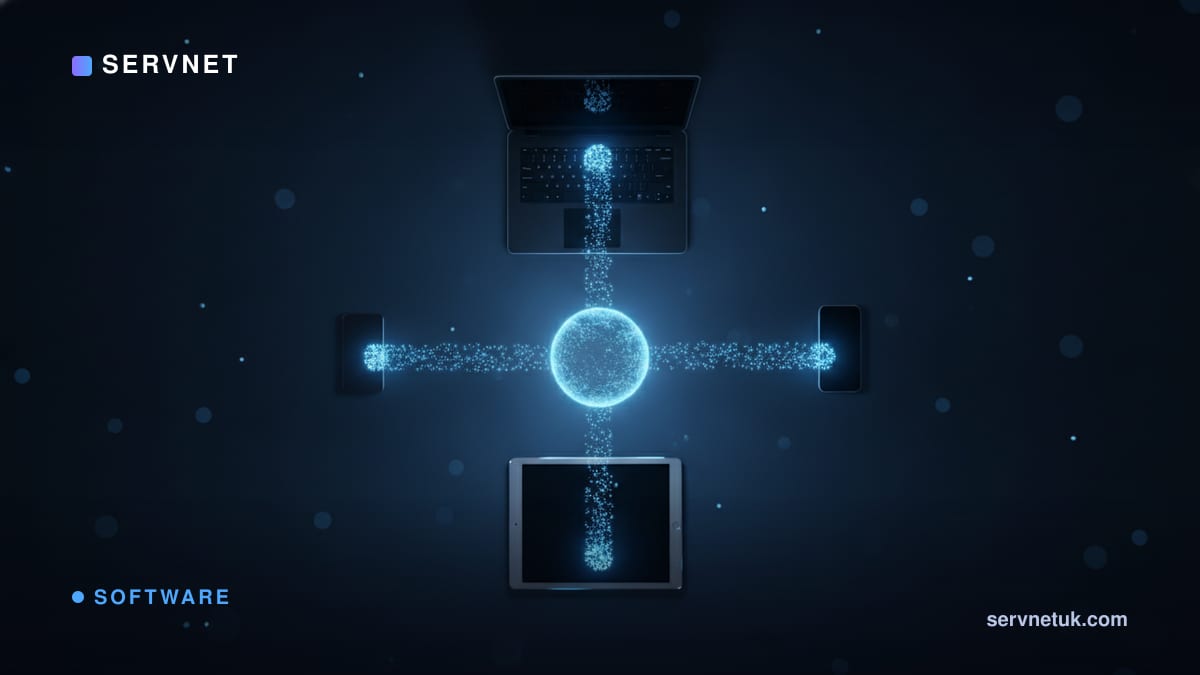
Microsoft Intune is one of those tools your IT provider mentions and you nod along to, without quite knowing what it does or why it appears on your bill. In plain English, it is how a business manages and secures all its laptops and phones from one central place - especially the ones scattered across home offices and coffee shops. If your staff work anywhere, Intune is how you keep some control without standing over their shoulders.
The plain-English definition
Microsoft Intune is a cloud service for managing your company's devices - laptops, desktops, phones and tablets - and the apps and data on them, all from a single dashboard, no matter where those devices physically are.
The category name is 'endpoint management' or sometimes MDM, mobile device management. The 'endpoint' is simply any device a person uses to do their work. Intune lets you set rules, push software, enforce security and, if needed, wipe a lost device - centrally, over the internet, without ever touching the machine in person. That last part is the whole point in an age of remote work.
What it actually lets you do
Stripped of the jargon, Intune handles the device chores that are tedious-but-critical and impossible to do by hand once you have more than a handful of staff.
- •Set security rules: require a PIN or password, enforce encryption, and block devices that fall out of compliance from reaching company data.
- •Deploy software and settings: push the apps, Wi-Fi, email and configuration a new starter needs, automatically, on day one.
- •Protect company data on personal phones: keep work email and files in a managed bubble without taking over someone's own device.
- •Remotely wipe a lost or stolen device: erase company data - or the whole machine - before it falls into the wrong hands.
- •Onboard new laptops hands-free: ship a sealed laptop to a home worker that sets itself up the moment they log in.
Why it matters now: the office walls are gone
Intune solves a problem that barely existed fifteen years ago. Back then, every device sat in the office behind the company firewall, and IT could walk over to fix it. Today your staff, and their laptops, are everywhere.
That scattering broke the old model of security and support. You can no longer assume a device is on your network, physically reachable, or even in the same country. Intune is the answer: it manages and protects devices over the internet wherever they are, so a laptop in a spare bedroom can be as controlled and secure as one that used to sit in the office. It is the device-side companion to the wider shift towards Zero Trust security, where trust is never assumed from location alone.
Do you already have it - and how it fits
Here is the part that surprises people: many businesses already own Intune and are not using it. It is bundled into Microsoft 365 Business Premium and the Enterprise plans, which we break down in our Microsoft 365 plans guide.
If you pay for Business Premium, Intune is sitting in your subscription right now. It works hand in glove with Microsoft Entra (the identity side - the accounts and logins) to make decisions like 'allow this login only from a compliant, encrypted device'. That pairing - manage the device with Intune, manage the identity with Entra - is the backbone of modern endpoint security and identity and access management for a Microsoft-based business.
Is it worth setting up?
For almost any business with remote or hybrid staff and Microsoft 365, the answer is a confident yes - particularly if you are paying for Business Premium and therefore already own it. The benefit is real control and security over a fleet you can no longer physically reach, plus a far smoother experience when onboarding new starters or replacing lost kit.
The honest caveat is that Intune rewards proper setup. Configured well, it is largely invisible to staff and a relief to manage; configured carelessly, it can lock people out or apply rules that get in the way. It is worth doing deliberately, ideally with someone who has set it up before. Pair it with the basics that make any device estate safer - multi-factor authentication, modern protection beyond traditional antivirus as covered in EDR vs antivirus, and a sensible plan for the laptops themselves, whether you are buying business laptops or refreshing what you have.