
🖥️ Raritan KX III G2 vs Vertiv HMX 8000
Dominion KX III G2 vs Avocent HMX 8000 compared across 24 matched specifications — scores, the full spec table and a verdict.
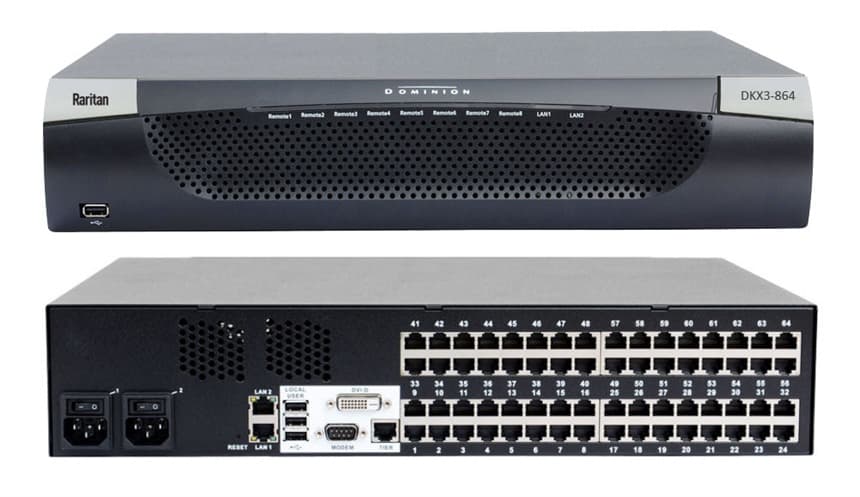
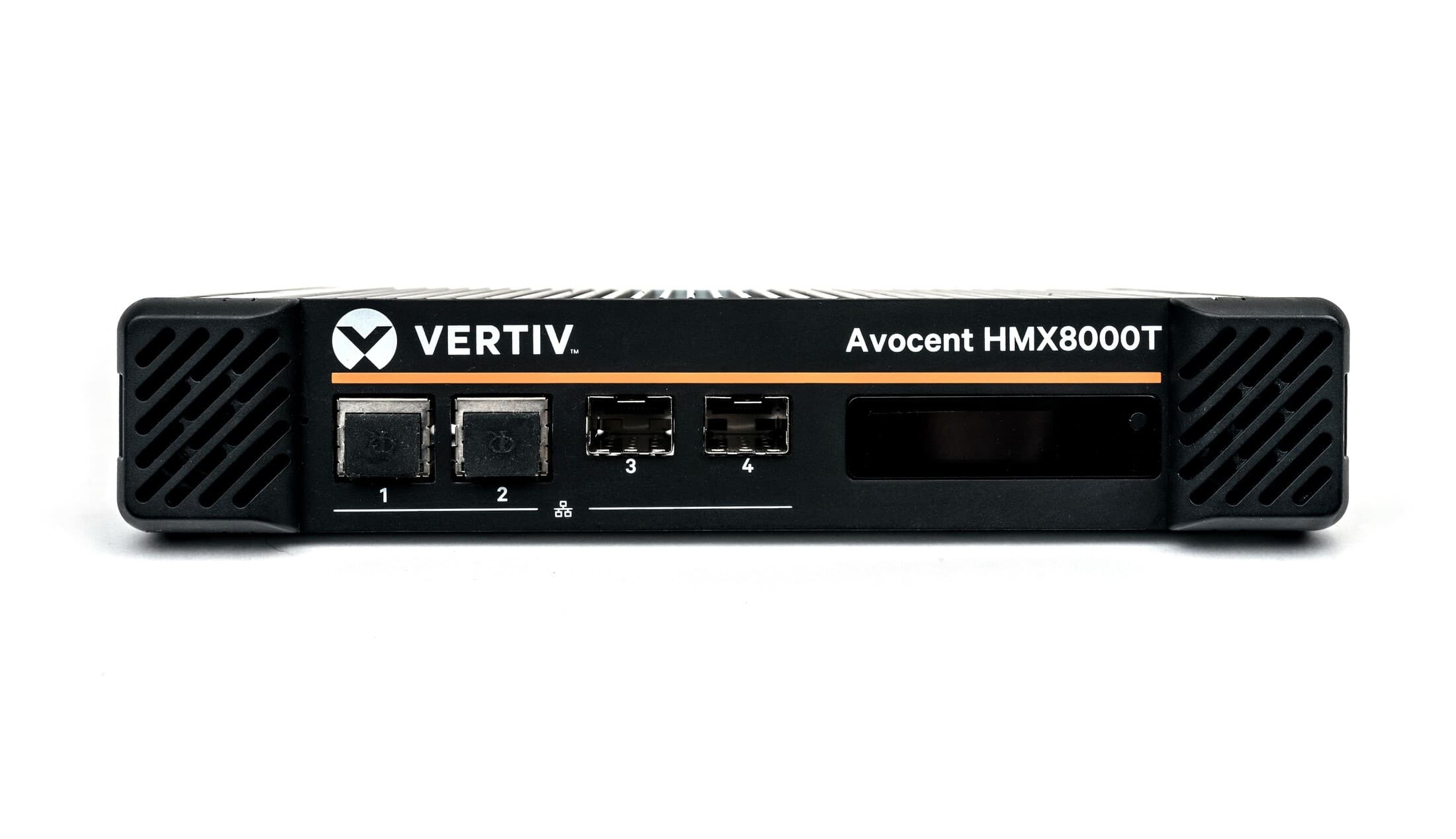
Raritan KX III G2 vs Vertiv HMX 8000: performance overview
Scores based on quantifiable specification values (1-10 scale)
Detailed Specifications
| Specification | Dominion KX III G2 Raritan | Avocent HMX 8000 Vertiv |
|---|---|---|
| Key Metrics | ||
| Architecture | Matrix KVM-over-IP switch (centralised) | Point-to-point / matrix IP KVM extender (distributed) |
| Maximum video resolution | 1080p at 30fps | 4K UHD, pixel-perfect lossless |
| Server ports per appliance | 8, 16, 32, 48 or 64 in 1U | -- |
| Concurrent remote users per switch | Up to 8 | Multiple workstations per target via multicast |
| Network transport | Dual Gigabit Ethernet (copper) | 10 Gbps fibre |
| Target-switching latency | -- | Under 1 second |
| Port density & connectivity | ||
| Server video interfaces supported | HDMI, DVI, DisplayPort, USB-C (via CIMs) | DisplayPort / HDMI / DVI via transmitter modules |
| Transmitter form factor | Per-server CIM dongle, cabled back to 1U switch | Zero-U transmitter mounted directly to server |
| Cascading / scale-out | Tiered cascading to 1,000+ servers from one UI | Matrix scaling via Avocent HMX Advanced Manager |
| USB peripheral support | USB keyboard/mouse, virtual media | USB 2.0 including tablets, joysticks, touch devices |
| Distance / reach | IP — LAN/WAN, no practical distance limit | IP over fibre — eliminates analogue distance limits |
| Resolution & user experience | ||
| Pixel-perfect / lossless video | Compressed (suitable for admin/console work) | Yes — lossless 4K for design/trading/control rooms |
| Mouse synchronisation | Absolute mouse with precise sync | Native USB HID, no calibration required |
| Audio | Stereo digital audio (model dependent) | Bidirectional stereo audio |
| Multicast (one target to many viewers) | Shared sessions via switch | Native IP multicast to multiple receivers |
| Security & management | ||
| Encryption | FIPS 140-2 validated AES | AES-128 encryption |
| Authentication | Local, LDAP, Active Directory, RADIUS, TACACS+ | Local plus AD/LDAP via Advanced Manager |
| Central management platform | CommandCenter Secure Gateway (CC-SG) | Avocent HMX Advanced Manager |
| Network resilience | Dual Gigabit NICs, failover | Fully redundant system with automatic failover |
| Audit & session logging | Per-user session logs, syslog, SNMP | Session logging via Advanced Manager |
| Deployment fit | ||
| Primary UK use case | Data centre / colo server-room administration | Broadcast, design, trading, control rooms, secure desks |
| Rack space per target | 1U shared across 8–64 servers | Zero-U (transmitter clips to server) |
| Cabling model | CAT5e/6 from CIM to central switch | Fibre from transmitter to receiver / matrix |
| Typical buyer | Sysadmins needing out-of-band BIOS-level access | Operators needing real-time pixel-perfect desktop extension |
Expert Analysis
These two products both wear the KVM-over-IP label but they solve fundamentally different problems. The Raritan Dominion KX III G2 is a centralised matrix switch designed to give a small team of administrators BIOS-level out-of-band access to dozens or hundreds of servers from anywhere on the network. The Vertiv Avocent HMX 8000 is a distributed IP extender designed to put a pixel-perfect 4K desktop in front of an operator who is sitting in a different room — or a different building — from the workstation they are driving. Buyers who treat them as interchangeable will end up with the wrong tool.
The KX III G2 wins on density and admin economics. Up to 64 server ports in a single 1U appliance, cascading to over 1,000 endpoints under one CommandCenter Secure Gateway pane, FIPS 140-2 validated AES, and the full set of enterprise auth back-ends (AD, LDAP, RADIUS, TACACS+) make it the natural fit for UK colo and enterprise data-centre teams that need auditable, role-based remote hands. The trade-off is video: 1080p at 30fps is fine for console work and remote BIOS, but it is not the right tool for colour-critical or motion-critical desktop work.
The HMX 8000 inverts those priorities. Lossless 4K over 10 Gbps fibre, sub-second target switching, native IP multicast and bidirectional USB 2.0 (including touch and HID devices) make it the standard choice for broadcast galleries, post-production suites, financial trading floors, air-traffic and utility control rooms, and secure-desk environments where operators must be physically separated from the compute. The zero-U transmitter is genuinely useful in dense racks. It is, however, a more expensive per-seat solution and its security model (AES-128, Advanced Manager) is a step below the KX III G2's FIPS-validated stack.
Recommendation framework: if your problem is "I need to manage a lot of servers remotely and prove who did what," buy the Raritan. If your problem is "I need to put a real, full-resolution desktop in a different room from the PC," buy the Vertiv. Sites with both problems — for example a broadcaster with a server estate behind a control-room wall — typically deploy them side by side rather than choosing one.
Ready to proceed?
Not sure which one fits your environment?
Our UK specialists will recommend the right option for your workload and send itemised pricing — vendor-neutral, no obligation.
Response within 4 business hours · 20+ yr UK reseller
Want to compare different products or add more to this comparison?
Open Interactive Comparison Tool →Made your choice? Spread the cost.
Whichever you choose, you don't have to pay for it all upfront — finance your new hardware from £129/mo ex VAT on hire purchase or lease. Compare monthly payments and terms in seconds.
See finance from £129/mo →Indicative estimate · subject to change · no credit check at this stage · hire purchase, lease & subscription for UK businesses
Indicative illustration only. Servnet Limited is not authorised or regulated by the FCA and does not provide financial advice or arrange finance. All finance opportunities are referred to Number Eight Business Finance. Finance policy
Related comparisons
Other head-to-heads featuring these models — useful if you’re still shortlisting.
Talk to a UK specialist
Get expert advice or a no-obligation quote — servers, storage, networking, maintenance, finance and cloud. We reply the same working day.