
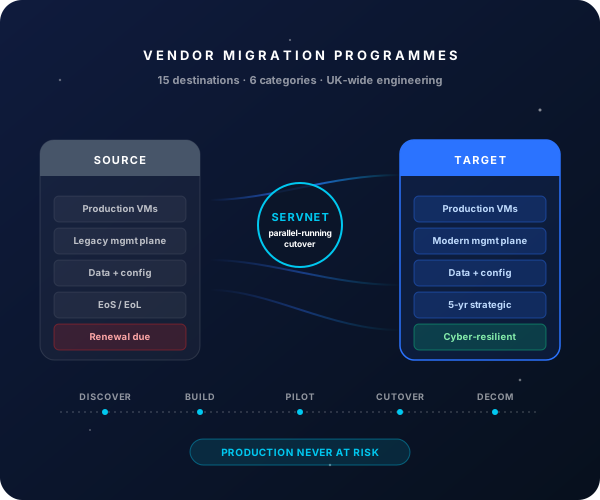
What good looks like after a VPN (flat-tunnel) → Zero-Trust Network Access (ZTNA) migration
Per-app access removes the "flat tunnel = network access" pattern that enables lateral movement.
End-to-end including app discovery, pilot user wave, mass rollout, VPN decommission.
No VPN client logon delays; transparent per-app access; faster overall.
Most UK cyber-insurers now ask about ZTNA in renewal questionnaires; ZTNA materially affects premium.
Why UK organisations migrate from VPN (flat-tunnel) to Zero-Trust Network Access (ZTNA)
- ✓Eliminate lateral movement risk from flat VPN tunnels — a top ransomware enabler
- ✓Per-app authentication + device posture checks (vs once-authenticated flat tunnel)
- ✓Better user experience — no client logon delays, no MFA prompts per session
- ✓Conditional Access integration with Entra ID + Defender for Endpoint posture
- ✓Material reduction in cyber-insurance premium (most insurers now require ZTNA or similar)
- ✓Strategic alignment with SASE direction (ZTNA is the access pillar of SASE)
Migration phasing — typical VPN (flat-tunnel) → Zero-Trust Network Access (ZTNA) programme
- 1
Discovery + app inventory
Weeks 1-4Application inventory — every internal app users access via VPN; usage pattern fingerprint; ZTNA platform selection (<a href="/zscaler">Zscaler Private Access</a>, Cisco Duo Network Gateway, Cloudflare Access, Fortinet ZTNA, others); architecture design.
- 2
ZTNA platform deployment
Weeks 5-8Connector deployment in each network segment hosting target apps; user identity federation with Entra ID; device posture policies; app-by-app access policies; SIEM forwarding.
- 3
Pilot user wave (20-50 users)
Weeks 9-11Pilot users access apps via ZTNA in parallel with VPN; performance + functional validation; helpdesk training; runbook refined.
- 4
Mass rollout
Weeks 12-18User waves migrated per department; VPN access removed per wave after ZTNA validated; daily review of access tickets.
- 5
VPN decommission
Weeks 19-20Legacy VPN infrastructure decommissioned; firewall rules tightened; remaining VPN exceptions documented (rare).
What Servnet delivers in a VPN (flat-tunnel) → Zero-Trust Network Access (ZTNA) migration
App inventory + ZTNA platform selection
Honest evaluation of ZTNA platforms against your environment; selection documented with rationale.
ZTNA platform deployment
Connectors deployed; user federation; device posture; app-by-app policies — full architecture implemented.
Entra ID Conditional Access integration
Conditional Access policies enforce identity + device + risk posture per access.
Per-app access policies
Every app discovered during inventory gets a documented access policy (who, what device posture, when).
User wave plan + helpdesk runbooks
Detailed wave plan + helpdesk scripts for access escalations + edge cases.
Post-migration support
90-day hypercare; optional ongoing managed ZTNA service.
Top risks + how we mitigate them
Indicative: VPN → ZTNA migrations for a 500-3,000 user estate typically run £25k-£60k professional services (excluding ZTNA platform licensing). ZTNA licensing typically £8-£25 per user per month depending on platform + tier. Total programme often cost-neutral with VPN eliminated and security uplift substantial. Talk to us for a sized commercial proposal.
FAQs — VPN (flat-tunnel) → Zero-Trust Network Access (ZTNA)
Which ZTNA platform should we pick?
Depends on your existing stack. M365 / Defender-heavy = Cisco Duo or Cloudflare. Existing Zscaler customers = ZPA. Fortinet FortiGate shops = Fortinet ZTNA. Genuinely vendor-neutral evaluation happens during discovery; we recommend platforms based on your environment, not commission.
Can we keep VPN for specific use cases?
Yes — many enterprises keep a slim VPN for very specific use cases (third-party contractor access, legacy device support, OT protocols). The goal is "VPN as exception, ZTNA as default" not "delete all VPN".
What about Conditional Access — isn't that already ZTNA?
Conditional Access enforces identity + device posture per app — it's a foundational component of ZTNA. But ZTNA platforms add the per-app network access tunnelling that lets you decommission the VPN entirely.
How does this fit with broader SASE strategy?
ZTNA is the access pillar of SASE; combined with SWG, CASB, DLP and SD-WAN you have the full SASE stack. Our 2026 SASE buyer's guide covers the strategy.
Ready to scope your VPN (flat-tunnel) → Zero-Trust Network Access (ZTNA) migration?
30-minute discovery call with an engineer who's run this migration before. Honest scoping, no sales script.
Book a scoping call →Talk to a UK specialist
Get expert advice or a no-obligation quote — servers, storage, networking, maintenance, finance and cloud. We reply the same working day.