
🔀 Cisco Catalyst 9300 vs 9400 vs 9500
Cisco Catalyst 9300-48T vs Cisco Catalyst 9400 Series vs Cisco Catalyst 9500-32C compared across 24 matched specifications — scores, the full spec table and a verdict.
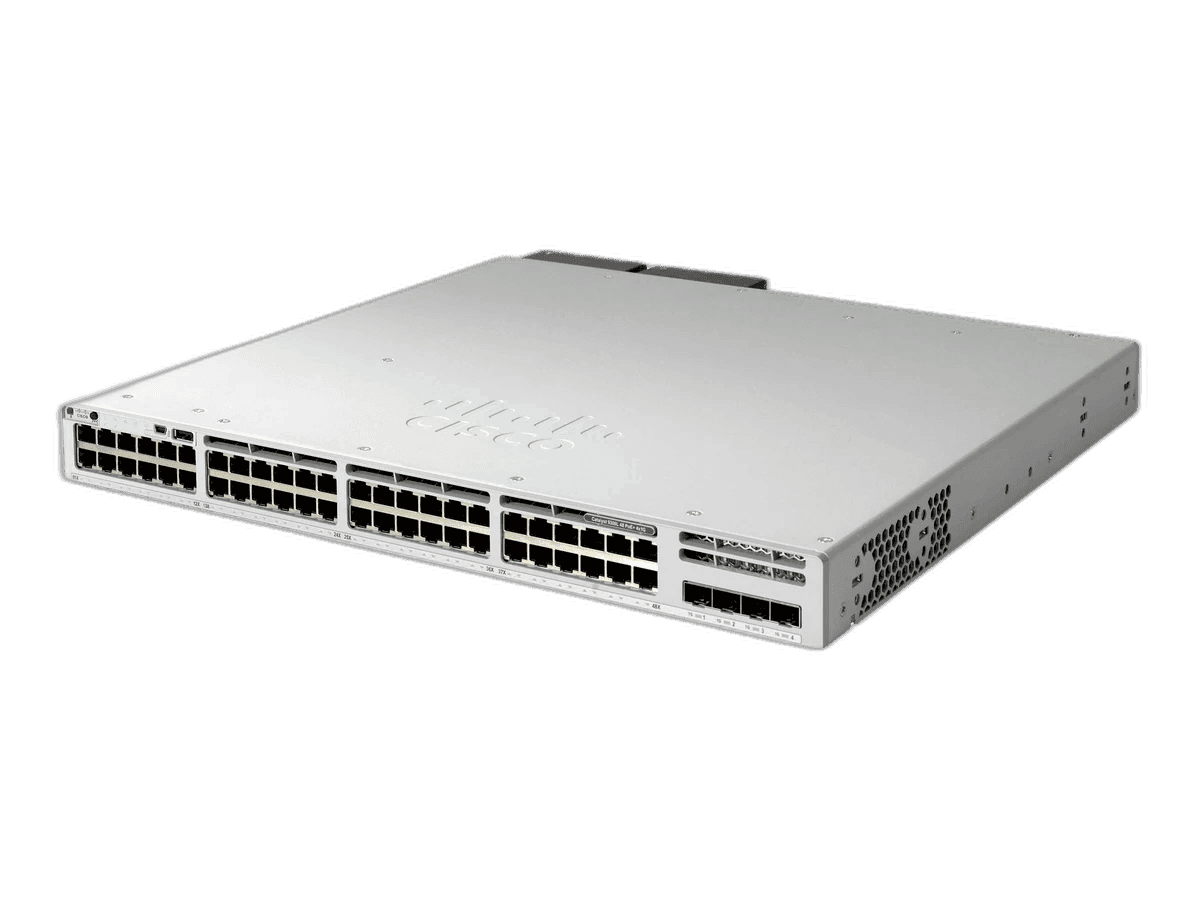
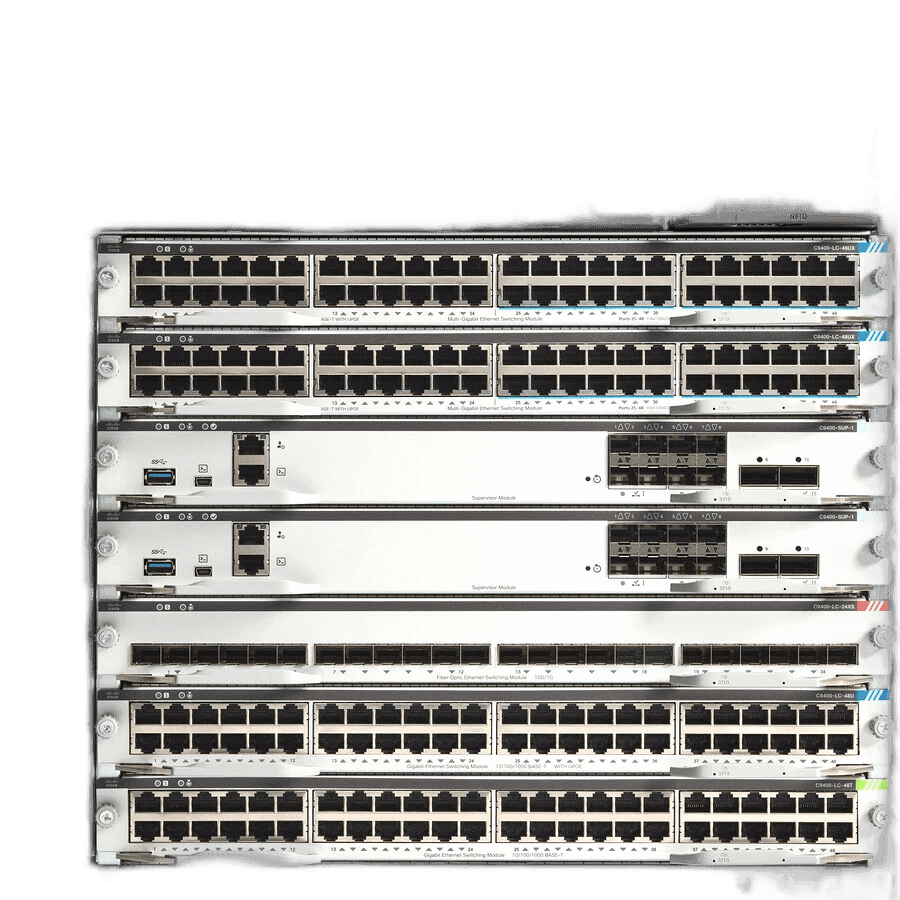
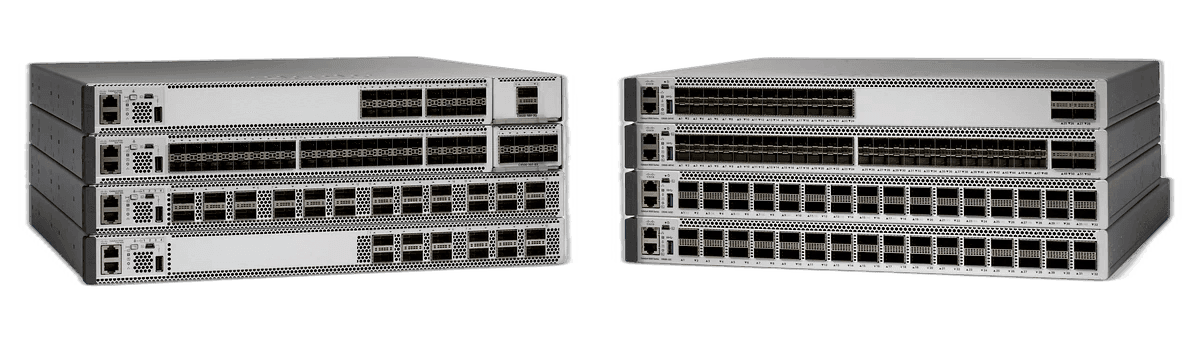
Cisco Catalyst 9300 vs 9400 vs 9500: performance overview
Scores based on quantifiable specification values (1-10 scale)
Detailed Specifications
| Specification | Cisco Catalyst 9300-48T Cisco | Cisco Catalyst 9400 Series Cisco | Cisco Catalyst 9500-32C Cisco |
|---|---|---|---|
| Key Metrics | |||
| Role in campus | Access layer | Distribution / core (modular) | Core / aggregation (fixed) |
| Form factor | 1U fixed, stackable | Modular chassis (4/7/10 slot) | 1U fixed |
| Switching capacity | Up to 1 Tbps (stack-dependent) | Up to 25.6 Tbps (C9410R) | 6.4 Tbps non-blocking |
| Forwarding rate | -- | -- | 4,761 Mpps |
| Highest-speed port | 10G SFP+ (uplinks) | 100G QSFP28 (uplink modules) | 100G QSFP28 |
| ASIC | UADP 2.0 | UADP 2.0 | UADP 3.0 |
| Port Density & Connectivity | |||
| Access ports | 48 × 1GbE RJ45 | Up to 384 × 1GbE / mGig per chassis (line-card dependent) | None — uplink/core role |
| Uplink ports | 4 × 10G SFP+ (modular uplink) | 40G / 100G QSFP+ line cards | 32 × 100G QSFP28 (or 128 × 25G via breakout) |
| mGig / multi-gigabit | Available on -MGig SKUs (not on -48T) | Yes, via UPOE+ line cards | No (core role) |
| Stacking | StackWise-480 — 480 Gbps, up to 8 units | Dual-supervisor redundancy (no stacking) | StackWise Virtual (2-node logical chassis) |
| Power & PoE | |||
| PoE on access ports | No PoE on -48T (data only; PoE on -48P/-48U variants) | Yes — up to 2,880W PoE per line-card slot, UPOE+ | No (core switch) |
| Power supply redundancy | Dual hot-swap PSU option | Redundant PSUs across chassis | Dual hot-swap PSU |
| Supervisor redundancy | No (fixed) | Yes — active/standby supervisors | Via StackWise Virtual pair |
| Security & Services | |||
| MACsec | 802.1AE on all ports | 802.1AE (line-card dependent) | 802.1AE on all ports |
| SD-Access role | Fabric edge | Fabric distribution / border | Fabric border / control plane |
| Encrypted traffic analytics (ETA) | Yes | Yes | Yes |
| TrustSec / SGT | Yes | Yes | Yes |
| Management & Software | |||
| Operating system | IOS-XE | IOS-XE | IOS-XE |
| Programmability | NETCONF, RESTCONF, gRPC, YANG, Python on-box | NETCONF, RESTCONF, gRPC, YANG | NETCONF, RESTCONF, gRPC, YANG, model-driven telemetry |
| Cisco DNA Center / Catalyst Center | Yes — full SD-Access edge | Yes — distribution node | Yes — border / control plane |
| Licensing | DNA Essentials / Advantage (subscription) | DNA Essentials / Advantage | DNA Essentials / Advantage |
| Resilience & Serviceability | |||
| In-Service Software Upgrade (ISSU) | Limited (stack rolling upgrades) | Yes — supervisor-level ISSU | Yes — via StackWise Virtual |
| Hot-swap modules | Uplink modules, PSU, fans | Supervisors, line cards, PSU, fans | PSU, fans (fixed chassis) |
| Target environment | Wiring closets, branch, mid-size campus access | Large campus distribution / collapsed core | Data-centre-adjacent core, large aggregation |
Expert Analysis
These three Catalysts are not really competitors — they are three layers of the same campus reference architecture, and the right choice depends on where the switch sits, not which is "best". The 9300-48T is a fixed 1U access switch with 48 gigabit RJ45 ports and 10G SFP+ uplinks, designed to live in a wiring closet and stack with StackWise-480 at 480 Gbps. The 9400 is a modular chassis with redundant supervisors and up to 25.6 Tbps of capacity, built for distribution or collapsed core in large campuses where you cannot tolerate a planned outage. The 9500-32C is a fixed 1U core with 32 × 100G QSFP28 ports and 6.4 Tbps non-blocking — the densest 100G of the three and the one that bridges campus into data-centre aggregation.
Where they differ in substance: the 9500-32C uses the newer UADP 3.0 ASIC and is the only one that delivers true 100G line-rate at this density, making it the natural SD-Access border or fabric control-plane node. The 9400 wins on resilience and PoE — dual supervisors, hot-swap line cards, and up to 2,880W of UPOE+ per slot for powering APs, cameras and desk phones at scale; nothing in the 9300 or 9500 line matches that physical redundancy. The 9300-48T is the cheapest per port and the most flexible to deploy, but the -T variant specifically has no PoE, which rules it out for any closet that also feeds wireless or telephony — buyers in that situation should be looking at the -48P, -48U or -48UXM SKUs instead.
For UK buyers the licensing model is the same across all three (DNA / Catalyst Center Essentials or Advantage subscription), so the TCO conversation is really about chassis cost, PoE budget, and how many years of subscription you commit to. NCSC-aligned campuses running SD-Access and TrustSec will get equivalent security posture from any of the three — MACsec is on all ports of the 9300-48T and 9500-32C, and on capable line cards in the 9400.
Recommendation framework: if you are refreshing wiring closets and don't need PoE on this particular run, the 9300-48T is the right answer; if you need PoE, pick a different 9300 SKU. If you are replacing an ageing 6500/6800 distribution layer in a large campus — university, hospital trust, council HQ — and you need supervisor redundancy and high PoE density, the 9400 is the only one of the three that fits. If you are building a new SD-Access fabric border, collapsing core and aggregation into 1U, or terminating 100G uplinks from a data centre, the 9500-32C is the cleaner choice.
Ready to proceed?
Not sure which one fits your environment?
Our UK specialists will recommend the right option for your workload and send itemised pricing — vendor-neutral, no obligation.
Response within 4 business hours · 20+ yr UK reseller
Want to compare different products or add more to this comparison?
Open Interactive Comparison Tool →Made your choice? Spread the cost.
Whichever you choose, you don't have to pay for it all upfront — finance your new hardware from £172/mo ex VAT on hire purchase or lease. Compare monthly payments and terms in seconds.
See finance from £172/mo →Indicative estimate · subject to change · no credit check at this stage · hire purchase, lease & subscription for UK businesses
Indicative illustration only. Servnet Limited is not authorised or regulated by the FCA and does not provide financial advice or arrange finance. All finance opportunities are referred to Number Eight Business Finance. Finance policy
Related comparisons
Other head-to-heads featuring these models — useful if you’re still shortlisting.
Talk to a UK specialist
Get expert advice or a no-obligation quote — servers, storage, networking, maintenance, finance and cloud. We reply the same working day.