
🔀 Cisco Catalyst 9500-32C vs 9500-48Y4C
Cisco Catalyst 9500-32C vs Cisco Catalyst 9500-48Y4C compared across 29 matched specifications — scores, the full spec table and a verdict.
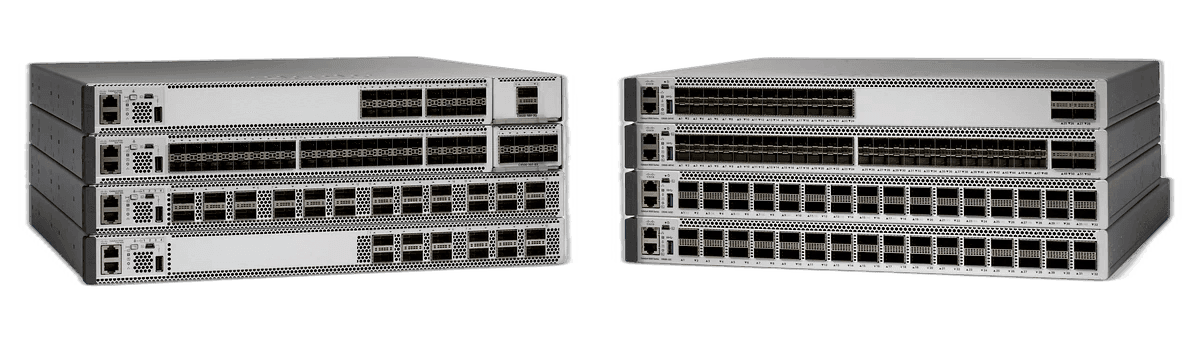
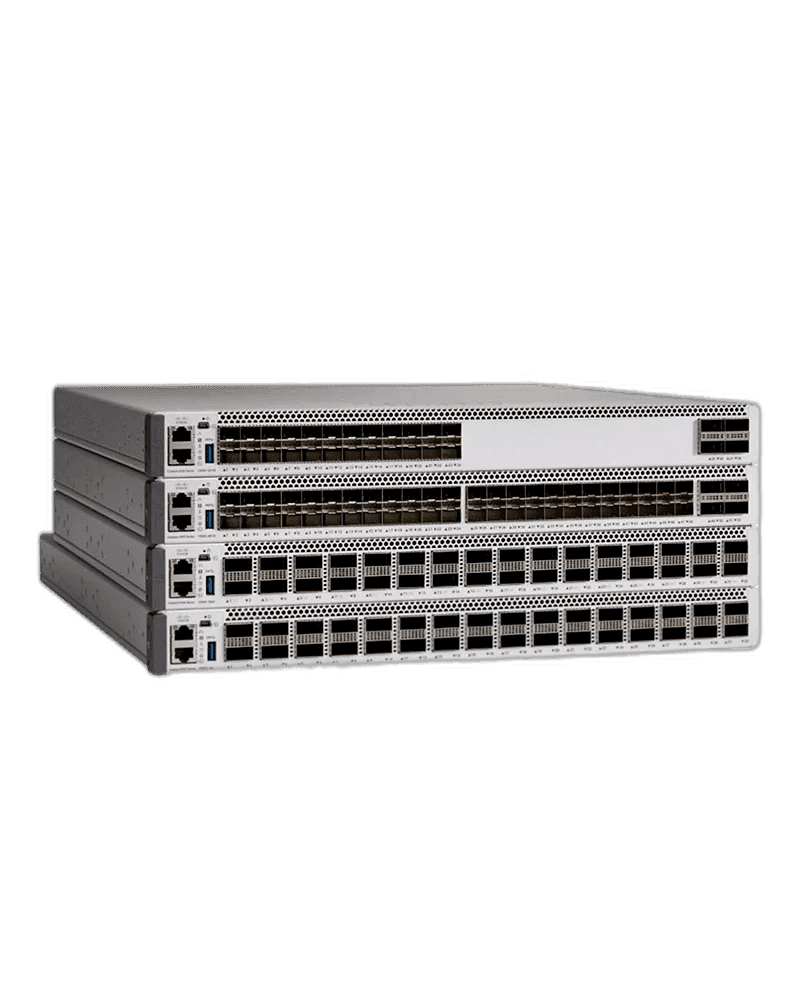
Cisco Catalyst 9500-32C vs 9500-48Y4C: performance overview
Scores based on quantifiable specification values (1-10 scale)
Detailed Specifications
| Specification | Cisco Catalyst 9500-32C Cisco | Cisco Catalyst 9500-48Y4C Cisco |
|---|---|---|
| Key Metrics | ||
| Switching capacity | 6.4 Tbps | 2.4 Tbps |
| Forwarding rate | 4,761 Mpps | 1,000 Mpps (approx.) |
| Primary port configuration | 32 × 100G QSFP28 | 48 × 25G SFP28 + 4 × 100G QSFP28 |
| Form factor | 1U fixed | 1U fixed |
| ASIC | Cisco UADP 3.0 | Cisco UADP 3.0 |
| Role | Campus core / spine | Distribution / aggregation / server leaf |
| Port density | ||
| 100G QSFP28 ports | 32 | 4 |
| 25G SFP28 ports | Up to 128 via 4×25G breakout on QSFP28 | 48 |
| 10G capable ports | Via QSFP-to-SFP+ breakout | 48 (25G ports support 10G SFP+) |
| 40G QSFP+ support | Yes (on QSFP28 ports) | Yes (on the 4 × 100G ports) |
| Total usable uplink bandwidth | 3.2 Tbps (32 × 100G) | 400 Gbps (4 × 100G) |
| Forwarding & buffers | ||
| Non-blocking line rate | Yes, all 32 × 100G | Yes, all ports at full duplex |
| Packet buffer | 36 MB shared | 36 MB shared |
| MAC address table | 64,000 | 64,000 |
| IPv4 routes (LPM) | 212,000 | 212,000 |
| Latency (cut-through, typical) | Sub-microsecond | Sub-microsecond |
| Resilience & management | ||
| StackWise Virtual | Yes (2-node logical chassis) | Yes (2-node logical chassis) |
| Redundant power supplies | Dual hot-swappable | Dual hot-swappable |
| Redundant fans | Hot-swappable, N+1 | Hot-swappable, N+1 |
| Operating system | Cisco IOS-XE | Cisco IOS-XE |
| Controller / fabric | Cisco DNA Center, SD-Access border/core | Cisco DNA Center, SD-Access core/distribution |
| Programmability | NETCONF/YANG, gNMI, Python on-box | NETCONF/YANG, gNMI, Python on-box |
| Security & segmentation | ||
| MACsec | IEEE 802.1AE on all ports (up to 100G) | IEEE 802.1AE on all ports (up to 100G) |
| TrustSec / SGT | Yes | Yes |
| Encrypted Traffic Analytics | Yes | Yes |
| Hardware root of trust | Yes (Cisco Trust Anchor) | Yes (Cisco Trust Anchor) |
| Power | ||
| Power supply options | 650W AC/DC | 650W AC/DC |
| PoE support | No (no copper ports) | No (no copper ports) |
| Typical power draw | ~330 W | ~250 W |
Expert Analysis
The practical difference between these two Catalyst 9500 models is role, not generation. The C9500-32C is a campus core/spine switch — 32 × 100G ports and 6.4 Tbps of fabric give you the headroom to aggregate every distribution stack, data centre leaf and inter-building link in a medium-to-large UK campus onto a single 1U pair. The C9500-48Y4C is a distribution or server-aggregation switch — 48 × 25G with 4 × 100G uplinks is the classic leaf profile for hyper-converged clusters, modern server NICs and high-density wiring closet uplinks.
Where the 32C wins is anything bandwidth-bound. With 3.2 Tbps of usable 100G uplink and line-rate forwarding at 4,761 Mpps, it is comfortably future-proof for SD-Access borders, multi-site DCI handoff or as the spine of a small Cisco ACI/VXLAN fabric. It also offers far more 25G ports in aggregate via QSFP28 breakout (up to 128) than the 48Y4C does natively, if you're prepared to manage breakout cabling. The trade-off is cost per port for anything below 100G, and the fact that you're paying for fabric you may not need at the distribution layer.
The 48Y4C wins on fit-for-purpose economics. If your servers, wireless controllers and access-layer uplinks are 10/25G, putting them on a 32C is over-engineering. The 48Y4C gives you native SFP28 density, the same IOS-XE feature set, the same MACsec-on-every-port security posture, the same StackWise Virtual resilience model, and 400 Gbps of 100G uplink to the core — which is enough for the vast majority of UK enterprise distribution blocks. The headline 2.4 Tbps fabric is non-blocking for its own port count; it is not a smaller version of the 32C, it is a different layer.
Recommendation: pick the C9500-32C when you are building or refreshing the campus core, running SD-Access at scale, or aggregating multiple distribution pairs and DC links onto a single redundant core. Pick the C9500-48Y4C for distribution layers, server pods, hyper-converged Nutanix/VxRail clusters and aggregation closets where 25G to the host and 100G to the core is the right shape. In many UK campus designs both belong in the same architecture — 48Y4C pairs at distribution, 32C pair at core — rather than one replacing the other.
Ready to proceed?
Not sure which one fits your environment?
Our UK specialists will recommend the right option for your workload and send itemised pricing — vendor-neutral, no obligation.
Response within 4 business hours · 20+ yr UK reseller
Want to compare different products or add more to this comparison?
Open Interactive Comparison Tool →Made your choice? Spread the cost.
Whichever you choose, you don't have to pay for it all upfront — finance your new hardware from £172/mo ex VAT on hire purchase or lease. Compare monthly payments and terms in seconds.
See finance from £172/mo →Indicative estimate · subject to change · no credit check at this stage · hire purchase, lease & subscription for UK businesses
Indicative illustration only. Servnet Limited is not authorised or regulated by the FCA and does not provide financial advice or arrange finance. All finance opportunities are referred to Number Eight Business Finance. Finance policy
Related comparisons
Other head-to-heads featuring these models — useful if you’re still shortlisting.
Talk to a UK specialist
Get expert advice or a no-obligation quote — servers, storage, networking, maintenance, finance and cloud. We reply the same working day.