
🔀 Cisco Catalyst 9500 vs 9600
Cisco Catalyst 9500-32C vs Cisco Catalyst 9600 Series compared across 26 matched specifications — scores, the full spec table and a verdict.
Cisco Catalyst 9500 vs 9600: performance overview
Scores based on quantifiable specification values (1-10 scale)
Detailed Specifications
| Specification | Cisco Catalyst 9500-32C Cisco | Cisco Catalyst 9600 Series Cisco |
|---|---|---|
| Key Metrics | ||
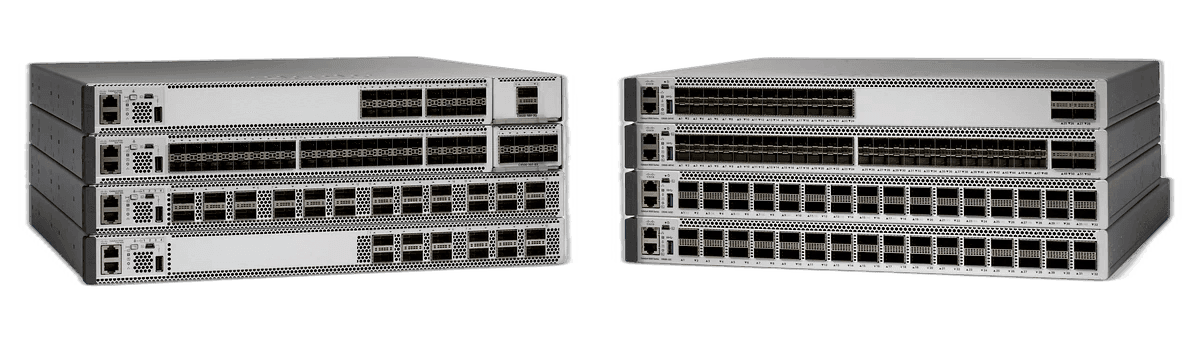
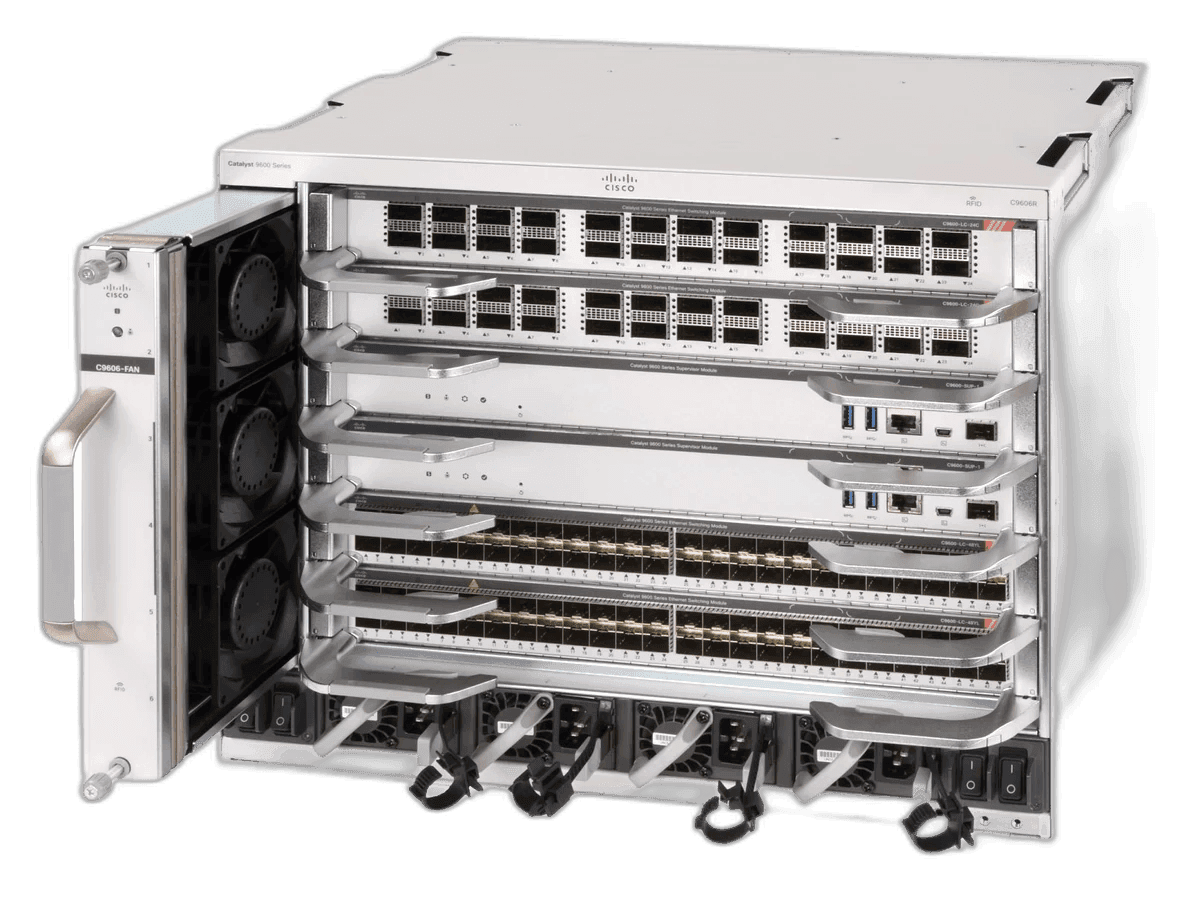
| Form factor | 1RU fixed | 6-slot (C9606R) or 10-slot (C9610R) modular chassis |
| Switching capacity | 6.4 Tbps | Up to 25.6 Tbps (C9610R, fully loaded with 100G line cards) |
| Forwarding rate | 4,761 Mpps | -- |
| Highest port speed | 100G QSFP28 | 400G QSFP-DD |
| 100G port count | 32 fixed | -- |
| ASIC | Cisco UADP 3.0 | Cisco UADP 3.0 |
| Port density & connectivity | ||
| 100G ports | 32 × QSFP28 (fixed) | Line-card dependent — up to 96 × 100G in C9606R, more in C9610R |
| 400G ports | -- | Available via QSFP-DD line cards |
| 25G support | Yes, via 4 × 25G breakout per QSFP28 (up to 128 × 25G) | Yes, via line cards |
| Slot count | Fixed — no expansion | 6 or 10 line-card slots plus supervisor slots |
| MACsec | IEEE 802.1AE on all ports | IEEE 802.1AE (line-card dependent) |
| Resilience & redundancy | ||
| Supervisor redundancy | N/A — single fixed control plane; pair via StackWise Virtual | Dual hot-swap supervisor engines |
| Chassis-level HA | StackWise Virtual (two physical 1RU units as one logical switch) | In-chassis SSO/NSF with redundant supervisors; can also be paired via StackWise Virtual |
| Hot-swap line cards | No (fixed) | Yes |
| Hot-swap power & fans | Redundant PSUs and fans | Redundant hot-swap PSUs and fan trays |
| ISSU | Supported via StackWise Virtual | Supported |
| Software & management | ||
| Operating system | IOS-XE | IOS-XE |
| Controller | Cisco DNA Center / Catalyst Center | Cisco DNA Center / Catalyst Center |
| SD-Access role | Border / control plane / fabric edge | Border / control plane — campus core |
| Programmability | NETCONF, YANG, gNMI, Python on-box | NETCONF, YANG, gNMI, Python on-box |
| Telemetry | Model-driven streaming telemetry | Model-driven streaming telemetry |
| Deployment fit | ||
| Typical role | Mid-to-large campus core or DC aggregation in a compact footprint | Large campus core / collapsed core for HQ and large sites |
| Rack space | 1RU | 7RU (C9606R) / 16RU (C9610R) |
| Expansion model | Scale out by adding another C9500-32C (StackWise Virtual) | Scale up by adding line cards in-chassis |
| Investment protection | Locked at 100G — replace unit to move to 400G | 400G-ready via line-card upgrade; same chassis lifecycle |
| Licensing | Cisco DNA Essentials/Advantage/Premier subscription | Cisco DNA Essentials/Advantage/Premier subscription |
Expert Analysis
The practical choice between these two comes down to whether you want a fixed 1RU core that you scale by pairing, or a modular chassis you scale by adding line cards. The C9500-32C delivers 6.4 Tbps and 32 × 100G in a single rack unit — extremely dense for the footprint and a sensible campus core or DC aggregation switch for mid-sized UK sites. The 9600 Series is a different class of product: a 6- or 10-slot chassis with dual supervisors, hot-swap line cards and a roadmap to 400G via QSFP-DD, reaching up to 25.6 Tbps in the C9610R.
Where the 9500-32C wins is density-per-rack-unit, power draw, and capital cost. Two 1RU units in StackWise Virtual give you a resilient logical core in 2RU with no chassis tax, which suits regional offices, secondary campuses, and SD-Access fabric borders where 100G is the ceiling for the next 5–7 years. It is, however, locked at 100G — when you need 400G uplinks to a spine or to a DC interconnect, you replace the unit rather than upgrade a card.
The 9600 Series wins on headroom and serviceability. In-chassis dual supervisors give true SSO/NSF without depending on a peer link, line cards are hot-swappable, and 400G is a line-card purchase rather than a forklift. The trade-offs are rack space (7RU or 16RU), higher power draw, and a materially higher entry price once you populate supervisors, line cards and DNA Advantage licensing across the chassis.
For most UK buyers, the decision framework is straightforward. Choose the C9500-32C if you have a mid-sized campus, want a compact and cost-efficient core, and 100G is enough for the lifecycle of the asset. Choose the 9600 Series if you are designing the core for a large HQ, university, hospital trust or multi-tenant site where 400G, in-chassis redundancy and a 7–10 year chassis lifecycle matter more than rack units or upfront cost. Both run the same IOS-XE and integrate identically with Catalyst Center and SD-Access, so the software experience does not differentiate them — the chassis decision does.
Ready to proceed?
Not sure which one fits your environment?
Our UK specialists will recommend the right option for your workload and send itemised pricing — vendor-neutral, no obligation.
Response within 4 business hours · 20+ yr UK reseller
Want to compare different products or add more to this comparison?
Open Interactive Comparison Tool →Made your choice? Spread the cost.
Whichever you choose, you don't have to pay for it all upfront — finance your new hardware from £172/mo ex VAT on hire purchase or lease. Compare monthly payments and terms in seconds.
See finance from £172/mo →Indicative estimate · subject to change · no credit check at this stage · hire purchase, lease & subscription for UK businesses
Indicative illustration only. Servnet Limited is not authorised or regulated by the FCA and does not provide financial advice or arrange finance. All finance opportunities are referred to Number Eight Business Finance. Finance policy
Related comparisons
Other head-to-heads featuring these models — useful if you’re still shortlisting.
Talk to a UK specialist
Get expert advice or a no-obligation quote — servers, storage, networking, maintenance, finance and cloud. We reply the same working day.