UK’s trusted IT infrastructure partner since 2003
sales@servnetuk.com
0800 987 4111
Servnet
ConfiguratorGet in Touch
← Comparison Tool

💾 Dell PowerScale F710 vs H7000

AI-powered analysis across 27 matched specifications

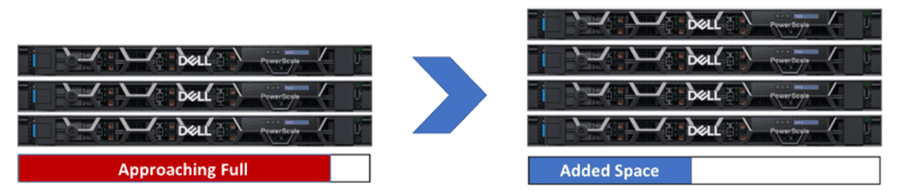
Dell PowerScale F710 all-flash NAS node 1U front view
Dell PowerScale F710
Dell Storage
8.6
Overall Score
Best for UK enterprises running AI/ML training, GPU-fed analytics, genomics or M&E rendering workloads that need sub-millisecond NVMe latency and 100GbE throughput on a scale-out NAS, where £/IOPS matters more than £/TB.
View Full Details
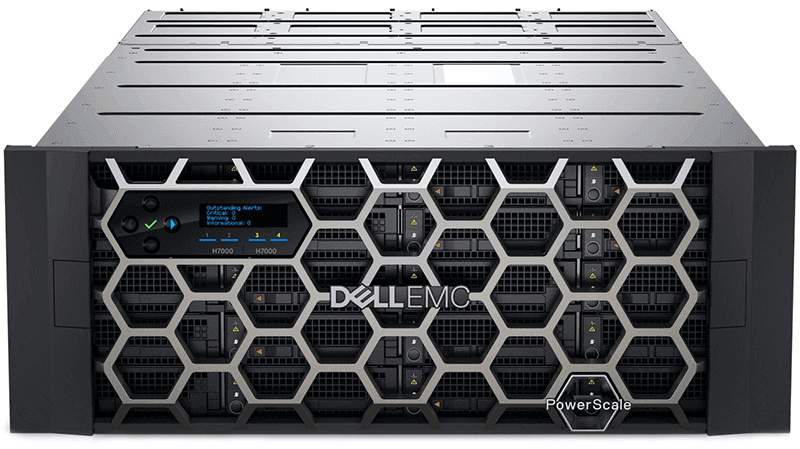
Dell PowerScale H7000 hybrid NAS 4U chassis front view
Dell PowerScale H7000
Dell Storage
8.0
Overall Score
Best for UK organisations needing dense, cost-effective capacity for backup targets, media archives or NHS imaging retention — typically deployed as the cold tier alongside F710 nodes in the same OneFS namespace with SmartTiering.
View Full Details

Performance Overview

Scores based on quantifiable specification values (1-10 scale)

PerformanceCapacity EconomicsData ServicesScalabilityResilienceManageabilityValue for workload
Dell PowerScale F710
Dell PowerScale H7000
Performance
Dell PowerScale F710
9.0
Dell PowerScale H7000
6.5
Capacity Economics
Dell PowerScale F710
6.5
Dell PowerScale H7000
9.0
Data Services
Dell PowerScale F710
8.5
Dell PowerScale H7000
8.3
Scalability
Dell PowerScale F710
9.0
Dell PowerScale H7000
8.5
Resilience
Dell PowerScale F710
8.5
Dell PowerScale H7000
8.5
Manageability
Dell PowerScale F710
8.5
Dell PowerScale H7000
8.5
Value for workload
Dell PowerScale F710
7.5
Dell PowerScale H7000
8.5

Detailed Specifications

Specification
Dell PowerScale F710
Dell Storage
Dell PowerScale H7000
Dell Storage
Key Metrics
Media typeAll-flash NVMe (QLC/TLC SSD)Hybrid (HDD + SSD cache)
Raw capacity per node38 TB – 1.2 PBUp to ~480 TB (4 × 12–24 TB HDD config plus SSD cache)
Chassis density1U per node (standalone)4 nodes in 4U chassis — up to 1.9 PB raw
Memory per node512 GB384 GB ECC
Front-end networking2 × 100GbE or 2 × 25GbE2 × 100GbE or 2 × 25GbE
Cluster scale3–252 nodes, up to 307 PB single namespaceScales within the same OneFS cluster as F710
Capacity & Media
Drive technologyNVMe QLC or TLC SSDSAS/SATA HDD with SSD read/write cache
HDD options--12, 16, 20 or 24 TB
SSD cache per noden/a — all-flash3.2 TB or 7.68 TB (1 or 2 drives)
Best-fit data temperatureHot / active / performance tierWarm and cold / archive tier
Inline data reductionSmartDedupe + SmartCompression (inline)Post-process efficiencies via OneFS
Performance
Workload profileLow-latency random and high-throughput streaming — AI/ML, analytics, M&E renderingSequential and large-file workloads — backup target, archive, video repositories
Latency classSub-millisecond (NVMe)Multi-millisecond (HDD-bound, SSD-cache accelerated)
Scaling modelLinear — performance scales with each node addedCapacity-led — performance per TB is lower than F710
Software & Data Services
Operating systemOneFS 9.7OneFS 9.10 or later
ProtocolsNFS, SMB, HDFS, S3, multi-protocolNFS, SMB, HDFS, S3, multi-protocol (same namespace as F710)
ReplicationSyncIQ — synchronous and asynchronousSyncIQ (cluster-wide)
TieringSmartTiering source for hot dataSmartTiering target for cold data auto-migrated from F710
Snapshots / WORMSnapshotIQ, SmartLock WORMSnapshotIQ, SmartLock WORM
Resilience & Management
Node failure toleranceUp to N+4 (OneFS protection levels)N+2 to N+4 across the cluster
Non-disruptive scaleAdd nodes online, auto-rebalanceAdd chassis online, auto-rebalance
Management planeOneFS WebUI, CloudIQ, DataIQ, APEX AIOpsOneFS WebUI, CloudIQ, DataIQ, APEX AIOps
EncryptionSED drives, data-at-rest encryptionSED drives, data-at-rest encryption
Deployment Economics
Relative £/TBHigh — performance flash pricingLow — bulk HDD economics
Relative £/IOPSLow — NVMe densityHigh — HDD-bound
Power profileLower watts per TB for active dataHigher watts per TB but lower watts per usable PB at rest
Typical UK use casesAI training data, VFX/render, analytics, primary unstructured workloadsBackup landing zone, media archive, research datasets, NHS imaging long-term retention

Expert Analysis

AI-generated based on published specifications

These two nodes are not really competitors — they are designed to sit in the same OneFS cluster and do different jobs. The F710 is an all-NVMe performance node built for sub-millisecond latency on AI/ML pipelines, analytics, rendering and other hot unstructured workloads. The H7000 is a high-density hybrid chassis that packs four nodes and up to 1.9 PB of raw HDD into 4U, with SSD cache in front, and is designed as the warm/cold tier of the same namespace.

If the workload is performance-led — GPU feeding, seismic, genomics, broadcast post-production — the F710 wins clearly. 512 GB of memory per node, NVMe QLC/TLC media and 100GbE front-end ports give it the latency and bandwidth profile that the H7000 simply cannot match, regardless of how much SSD cache you put in front of spinning disk. Conversely, when the requirement is bulk capacity at a sensible £/TB — backup landing zones, media archives, NHS imaging retention, research datasets that have aged off primary — the H7000 is materially cheaper per usable terabyte and denser per rack unit. Trying to serve cold archive from an F710 cluster is an expensive way to store cold data.

The more interesting decision for most UK buyers is not 'either/or' but ratio. OneFS 9.10 lets both node types share a single namespace, and SmartTiering will automatically migrate cold files from F710 to H7000 based on policy. A typical mixed cluster might be 20–30% F710 capacity for the active working set and 70–80% H7000 for everything else, governed by a single management plane (OneFS, CloudIQ, DataIQ). That is where PowerScale earns its premium over commodity NAS.

Recommendation: pick F710-only if your entire dataset is hot and latency-sensitive and budget allows. Pick H7000-only if you are replacing an archive or backup target and performance is a secondary concern. For anything in between — which is most general-purpose enterprise file estates — design a mixed cluster and let SmartTiering do the work.

Dell PowerScale F710
Best for UK enterprises running AI/ML training, GPU-fed analytics, genomics or M&E rendering workloads that need sub-millisecond NVMe latency and 100GbE throughput on a scale-out NAS, where £/IOPS matters more than £/TB.
Dell PowerScale H7000
Best for UK organisations needing dense, cost-effective capacity for backup targets, media archives or NHS imaging retention — typically deployed as the cold tier alongside F710 nodes in the same OneFS namespace with SmartTiering.

Ready to proceed?

Want to compare different products or add more to this comparison?

Open Interactive Comparison Tool →