

A single NVIDIA GB200 NVL72 rack draws 120-140 kilowatts and costs roughly $2-3 million in hardware alone — built to deliver 1.4 exaflops for trillion-parameter model training. For most UK enterprises, that's the wrong yardstick entirely. The UK's data centres already consume 5.8-6% of national electricity supply, industrial power costs four times more than in the US, and grid connection requests have hit roughly 50GW against a peak demand of just 45GW. Before committing capital and years of planning to liquid-cooled, multi-megawatt infrastructure, use our AI GPU calculator to ask the blunter question: does your workload need rack-scale compute, or would one air-coolable 8-GPU node, drawing around 10kW, quietly do the job?
View the data behind this chart
| 8-GPU inference node | Air-cooling ceiling (30-40kW) | GB200 NVL72 rack | |
|---|---|---|---|
| Power consumption (kW) | kW10.1 | kW35 | kW130 |
The 130kW reckoning: sizing for hype, not workload
Global AI infrastructure spending is forecast to hit $487 billion in 2026 for hardware alone, according to IDC, while Gartner puts total worldwide AI spending — infrastructure, software, services and platforms combined — at $2.59 trillion, with infrastructure accounting for over 45% of that figure. That volume of capital is pulling UK IT leaders toward the same rack-scale systems hyperscalers are deploying, largely because that's what the headlines cover.
But adoption data tells a more sober story. Globally, 88% of organisations now use AI in at least one business function, yet only around 33% have scaled it enterprise-wide. In the UK, 54% of firms were actively using AI as of March 2026, but just 11% of SMEs use it extensively for automation. Most real-world deployments are nowhere near the trillion-parameter training runs that rack-scale systems exist for — which means most infrastructure decisions should be sized to that reality, not to the frontier.
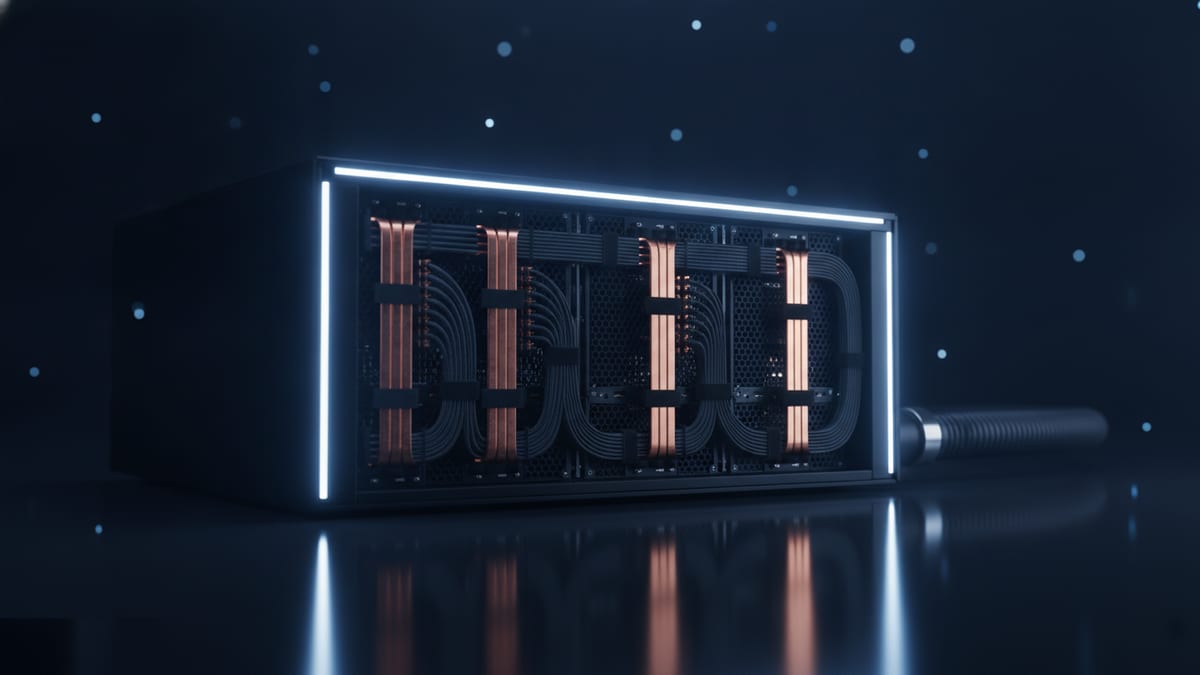
What a GB200 NVL72 rack actually is — and who genuinely needs one
NVIDIA's GB200 NVL72 integrates 72 GPUs into a single liquid-cooled rack delivering 1.4 exaflops of AI compute, purpose-built for processing trillion-parameter models. It draws 120-140kW of sustained power and costs approximately $2-3 million in hardware alone. That places it well beyond the 30-40kW ceiling at which air cooling stops being viable — direct-to-chip liquid cooling isn't an optional upgrade for this class of system, it's mandatory.
Dell'Oro Group notes that direct-to-chip liquid cooling has now become the default architecture for AI-centric deployments in 2026, having moved from niche to foundational in barely two years. That shift is real, but it's a shift for organisations training frontier-scale models — hyperscalers, national AI labs, and a small number of enterprises running genuinely trillion-parameter workloads. If that isn't your workload, the NVL72's economics and facility requirements simply don't apply to you.
The 8-GPU alternative: right-sized for real UK workloads
A typical 8-GPU server node running inference draws around 10.1kW, including server overhead and standard data-centre cooling losses. That figure sits comfortably beneath the 30-40kW air-cooling ceiling, meaning it can be deployed in a conventional data hall or comms room without a liquid-cooling retrofit, specialist plumbing, or the multi-year grid connection queue that rack-scale systems increasingly face in the UK.
This is the pragmatic starting point for the vast majority of UK enterprises: fine-tuning, retrieval-augmented generation, internal copilots, agentic workflows and production inference services rarely require anything close to 1.4 exaflops of raw compute. You can configure your ideal server around a single air-cooled 8-GPU node and scale by adding nodes as demand proves out — rather than committing capital to a facility built for a workload you may never run.
In practical terms, that 30-40kW ceiling also sets a rough limit on how many air-cooled 8-GPU nodes a single rack or data hall can hold before liquid cooling becomes unavoidable: at roughly 10.1kW per node, three nodes bring a rack to around 30kW, while a fourth pushes it to roughly 40kW — right at the upper edge of what air cooling can handle. UK IT teams scaling incrementally should treat three nodes per air-cooled rack as a practical planning ceiling, distributing any additional nodes across separate racks or data halls rather than stacking a fourth or fifth node onto the same air-cooled footprint, which would force the same liquid-cooling and facility-upgrade decisions this guide is designed to help you avoid.
The true cost of power and cooling in the UK
Power is where UK-specific economics bite hardest. Industrial electricity averaged $111.65 per megawatt-hour in May 2026, compared with $28 in the US — a gap that compounds directly with every additional kilowatt a rack draws. GPU thermal design power is also approaching 1,000 watts per chip by 2026-27, pushing air cooling further toward its limits and making liquid-cooling commitments even harder to unwind once made.
UK data centres already account for 5.8-6% of national electricity supply, a level close to the threshold where community and political pushback against new facilities tends to intensify. Grid capacity is the sharper constraint: over 140 proposed data centre projects have requested roughly 50GW of connection capacity as of February 2026, against a UK peak demand of only around 45GW. Nscale's own £2 billion UK data centre is already facing power readiness issues ahead of its planned 2027 opening — a warning sign for any enterprise assuming rack-scale power will simply be available on schedule. For a deeper look at what high-density deployment actually demands, see our analysis of hosting high-density AI racks in the UK.
Worked example: sizing an enterprise LLM workload
Start by classifying the workload. Internal fine-tuning and production inference for a copilot or agentic application sit at one end; continuous pre-training of a trillion-parameter foundation model sits at the other. Map that classification to a power envelope: an 8-GPU node at roughly 10.1kW covers the former comfortably within standard air-cooled facility limits, while only genuine frontier-training workloads push you toward the 120-140kW liquid-cooled territory of a GB200 NVL72.
Next, apply a cost gate. A GB200 NVL72 rack costs approximately $2-3 million in hardware before power, cooling infrastructure or facility upgrades are added — a capital commitment that should be justified by a workload that actually needs 1.4 exaflops, not by a desire for future-proofing. Finally, apply a UK power-reality check: confirm your chosen site can actually deliver the required density without joining a multi-year grid connection queue, using Nscale's own £2 billion project as a cautionary benchmark for how far even well-funded plans can be delayed.
Before any procurement conversation, work through this in order, using only what you can actually measure:
- Workload type: is this production inference, fine-tuning and RAG, or continuous pre-training of a trillion-parameter foundation model? Only the latter genuinely requires GB200 NVL72-class compute.
- Power envelope: can your projected node count be satisfied within roughly 10.1kW per 8-GPU node, or does aggregate draw push toward the 120-140kW a single NVL72 rack consumes?
- Cooling threshold: will your total rack draw stay under the 30-40kW air-cooling ceiling, or does it cross into mandatory direct-to-chip liquid cooling?
- Budget gate: does the workload justify the $2-3 million hardware cost of a single NVL72 rack, or does it fit an incremental, lower-capital 8-GPU deployment instead?
View the data behind this chart
| Power profile | Cooling need | Best-fit buyer | |
|---|---|---|---|
| 8-GPU air-cooled node | ~10kW draw | Standard air cooling | Most UK enterprises |
| GB200 NVL72 rack | 120-140kW draw | Mandatory liquid cooling | Frontier model training |
| Public cloud AI services | Consumption-based | Provider-managed | Variable/bursty loads |
| Specialised AI colo | Rack-scale ready | Liquid-cooling capable | Hybrid scale-out |
FinOps for AI: forecasting spend without overcommitting
With global hardware spending forecast at $487 billion in 2026 and total AI spending at $2.59 trillion, the market is moving too fast for fixed multi-year infrastructure bets to be low-risk. The gap between the 88% of organisations using AI somewhere and the 33% who've scaled it enterprise-wide is itself a FinOps signal: most deployments are still proving value, not running at full utilisation, so capacity built for peak hype rather than proven demand sits idle.
Agentic AI — autonomous, multi-step AI systems — is forecast by Gartner to feature in 40% of enterprise applications by the end of 2026, which will genuinely increase inference demand over time. The right response is incremental: deploy an air-cooled 8-GPU node, instrument its utilisation, and add capacity only once that node is consistently saturated. That gives finance and IT leaders a visible, defensible cost-allocation trail instead of a single large capex decision made on projected rather than observed demand.
Cloud, on-prem, colo or hybrid: matching the model to the workload
Public cloud AI services remain the right default for bursty, unproven or rapidly evolving workloads, since elasticity avoids the UK's power and grid constraints entirely — you're renting someone else's capacity problem. On-premises 8-GPU nodes suit steady, predictable inference or fine-tuning workloads where data sovereignty or latency matter and the power draw stays within normal facility limits. Colocation earns its place once density grows past what your own facility can support, without requiring your own capital-intensive liquid-cooling build.
The UK's regulatory backdrop reinforces a measured approach: 2026 AI policy applies existing sector regulators rather than a single comprehensive AI Act, while government backing — a £500 million sovereign AI programme and £1.6 billion in UKRI funding for 2026-2030 — signals long-term ambition without removing the near-term grid and power constraints buyers face today. Before committing to any one path, compare cloud vs. on-premise TCO against your actual workload profile rather than the industry's rack-scale narrative.
Key takeaways and the recommendation for UK buyers
The rack-scale narrative dominates AI infrastructure coverage in 2026, but the data on UK power costs, grid capacity and actual enterprise AI adoption all point the same way: right-sizing beats future-proofing for the vast majority of buyers. An air-cooled 8-GPU node deployed now, instrumented for utilisation, and scaled deliberately will outperform a speculative rack-scale commitment on cost, delivery timeline and grid risk for almost every UK enterprise workload in 2026.
Sources
Every figure in this article traces to the sources below.
- •Fireline Broadband — air cooling limits and legacy rack power baselines
- •Dell'Oro Group — direct-to-chip liquid cooling as 2026 default
- •Introl — GB200 NVL72 power, compute and cooling specification
- •AI Data Center Power Requirements in 2026 — GB200 NVL72 hardware cost
- •Digital Applied (IDC) — global AI infrastructure hardware spending forecast
- •Gartner, Inc. — total worldwide AI spending forecast for 2026
- •Aristral — global AI adoption and enterprise scaling statistics
- •Synvestable — agentic AI adoption forecast for 2026
- •Market Decipher — GPU thermal design power trajectory to 2026-27
- •Resultsense — UK data centre share of national electricity consumption
View the data behind this chart
| Layer | Detail |
|---|---|
| GPU compute silicon | 72 GPUs delivering 1.4 exaflops per rack |
| Power delivery infrastructure | 120-140kW sustained draw, UK grid-constrained |
| Direct-to-chip liquid cooling | Mandatory above the 30-40kW air-cooling ceiling |
| Rack-scale networking fabric | Interconnect built for trillion-parameter models |