
Mixed estates are where this gets complicated: HPE, Dell, Cisco and NetApp each have a different firmware position. Build one schedule across all of them and get a verdict per device.
What You Gain with Multi-Vendor Maintenance
A single Servnet support number handles faults across every vendor in your estate. No more calling Dell, then HPE, then Cisco to work out who owns a cross-vendor incident.
All hardware consolidated into a single annual invoice and renewal date. Eliminate the admin overhead of tracking 8–12 separate OEM contract renewals every year.
OEM SLAs vary by vendor — Servnet applies a single agreed SLA tier (NBD, 4-Hour or Same-Day) uniformly across every device in scope, regardless of manufacturer.
Unlike OEM contracts which expire at EOSL, Servnet continues to support end-of-life hardware within your multi-vendor contract — no gaps as devices age past support dates.
A single named Servnet account manager owns your entire estate relationship. They know your environment, your priorities, and your escalation contacts.
When a fault involves cross-vendor components, Servnet triages the root cause — no more vendor finger-pointing between Dell, HPE and Cisco whilst your system is down.
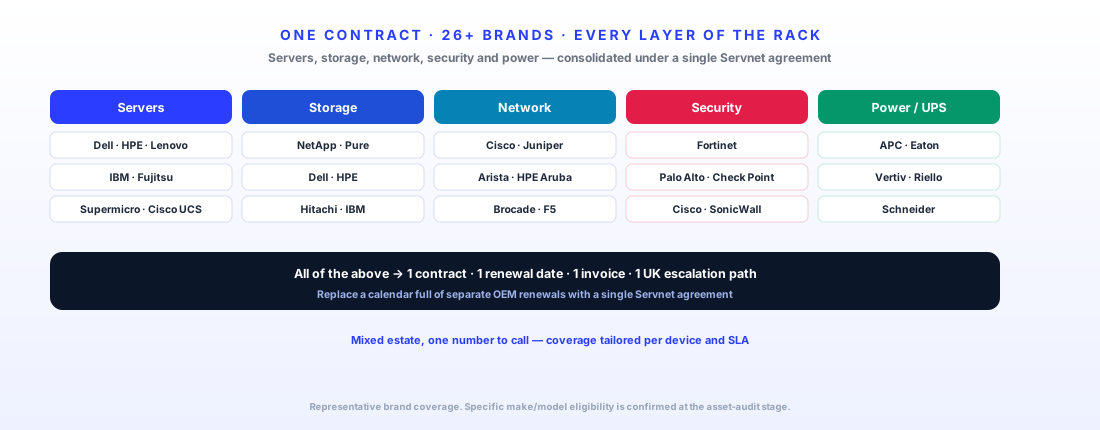
Hardware Brands Covered in One Contract
26 major vendors. All supported under a single Servnet multi-vendor maintenance agreement.
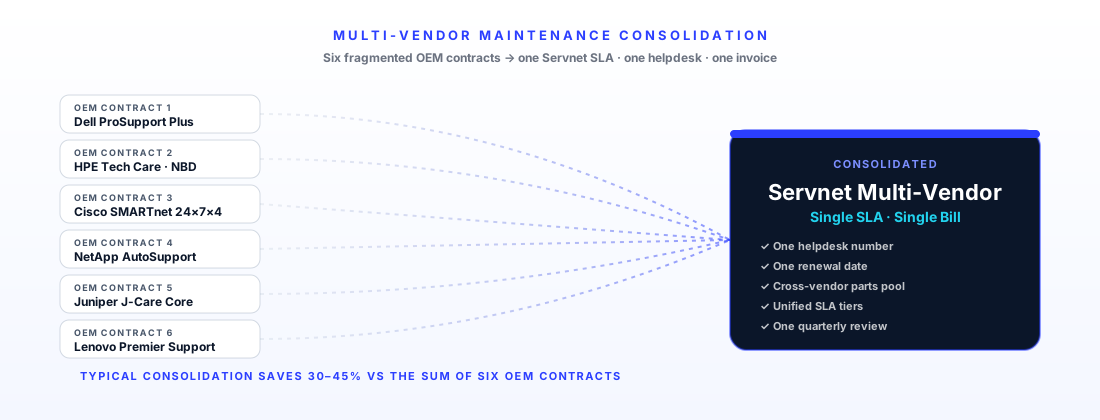
Before & After: Consolidating to Servnet
A real-world example: a 60-device mixed estate previously managed across 6 OEM contracts.
| Area | Before — Multiple OEM | After — Servnet ✓ |
|---|---|---|
| A | 6 separate OEM contracts | 1 Servnet agreement |
| B | 6 different renewal dates | 1 annual renewal date |
| C | 6 invoices, 6 PO numbers | 1 invoice, 1 PO |
| D | 6 support hotlines to call | 1 Servnet support number |
| E | SLA varies per OEM | Consistent SLA per criticality tier |
| F | EOL hardware unsupported | EOL hardware covered in same contract |
| G | Admin time across several contracts | One contract to administer |
| H | OEM renewal uplifts | Fixed pricing for contract term |
Multi-Vendor Maintenance — FAQs
Each OEM has different renewal dates, pricing structures, support portals, escalation processes and SLA terms. IT teams managing 8–12 separate OEM contracts spend significant time each year on renewals, contract management and fault logging — time better spent on productive work. A single Servnet contract eliminates all of this overhead.
Servnet supports 26+ major hardware and software brands including Dell, HPE, Cisco, Lenovo, IBM, Fujitsu, Fortinet, NetApp, Hitachi Vantara, Arista, Juniper, Palo Alto, Check Point, F5, Brocade, Extreme Networks, Riverbed, Nutanix, VMware, Veritas and more. If you have a hardware brand not on this list, contact us — we can usually accommodate additional vendors.
We begin with a full asset audit of your estate. We then map all existing OEM contracts — noting expiry dates, SLA levels and costs. Servnet presents a unified proposal covering the full estate. Transition is phased to match existing contract expiry dates, ensuring no coverage gap at any point.
Usually not, but it depends on the estate. We price each device against your current OEM contracts and show the difference line by line, and one contract removes the administration of several agreements. As an independent benchmark, Gartner’s 2019 Market Guide for Data Center and Network Third-Party Hardware Maintenance put TPM savings at 50–70% off OEM support net prices.
This is one of the most valuable aspects of multi-vendor maintenance. Servnet takes ownership of the fault regardless of which vendor's hardware is involved. We triage the root cause, engage the correct certified engineer, and manage the fix end-to-end — eliminating the vendor finger-pointing that delays resolution in fragmented support models.
Yes. We support phased transitions — devices under active OEM contracts stay as-is until expiry, then migrate to Servnet. We track the full estate (OEM and Servnet) in a single service record so nothing falls through the gaps. Many organisations run a hybrid for 12–24 months as OEM contracts naturally expire.
Unlike OEM contracts where each vendor imposes their own SLA structure, a Servnet multi-vendor contract allows you to assign SLA tiers device-by-device — regardless of manufacturer. A Dell server and a Cisco switch in the same critical data centre rack can both carry a 4-hour SLA, under a single agreement.
For estates of 50+ devices, we assign a dedicated onboarding manager. Phase one is an asset discovery — typically completed in 3–5 days. Phase two is contract mapping and proposal. Phase three is go-live, phased to align with existing OEM contract expiry. A typical 100-device estate is fully onboarded within 3–4 weeks.
Ready to Consolidate Your Hardware Contracts?
Share your current contract details and we will produce a unified Servnet multi-vendor proposal — showing total cost, coverage and your estimated saving.
Talk to a UK specialist
Get expert advice or a no-obligation quote — servers, storage, networking, maintenance, finance and cloud. We reply the same working day.