
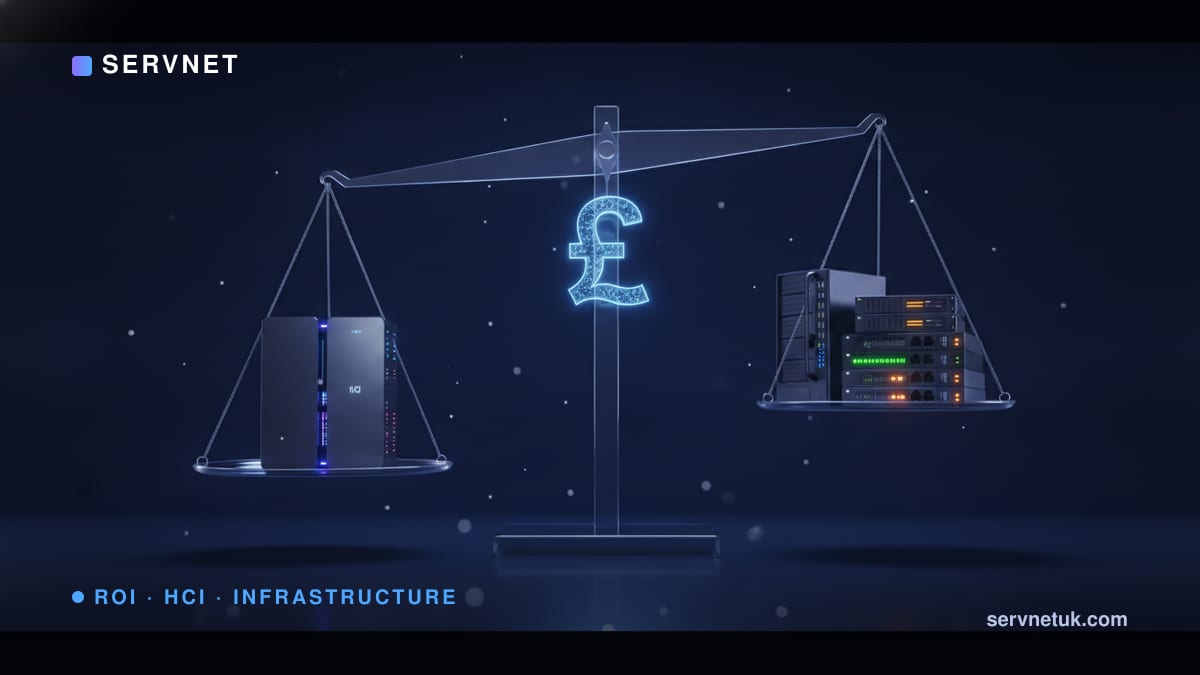
Hyperconverged (HCI) replaced three-tier (separate compute + storage + network) as the default mid-market virtualisation architecture between 2016-2024. But HCI doesn't fit every workload. This is the honest ROI framework for HCI vs three-tier in 2026.
View the data behind this chart
| Y1 | Y2 | Y3 | Y4 | Y5 | |
|---|---|---|---|---|---|
| HCI | £k220 | £k18 | £k18 | £k22 | £k22 |
| 3-tier | £k280 | £k28 | £k28 | £k35 | £k35 |
Where HCI beats three-tier
Mid-market virtualisation (50-500 VMs) — operational simplicity + lower total cost.
Branch / remote office (2-4 node clusters) — minimal hardware footprint, single-vendor support.
VDI / EUC workloads — HCI's tight compute + storage coupling fits VDI patterns well.
Greenfield deployments — no existing SAN investment to leverage.
Where three-tier still beats HCI
Large enterprise (1,000+ VMs) with mature SAN team — existing investment + skills.
High-performance databases with specific SAN requirements (Oracle RAC, SAP HANA TDI) — dedicated array often better.
Mixed workloads where compute + storage scale independently — HCI's tight coupling forces unwanted refresh patterns.
Workloads needing specific storage features (FC, FICON, mainframe attach) HCI doesn't support.
The 5-year TCO framework
For 200-VM environment: HCI typically 15-30% lower 5-year TCO vs equivalent three-tier (compute + SAN + switching + management).
Operational savings real: single vendor, single support call, single management plane. Typically 1-2 FTE saving over three-tier.
Caveat: if existing SAN investment has 2+ years remaining + skills are deep, HCI migration is cost-neutral or worse over 5 years.
Platform selection
See our HCI buyer's guide for Nutanix vs VMware vSAN vs Azure Stack HCI comparison.
Most UK mid-market 2026 HCI selections land on Nutanix (post-Broadcom migration wave — see our VMware-after-Broadcom playbook) or Azure Stack HCI (Microsoft-shop customers). Servnet sizes both options against the customer's existing cloud vs on-prem mix + workload-specific refresh-or-extend timing.