
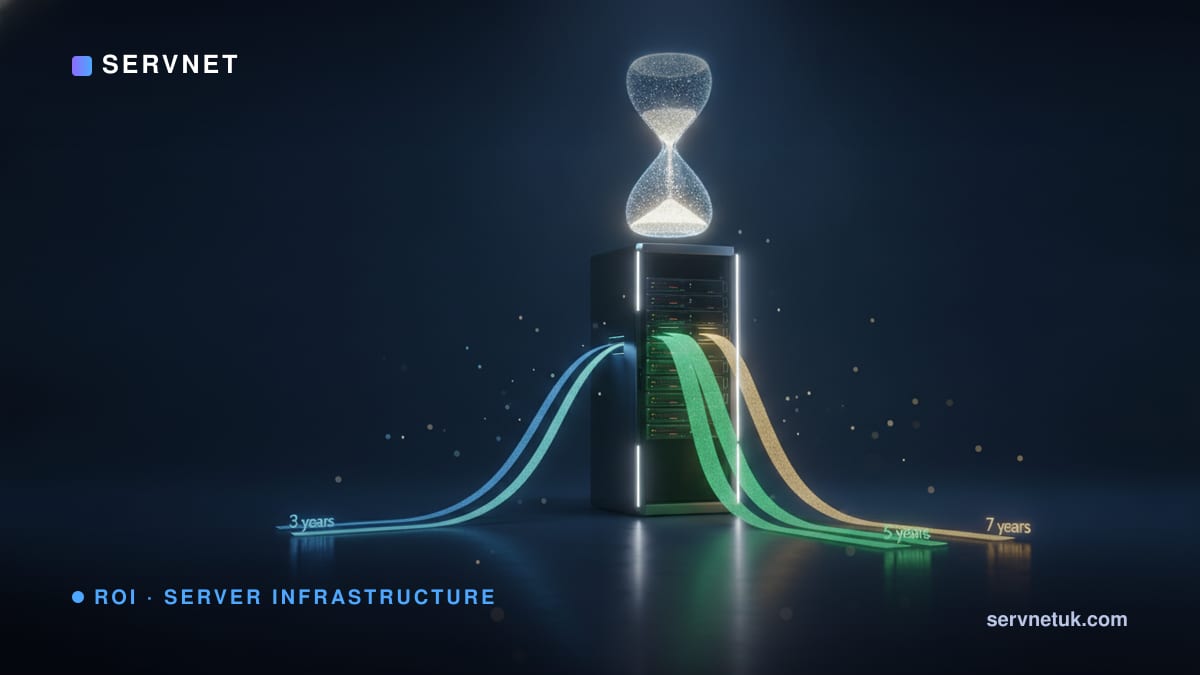
The "refresh every 5 years" rule of thumb made sense in 2010 — hardware aged faster, OEM warranties expired predictably, and capex cycles aligned. In 2026 the calculation is different. This is the decision framework Servnet runs with UK customers facing server refresh decisions.
The 3 refresh strategies
3-year refresh — premium hardware leases / consumption models (Dell APEX, HPE GreenLake). High flex, high cost, simple operations.
5-year refresh — traditional capex, OEM ProSupport throughout. Industry standard for 15+ years. Still appropriate for many.
7-year refresh — capex amortised longer, transition to TPM at year 4-5 when OEM gets expensive. Best 5-year TCO for stable workloads.
When 3-year refresh wins
AI / GPU workloads — generation-on-generation perf jumps justify aggressive refresh.
Trading floor / latency-critical FS — every CPU generation matters.
Consumption pricing (APEX / GreenLake) — capex shifts to opex, refresh is included in subscription.
When 5-year refresh wins
Standard virtualisation workloads where DDR5 + Gen5 NVMe + 25/100 GbE are the relevant generation shift.
Microsoft / VMware licensing cycles often align to 5-year hardware refresh.
OEM ProSupport remains economic through year 5 for most platforms.
View the data behind this chart
| Y1 | Y2 | Y3 | Y4 | Y5 | |
|---|---|---|---|---|---|
| Refresh now | £k40 | £k8 | £k8 | £k10 | £k10 |
| Extend 3yr | £k16 | £k16 | £k16 | £k42 | £k8 |
When 7-year refresh wins
Stable workload (file servers, print servers, branch infrastructure, secondary database replicas).
TPM coverage from year 4-5 onwards is usually priced below continuing OEM cover — Gartner’s 2019 Market Guide for Data Center and Network Third-Party Hardware Maintenance put TPM savings at 50–70% off OEM support net prices.
Lowest 5-year TCO when modelled honestly — see our TPM TCO analysis.