
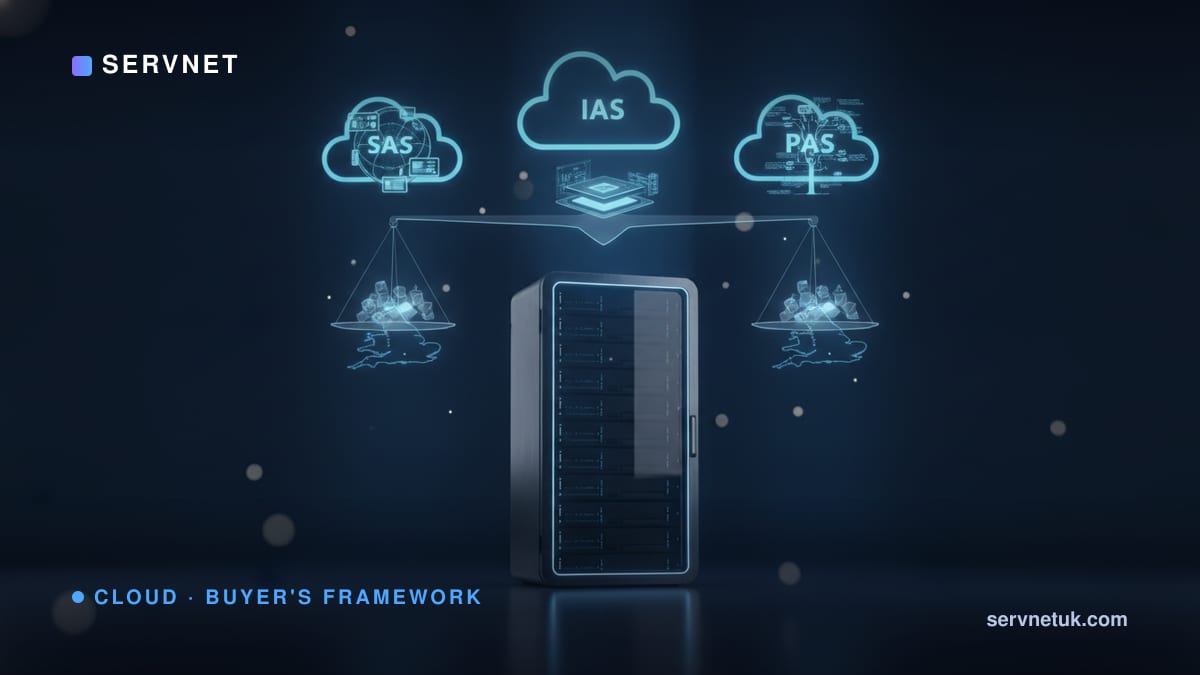
The cloud "as-a-service" stack — SaaS, PaaS, IaaS — gets thrown around in UK IT discussions without much rigour. The right choice for each workload depends on operational responsibility, customisation needs, and where the value lives.
View the data behind this chart
| Layer | Detail |
|---|---|
| Application | SaaS: vendor · PaaS: you · IaaS: you |
| Runtime / data | SaaS: vendor · PaaS: vendor · IaaS: you |
| OS / middleware | SaaS: vendor · PaaS: vendor · IaaS: you |
| Hypervisor / HW | All three: vendor |
The three models in plain terms
SaaS — vendor runs entire stack. You consume as web app + APIs. Microsoft 365, Salesforce, Workday, Xero. Customer responsibility: data, users, access.
PaaS — vendor runs infrastructure + runtime + tooling. You deploy code. Azure App Service, AWS Elastic Beanstalk, Heroku. Customer responsibility: code + data + config.
IaaS — vendor runs hardware + hypervisor + network. You manage OS up. Azure VMs, AWS EC2. Customer responsibility: OS patching, app install + config, everything above.
When to pick SaaS
Workload is a commodity — email, productivity, CRM, ERP, HR, accounting. Microsoft 365 + Salesforce + Workday + Xero are SaaS because the underlying capability is standardised across customers.
You don't need deep customisation or unusual integrations. SaaS configuration > customisation as a rule.
When to pick PaaS
Building custom software but don't want to manage infrastructure. Microservices, customer-facing APIs, internal apps with specific business logic.
Elastic auto-scaling without operational burden of managing compute. Azure Functions, AWS Lambda, Container Apps.
Trade-off: vendor lock-in is real. Refactoring a PaaS app to a different cloud is significant work.
When to pick IaaS
Lift-and-shifting existing applications that aren't cloud-native. IaaS is your bridge.
You need specific OS / kernel / firmware control that PaaS doesn't allow (database appliances, specialist software, GPU compute).
Existing licensed software with strict deployment requirements (SAP, Oracle, ESRI).
The honest mixed reality
Most UK mid-market orgs run all three. Typical pattern: SaaS for office productivity + CRM + HR. IaaS for legacy apps + Windows / Linux servers (still often on on-prem servers Servnet manages). PaaS for net-new custom development.
Operational maturity = knowing which workload sits where + actively shifting workloads to the right model over time. Pair this view with the cloud vs on-prem 5-yr TCO model, AWS vs Azure selection, and cloud-security posture for governance.