
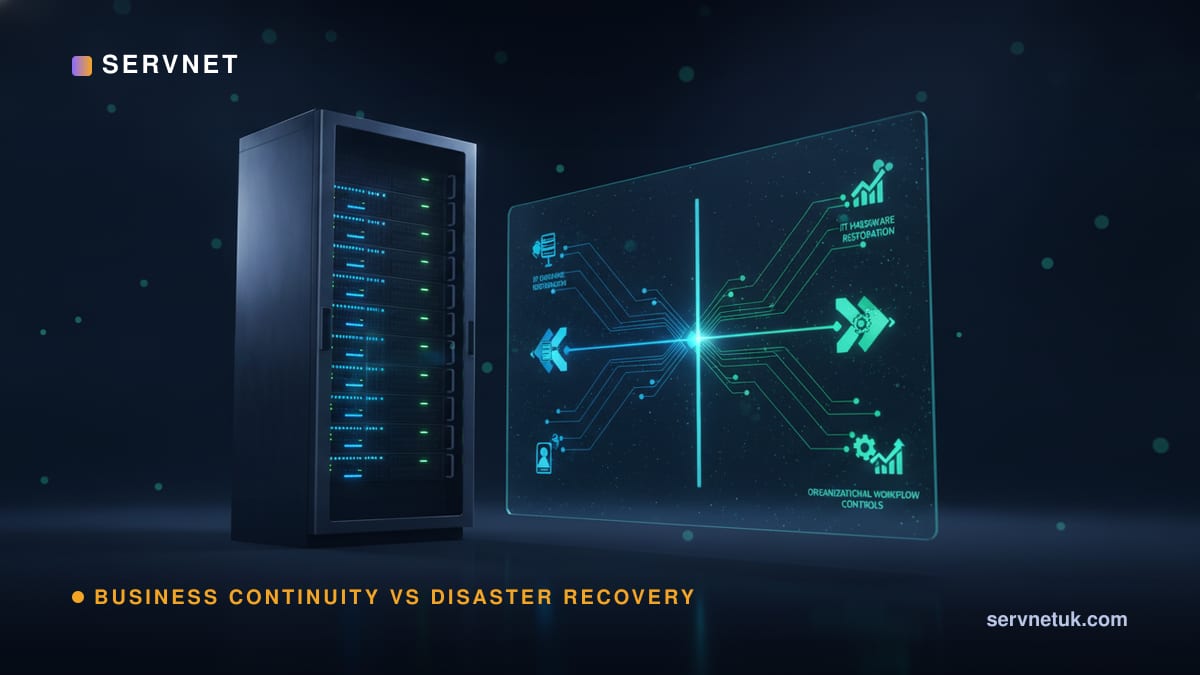
Business continuity and disaster recovery are frequently conflated in enterprise IT planning, yet they represent two fundamentally different operational responsibilities. Business continuity (BC) focuses on maintaining essential organisational functions during an unplanned disruption, whereas disaster recovery (DR) focuses on restoring the systems, data, and supporting infrastructure required for those functions after an outage. Conflating the two leaves critical operational blind spots: an organisation may successfully restore its storage arrays while remaining unable to deliver services to clients, or establish manual workplace workarounds while losing unrecoverable customer databases. In the UK, formal standards such as EN ISO 22301:2019 and guidance from the National Cyber Security Centre (NCSC) help organisations distinguish and coordinate business continuity and disaster recovery responsibilities. Achieving true operational resilience requires aligning business-owned operating models with technical IT runbooks, backed by our backup and disaster recovery solutions.
View the data behind this chart
| Layer | Detail |
|---|---|
| ISO 22301 Management System | BCMS governance and organizational risk acceptance |
| Incident Command & Communications | NCSC assigned roles, triggers, and contact paths |
| Business Continuity Operations | Workforce workarounds and client service delivery |
| Technical Disaster Recovery | Network, compute, and hypervisor reconstruction |
| Data & Backup Restoration | NCSC ransomware recovery and volume verification |
Defining the Boundary: Business Continuity vs Disaster Recovery
The core distinction between business continuity and disaster recovery lies in scope, ownership, and ultimate objectives. Business continuity encompasses the strategies, policies, and operational arrangements that, in line with ISO 22301’s definition, ensure an organisation can continue to deliver critical services and products at acceptable predefined levels following a disruptive incident. It covers human resources, physical facilities, supply chains, crisis communications, and alternative operating processes. Disaster recovery, by contrast, is a specialised discipline closely linked to business continuity, focused on restoring technology and data needed to support continuity plans. Its primary remit is the restoration of technology assets—servers, network links, databases, hypervisors, and data repositories—following an event such as physical infrastructure failure, power loss, or a cyber attack.
When an incident occurs, business continuity and disaster recovery activate in parallel but operate across different layers of the organisation. If a primary data centre suffers catastrophic water damage or a severe ransomware deployment, the disaster recovery team activates technical runbooks to restore virtual machines, repoint DNS records, and recover volumes from offline or isolated storage. Simultaneously, the business continuity team coordinates executive leadership, directs operational staff to manual alternative workflows, liaises with third-party logistics partners, and manages regulatory and customer communications.
Without an effective disaster recovery strategy, business continuity measures will eventually exhaust their manual workarounds and fail as operational backlogs compound. Conversely, pristine disaster recovery execution is meaningless if workforce safety, customer triage, regulatory notifications, and supply chain logistics are left unmanaged while systems recover.
- •Business continuity addresses overarching organisational survival, focusing on business functions, human resources, suppliers, and client-facing service levels.
- •Disaster recovery operates inside the IT and infrastructure boundary, concentrating on system uptime, infrastructure rebuilds, and verified data recovery.
- •Business continuity plans are owned by operational business units and executive leadership; disaster recovery plans are owned by IT infrastructure and engineering teams.

Business Continuity: Governance, Scope, and the ISO 22301 Standard
In the UK, formal governance for business continuity is anchored in EN ISO 22301:2019, published by the British Standards Institution (BSI) on 30 November 2019 following the international release of ISO 22301:2019 in October 2019. This international standard specifies the requirements for implementing, maintaining, and improving a Business Continuity Management System (BCMS). The standard explicitly defines the purpose of a BCMS: to establish continuity capabilities appropriate to the specific level of impact an organisation may or may not accept following an operational disruption.
Under ISO 22301, an organisation must implement a structured framework designed to protect against, reduce the likelihood of, prepare for, respond to, and recover from disruptive incidents. The standard establishes that continuity cannot be treated as an ad-hoc emergency checklist; it must function as a living management process embedded into organisational governance. This framework was further updated in February 2024 through ISO 22301:2019/Amd 1:2024, which adds explicit climate‑change considerations to the management system’s operational context, requiring organisations to determine whether climate change is a relevant issue and to recognise related requirements from interested parties.
Central to any ISO 22301-aligned continuity plan is the Business Impact Analysis (BIA). The BIA identifies the organisation's essential activities, maps the dependencies required to sustain them—including personnel, external suppliers, facilities, and underlying software—and determines the operational and financial impacts of their interruption over time. For enterprise organisations and mid-market operators alike, the BIA sets the baseline tolerance for downtime, which subsequently dictates technical recovery requirements.
Disaster Recovery: Technical Runbooks, Backup Restoration, and NCSC Guidance
While business continuity addresses the whole enterprise, disaster recovery is an operational engineering discipline. A disaster recovery plan (DRP) consists of granular technical runbooks designed to return IT infrastructure from an offline or corrupted state back to full production. These runbooks document precise recovery sequencing: restoring bare-metal hardware or hypervisor hosts, standing up core network routing and active directory services, restoring database clusters, verifying data integrity, and re-establishing application dependencies.
In the UK public and private sectors, practical expectations for disaster recovery are outlined by the National Cyber Security Centre (NCSC). The NCSC incident‑management collection, first launched on 19 September 2019, is described by NCSC as guidance to help organisations plan, build, develop, and maintain an effective cyber incident response capability. Rather than presenting generic resilience theory, NCSC guidance sets out practical recommendations and tangible technical controls that organisations are expected to adopt where appropriate. In its Response and Recovery Guide (v3, October 2020), the NCSC instructs organisations to ensure they know how to restore a backup in the event of data loss, such as that caused by ransomware, and to test backup restoration, not just backup creation, on a regular basis.
Restoring backups during a disaster is often far more complex than simple file extraction. In the event of an advanced cyber disruption, recovery teams must verify that backup images themselves are uncompromised, that recovery targets are isolated from persistence mechanisms, and that recovery procedures function under network segmentation. Organising infrastructure to understand Recovery Time Objective (RTO) and Recovery Point constraints ensures that systems can be systematically recovered before the business incurs unacceptable operational damage.
Side-by-Side Comparison: BCP vs DRP in Practice
Distinguishing between a Business Continuity Plan (BCP) and a Disaster Recovery Plan (DRP) requires evaluating their distinct inputs, triggers, owners, and deliverables. While the two plans must interface smoothly during a declared emergency, merging them into a single unwieldy document frequently causes confusion when rapid decisions are required.
The BCP serves as the strategic operational manual for business leaders. It contains invocation criteria, emergency team structures, alternative site logistics, communication templates for staff and regulators, and manual procedures for handling transactional workloads without IT access. The DRP, on the other hand, is an infrastructure-facing manual intended for system administrators, storage engineers, and network specialists. It contains technical recovery scripts, administrative credentials access protocols, network routing failover procedures, and backup storage retrieval processes.
- •Ownership: BCP is owned by executive leadership, operational risk directors, and business unit heads. DRP is owned by the Chief Information Officer, IT Director, and infrastructure leads.
- •Core Objective: BCP maintains business viability and service delivery to customers. DRP restores IT infrastructure, applications, and verified data integrity.
- •Activation Triggers: BCP activates when an event impairs operational service capabilities (e.g., facility loss, widespread staffing absence, cyber lockdown). DRP activates when critical IT systems, platforms, or data repositories become unavailable or corrupted.
- •Key Deliverable: BCP delivers continuous or degraded business operations via workarounds. DRP delivers restored systems, servers, network links, and intact databases.
- •Testing Focus: BCP is tested using executive tabletop simulations, operational process walk-throughs, and staff relocation drills. DRP is tested using system failover tests, bare-metal recovery drills, and active backup restoration runs.
UK Regulatory Alignment: NCSC CAF and Severe Cyber Threat Planning
UK organisations, particularly those operating essential or regulated services, face specific regulatory and national security expectations regarding resilience. The NCSC Cyber Assessment Framework (CAF) sets out explicit principles for entities operating critical services or managing elevated operational risk. Under CAF Principle D1 (Response and Recovery Planning), first published on 18 April 2024 and maintained through periodic updates (most recently published in August 2026), organisations are expected to maintain well-defined and tested incident management processes aimed at ensuring the continuity of essential functions during system or service failure.
CAF Principle D1 reinforces that technical recovery must be tied directly to organizational service continuity. An organisation cannot claim resilience merely by possessing unverified backup tapes or off-site cloud snapshots; it must prove through testing that its recovery mechanisms sustain essential functions under active failure conditions. Furthermore, the NCSC Response and Recovery Guide directs organisations to assign explicit roles to staff, document who owns each incident responsibility, and clearly record how those individuals can be contacted during a crisis.
This governance landscape was complemented by the release of the NCSC severe-cyber-threat guidance on 28 January 2026 (the current edition as of publication). This guidance structures resilience work into four complementary activity areas, encouraging organisation-wide response strategies and the ability to maintain operations and recover during severe disruption. For UK infrastructure leaders, this requires harmonising BC leadership and DR engineering teams into a unified command structure that satisfies both ISO 22301 requirements and NCSC scrutiny.
Continuity Planning for UK Small Businesses vs Enterprise Organisations
A common misconception is that business continuity management systems are only relevant to large enterprises. For UK small and medium-sized enterprises (SMEs), an extended operational halt can lead to immediate commercial failure. However, a continuity plan for small business operations must be structured appropriately to avoid administrative paralysis.
In a small business, a single individual often holds overlapping responsibilities across business leadership and IT management. In this environment, the BCP should focus on critical single points of failure: identifying key personnel whose absence would halt operations, documenting external software-as-a-service dependencies, and establishing out-of-band communication channels (such as dedicated Signal groups or secondary cloud identity tenants) if primary corporate email becomes unavailable. The associated disaster recovery plan must be concise and actionable on a modest budget: rather than maintaining costly secondary hardware, UK SMEs can adopt managed Backup-as-a-Service (BaaS) paired with automated, object-locked cloud snapshots (such as S3 Object Lock or Azure Immutable Blob storage via Veeam or Acronis) and entry-level cloud DRaaS that allows critical servers to spin up as pay-as-you-go virtual instances if on-premises infrastructure is compromised.
Enterprise organisations, by contrast, must manage formal cross-departmental coordination under EN ISO 22301:2019. Enterprise BCPs encompass dedicated crisis management teams, integrated media handling protocols, formal union or employee representative consultations, and complex supply chain contingencies. Enterprise DR strategies require distributed infrastructure across isolated recovery zones, orchestrated failovers, and rigorous division of duties to ensure that operational teams and technical engineering units can execute their responsibilities simultaneously without operational friction.
Practical Testing Methodologies: Tabletop Exercises to Backup Verification
A continuity or disaster recovery plan exists only as a theoretical hypothesis until it has been rigorously validated. Both ISO 22301 and NCSC guidance emphasise regular testing and exercising of continuity and incident response arrangements as a core part of effective compliance with organisational policies and sound risk management. Organisations must apply different testing methodologies across the BC and DR domains to ensure complete operational readiness.
For business continuity, tabletop exercises and scenario walk-throughs provide the most effective validation mechanism. In a tabletop exercise, senior executives, department heads, communications teams, and operational managers assemble to simulate a severe incident—such as a facility closure or extortion incident. The exercise tests decision-making authority, communication escalations, third-party vendor coordination, and the viability of manual operational workarounds under time-pressured conditions.
For disaster recovery, testing must be technical, empirical, and measurable. In line with the NCSC Response and Recovery Guide instruction to ensure verified backup restoration, IT teams must periodically execute full restore tests into isolated virtual environments. Merely monitoring green checkmarks on backup software logs is insufficient; engineers must restore system states, boot database services, verify transaction consistency, and calculate recovery execution times. Identifying that a recovery script fails, that an encryption key is missing, or that bandwidth constraints delay volume hydration during a drill prevents catastrophic failure during a genuine emergency.
Building an Integrated BC/DR Strategy
Integrating business continuity and disaster recovery into a cohesive operational capability requires a clear governance hierarchy. Strategy begins with the business impact analysis, which defines allowable downtimes for key business services. These operational limits dictate the technical recovery metrics—Recovery Time Objectives (RTO) and Recovery Point Objectives (RPO)—that the IT department must engineer within the disaster recovery architecture.
Translating these operational tolerances into infrastructure procurement requires mapping RTO and RPO bands to concrete technical architectures. For non-critical workloads with RTO/RPO targets exceeding 24 to 48 hours, organisations can rely on cost-effective air-gapped tape or cold cloud archive storage (such as AWS Glacier Flexible Retrieval or Azure Archive), where rehydration delays are commercially acceptable. For standard business applications requiring 4- to 12-hour recovery windows, cloud-based Disaster Recovery-as-a-Service (DRaaS) or automated image replication to a secondary colocation rack provides automated spin-up without the expense of running parallel compute 24/7. Conversely, mission-critical databases demanding near-zero RTO and RPO (sub-minute failover) require synchronous array-level SAN replication, hyperconverged infrastructure (HCI) metro clustering, and automated BGP/DNS routing failover. Infrastructure buyers can evaluate these exposure thresholds and justify capital expenditure versus operational expenditure using a downtime cost calculator, while safeguarding repositories using the importance of immutable backups to withstand ransomware.
The final integration step involves unifying incident management escalation paths. When a disruption strikes, clear trigger points determine whether the event requires a localised IT response, full DRP invocation, or organisation-wide BCP activation. By clearly documenting who owns each incident responsibility and keeping emergency instructions secured in safe, accessible offline locations as directed by NCSC guidance, UK organisations ensure that technology recovery and business process continuation proceed in absolute alignment.
Sources
Every figure in this article traces to the sources below.
- •BSI — EN ISO 22301:2019 Publication and Requirements
- •ISO — ISO 22301:2019 Standard Overview
- •ISO — ISO 22301:2019/Amd 1:2024 Climate Action Changes
- •NCSC — Incident Management Guidance Collection
- •NCSC — Response and Recovery Guide
- •NCSC — Cyber Assessment Framework Principle D1
- •NCSC — Severe Cyber Threat Preparedness Guide