
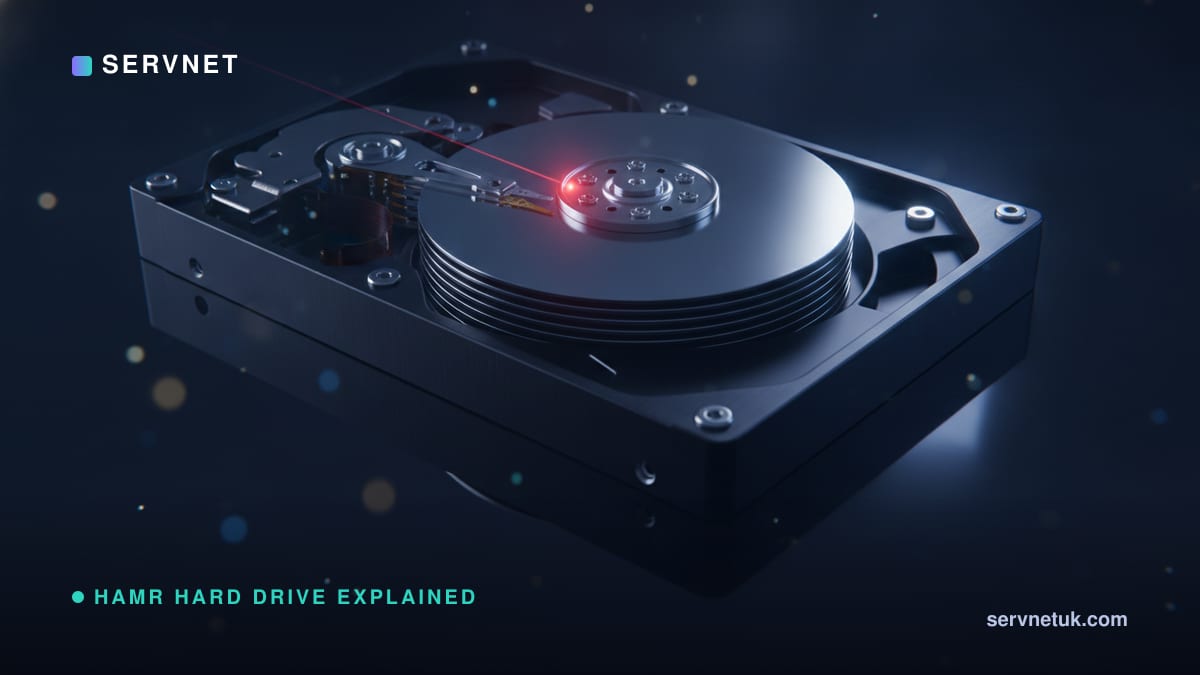
Heat-assisted magnetic recording (HAMR) sounds exotic, but it solves a very old problem: how to pack more data onto a spinning disk without the bits becoming magnetically unstable. The trick is a laser pulse lasting only a nanosecond-scale instant, hot enough to momentarily soften the magnetic media so a write head can flip a much smaller bit. This explainer covers exactly how that works, what capacities are commercially real in mid-2026 versus still on a roadmap, and why UK businesses running backup, archive and nearline tiers still can't fully swap hard disks for all-flash versus nearline HDD TCO economics.
View the data behind this chart
| TB per platter/disk | PMR benchmark | 1st commercial HAMR | Mozaic demonstrated | Future lab demo |
|---|---|---|---|---|
| Capacity per platter/disk (TB) | 1.5 | 3 | 3.6 | 6 |
What is HAMR, in plain English?
Heat-assisted magnetic recording is a hard drive write technique that uses a localised laser pulse to briefly heat the recording medium during the write operation, allowing data to be written at a higher areal density than conventional perpendicular magnetic recording (PMR) permits, according to IEEE's technical overview of the technology.
The reason this matters is a physical constraint engineers have wrestled with for years: shrink a magnetic bit too far under PMR and it becomes thermally unstable and prone to spontaneously flipping, corrupting data. Western Digital describes HAMR as solving this by using laser heating to temporarily reduce the media's magnetic anisotropy, which lets the drive use smaller, more stable bits than PMR media could support at the same size. Crucially, this is not a lab curiosity any more — IEEE identifies Seagate's Mozaic 3+ family as the first commercial HAMR product line.

Inside the write process: laser, Curie point, and the coercivity trick
A technical explainer from TU Chemnitz describes the mechanism precisely: an additional laser, paired with a plasmonic near-field transducer, heats the media locally to close to or above its Curie temperature during a nanosecond-scale write process. That heat pulse briefly lowers the medium's coercivity — its resistance to having its magnetic polarity changed — just long enough for the write head to flip the bit into the desired state, as IEEE explains.
Once the laser pulse ends, the tiny heated spot cools within nanoseconds and the new magnetic state locks in. TU Chemnitz's overview stresses that long-term storage and readback happen at room temperature — the heating is confined strictly to the instant of writing, not an ongoing condition of the drive. The remaining engineering challenge is one of precision: focusing enough energy into a spot small enough to write a modern-density bit, synchronised to nanosecond timing with the head's position, without heat bleeding into neighbouring bits already written on the disk.
Platter density, areal density and drive capacity are three different numbers
This is where most explainers get sloppy, and it's worth being exact. IEEE cites current PMR designs at roughly 1.5TB per platter, against Seagate's first commercial HAMR platters — the Mozaic 3+ family — at over 3TB per platter. Separately, Seagate's own technology material states the Mozaic platform has demonstrated 3.6TB per disk in areal-density terms, and describes future platforms showing 6TB per disk in lab demonstrations. An older Seagate technical overview separately puts the underlying HAMR areal-density target at around 5 terabits per square inch (Tbpsi).
None of these platter-level or areal-density figures should be read as a finished drive's total capacity — a multi-platter drive's marketed TB figure is built from several of these platters stacked together, and lab demonstration density is not the same as a shipping product. Keeping the platter number, the Tbpsi number, and the eventual drive-capacity number separate is essential to reading vendor roadmaps correctly.
HAMR in mid-2026: what's actually shipping versus what's still a target
IEEE's identification of Seagate's Mozaic 3+ as the first commercial HAMR family confirms the technology has moved past the demonstration stage into real products — see our detailed look at Seagate Mozaic: roadmap to 40TB HAMR drives for UK-specific buying detail. But vendor roadmaps move in stages: capacity classes shipped, capacity classes announced for qualification or limited launch, and capacity classes that remain future targets.
Western Digital frames this candidly, stating that its optimal inflection point for HAMR emerges at 40TB and above, where the capacity gain starts to outweigh the added cost and reliability risk of a newer platform — but this is explicitly a stated threshold, not a guarantee of current shipping availability. Seagate's own published target, per IEEE, is a 50TB drive. UK buyers should treat any 40TB+ figure quoted by a vendor as a roadmap or qualification-stage claim until confirmed against an actual, orderable SKU at the point of procurement.
HAMR versus PMR: performance and reliability trade-offs
HAMR changes how densely data is packed onto the platter; it does not change the fundamental mechanics of a spinning disk with a moving head. That means the performance uplift from HAMR shows up primarily in sustained sequential throughput as density rises, not in random I/O or latency, which remain governed by rotational speed and seek behaviour regardless of recording technology.
On reliability, the addition of a laser and near-field transducer inside the head assembly is a genuine new point of engineering complexity compared with a conventional PMR head. TU Chemnitz's description that heating is confined to a nanosecond-scale write event, with storage and readback at room temperature, is the core reassurance vendors point to — the media itself isn't kept hot. The added cost associated with HAMR stems largely from these new components: the laser diode and the plasmonic near-field transducer both add manufacturing complexity beyond a standard PMR head assembly, which is precisely why Western Digital frames its 40TB inflection point as the level at which capacity gains start to outweigh this added cost and reliability risk, rather than treating HAMR as a like-for-like cost swap with PMR. However, no independently verified failure-rate or MTBF comparison between HAMR and PMR drives is available in current source material, so UK buyers should qualify vendor reliability claims through their own testing cycles rather than accepting them at face value.
Why UK archive and nearline tiers still can't do without HDDs
The commercial case for HAMR in the UK has nothing to do with beating SSDs on speed. High-capacity hard disks remain the cheapest tier for backup, archive, surveillance footage, media repositories and nearline object storage — workloads where cost per TB, physical density in the rack, and long service life matter far more than millisecond latency.
This makes HAMR most relevant to hyperscale operators, managed service providers, and enterprise storage refresh cycles rather than to laptops or general-purpose application servers. For organisations managing retention under UK GDPR and sector-specific retention rules, the practical procurement question isn't whether HAMR is exciting — it's whether a 30TB-to-40TB-class drive reduces rack space, power draw and per-TB media cost enough to justify bringing a new drive platform into an already-qualified estate. See cold archive storage servers for how this plays out in retention-heavy deployments.
The roadmap beyond 2026, and what it means for procurement today
Seagate's published target of a 50TB drive, alongside its own lab demonstration of 6TB per disk described in its technology material, signals where the platform is heading — but both figures sit ahead of general commercial availability rather than describing what's on price lists today. Tracking the gap between lab-demonstrated density and shipping drive capacity is the single most useful discipline for a UK buyer evaluating vendor claims; our future HDD capacity roadmap tracks that gap by vendor and generation.
For procurement teams, the practical takeaway is to separate three questions before committing budget: is this capacity class shipping in volume, is it in qualification or limited launch, or is it a stated roadmap target. Conflating any of the three risks locking a refresh cycle to a drive that isn't actually orderable yet.
Sources
Every figure in this article traces to the sources below.
- •IEEE — HAMR mechanism, Mozaic 3+ as first commercial family, PMR platter benchmark
- •Seagate — HAMR areal density target of ~5 Tbpsi
- •Seagate — Mozaic 3.6TB/disk demonstration and 6TB/disk lab result
- •Western Digital — HAMR mechanism and 40TB inflection point
- •TU Chemnitz — laser, near-field transducer, and nanosecond write-event physics