
🌐 Cisco Catalyst 8200 SD-WAN vs C8300 SD-WAN
Catalyst 8200 vs Catalyst 8300 compared across 27 matched specifications — scores, the full spec table and a verdict.
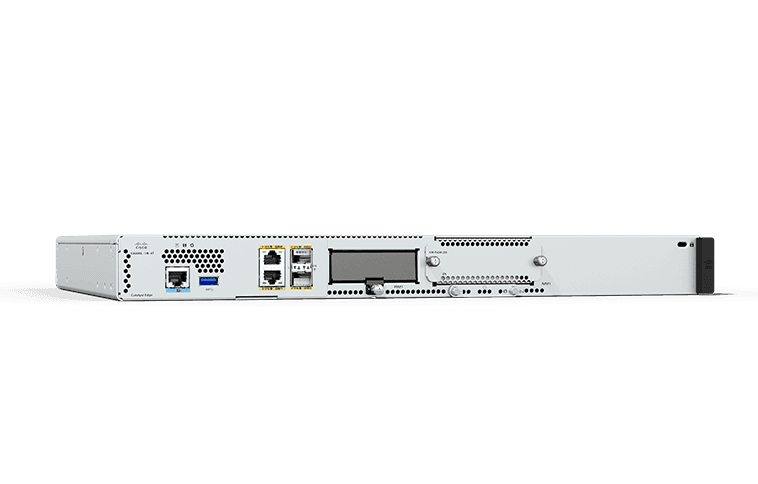

Cisco Catalyst 8200 SD-WAN vs C8300 SD-WAN: performance overview
Scores based on quantifiable specification values (1-10 scale)
Detailed Specifications
| Specification | Catalyst 8200 Cisco | Catalyst 8300 Cisco |
|---|---|---|
| Key Metrics | ||
| SD-WAN throughput | Up to 1 Gbps (1400-byte); 900 Mbps IMIX | Up to 18.8 Gbps (1400-byte) on C8300-2N2S-4T2X; up to 2 Gbps on 6T models |
| IPsec VPN throughput | Up to 1 Gbps (1400-byte); 900 Mbps IMIX | Up to 9.3 Gbps IMIX on C8300-2N2S-4T2X; 1.9 Gbps IMIX on 6T models |
| CPU cores | 8 (4 on C8200L) | 8 or 12 |
| Base / max memory | 8 GB (expandable to 32 GB) | 8 GB (expandable to 32 GB) |
| Modular expansion slots | 1 x NIM + 1 x PIM | 1 x NIM + 1 x SM + 1 x PIM (1RU) or 2 x NIM + 2 x SM + 1 x PIM (2RU) |
| Target deployment | Small to medium branch | Medium to large branch / regional hub |
| Performance | ||
| Aggregate IP throughput | Up to 3.8 Gbps (IPv4 forwarding, 1400-byte) | Up to 19.7 Gbps (IPv4 forwarding, 1400-byte) |
| SD-WAN throughput | 1 Gbps (1400-byte) | 2–18.8 Gbps (1400-byte, model-dependent) |
| Hardware crypto acceleration | Yes | Yes |
| CPU | 8-core (4-core on C8200L) | 8- or 12-core |
| Connectivity | ||
| Fixed WAN/LAN ports | 4 x GE (2 x RJ45 + 2 x SFP) | Varies by SKU — multiple GE / 10GE options |
| NIM (Network Interface Module) slots | 1 | 1 (1RU) or 2 (2RU) |
| SM (Service Module) slots | 0 | 1 (1RU) or 2 (2RU) |
| 5G support | Yes (5G pluggable module) | Yes (5G pluggable module) |
| Cellular / LTE WAN | Via pluggable LTE / 5G module (PIM) | Via pluggable LTE / 5G module (PIM) |
| Security & Services | ||
| Integrated NGFW | Yes | Yes |
| IPS / IDS | Yes | Yes |
| URL filtering | Yes | Yes |
| Cisco Umbrella SIG integration | Yes | Yes |
| ThousandEyes agent | Yes | Yes |
| TrustSec / SD-Access | Yes | Yes |
| Platform & Management | ||
| Operating system | Cisco IOS XE | Cisco IOS XE |
| SD-WAN controller | Cisco Catalyst SD-WAN Manager (vManage) | Cisco Catalyst SD-WAN Manager (vManage) |
| Zero Touch Provisioning | Yes | Yes |
| Programmability (NETCONF/YANG, RESTCONF) | Yes | Yes |
| Redundant power supply | No (internal fixed AC PSU) | Yes (dual PSUs ship as standard) |
| Fanless variant | No (C8200 and C8200L use internal fans) | No |
Expert Analysis
The practical difference between these two platforms is sizing, not capability. Both run the same Cisco IOS XE image, both have full feature parity in Catalyst SD-WAN Manager, and both integrate the same way with Umbrella SIG, ThousandEyes and TrustSec. What you are buying when you step up from the 8200 to the 8300 is far more encrypted throughput on the 10G models (up to 9.3 Gbps IMIX IPsec on the C8300-2N2S-4T2X against 900 Mbps IMIX on the C8200-1N-4T, while the 6T models reach 1.9 Gbps), Service Module slots, 10G WAN port options and dual power supplies as standard.
The Catalyst 8200 is the right answer for the typical UK branch: under 200 users, a single WAN circuit (or a circuit plus 4G/5G failover), and a need for SD-WAN, NGFW and SIG without a separate appliance. Its C8200L variant (4-core CPU, up to 500 Mbps IPsec) suits retail back-offices, GP surgeries and small professional-services sites where encrypted WAN demand is modest. The trade-off is a single internal PSU and only one NIM slot (plus one PIM) — if the box dies, the site is offline until an engineer attends.
The Catalyst 8300 earns its place at larger branches, regional hubs and any site where the WAN aggregates more than ~1 Gbps of encrypted traffic, where dual power is a hard requirement, or where 10G WAN ports are needed. The SM slots (and a second NIM on 2RU models) also matter if you need voice gateways, additional Ethernet density, or specialised modules co-resident with the SD-WAN edge.
As a rule of thumb: choose the 8200 for branches up to roughly 200 users on sub-gigabit circuits where cost-per-site matters; choose the 8300 for hub sites, sites with gigabit-plus encrypted WAN, anywhere dual PSU is mandated (financial services, healthcare hubs covered by NIS2/DSPT resilience expectations), and any deployment where Service Module expansion is part of the roadmap.
Ready to proceed?
Not sure which one fits your environment?
Our UK specialists will recommend the right option for your workload and send itemised pricing — vendor-neutral, no obligation.
Response within 4 business hours · 20+ yr UK reseller
Want to compare different products or add more to this comparison?
Open Interactive Comparison Tool →Made your choice? Spread the cost.
Whichever you choose, you don't have to pay for it all upfront — finance your new hardware from £258/mo ex VAT on hire purchase or lease. Compare monthly payments and terms in seconds.
See finance from £258/mo →Indicative estimate · subject to change · no credit check at this stage · hire purchase, lease & subscription for UK businesses
Indicative illustration only. Servnet Limited is not authorised or regulated by the FCA and does not provide financial advice or arrange finance. All finance opportunities are referred to Number Eight Business Finance. Finance policy
Related comparisons
Other head-to-heads featuring these models — useful if you’re still shortlisting.
Talk to a UK specialist
Get expert advice or a no-obligation quote — servers, storage, networking, maintenance, finance and cloud. We reply the same working day.