
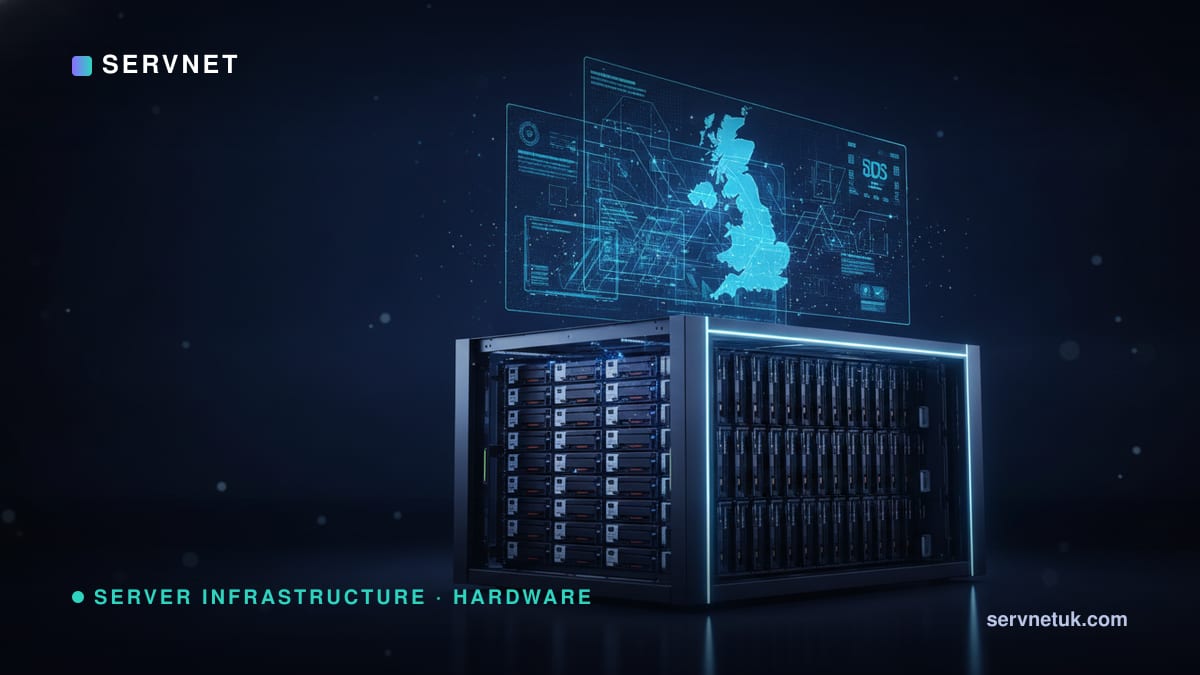
The HPE Apollo 4200 is one of those servers that does exactly one job extremely well: hold an enormous number of disks in a single, conventional-depth chassis and present them to a software-defined storage platform. It is the machine UK teams reach for when they need raw capacity by the petabyte, for Ceph, Scality, object stores, big-data lakes or large backup tiers, without resorting to a separate disk shelf for every node. This is the engineering view: how the 4200 is built, where its density comes from, how the disk-to-controller path actually works, and when a dense node beats a standard rack server or a JBOD-attached design.
View the data behind this chart
| Layer | Detail |
|---|---|
| Dense LFF bays | Dozens of drives in 2U drawers |
| SAS expander | Fans ports out to every bay |
| HBA (pass-through) | IT mode — each disk native |
| Controllers + CPU | SDS layer manages redundancy |
What the Apollo 4200 is for
The Apollo 4200 Gen10 is a 2U server whose defining feature is capacity. Where a normal 2U rack server fits perhaps a dozen large drives across its front, the 4200 packs dozens of large-form-factor (LFF) drives into the same height by using internal drawers and clever internal layout, while remaining a standard-depth rack server rather than an exotic deep chassis. The result is a single node that holds the capacity that used to require a server plus an external shelf.
That density is the whole point, because the workloads it targets, distributed file systems, object storage and capacity-tier backup, scale by adding nodes that each contribute as much disk as possible. Fewer, denser nodes means fewer servers to manage, power and licence for a given petabyte, which is the same density logic that drives the rest of the HPE Apollo family and distinguishes it from general-purpose HPE servers.
How the drives connect: the controller and HBA path
Packing in drives is only useful if the data path behind them can keep up, and this is where the 4200 is more interesting than a simple drive count. The many drives connect through SAS expanders, components that fan a small number of controller ports out to a large number of drive bays, onto a storage controller. For software-defined storage, that controller is typically a host bus adapter (HBA) rather than a RAID card.
The distinction matters. Software-defined storage platforms such as Ceph want direct, unmediated access to each disk so they can manage redundancy, placement and healing themselves; a RAID controller that hides disks behind a logical volume actively gets in the way. An HBA in pass-through (sometimes called IT mode) presents every drive natively to the operating system and the SDS layer, which is exactly what those platforms expect. Choosing and configuring that adapter correctly is central to the build, and it is why the host bus adapters decision is not an afterthought on a node like this.
- •Dozens of LFF drives in a standard-depth 2U chassis via internal drawers
- •SAS expanders fan controller ports out to the full set of drive bays
- •HBA in pass-through (IT mode) presents each disk natively for SDS
- •Avoid hiding disks behind RAID volumes where the SDS layer manages redundancy
Balancing capacity with compute and memory
A dense storage node is not all disk. The 4200 still carries server-class CPU and memory, and getting that balance right is what separates a good SDS host from a sluggish one. Distributed storage software consumes real CPU and RAM, for erasure coding, checksums, compression, replication and especially for recovery when a disk or node fails and the cluster rebuilds. Under-provision the compute and the node becomes a bottleneck precisely when it is under most stress.
So the engineering exercise is to match processor cores and memory to the capacity and the software, neither starving the SDS layer nor paying for compute that idle disks will never use. That sizing depends on the platform and the redundancy scheme, and it is the kind of trade-off we model per deployment as part of designing an Apollo storage tier rather than reading it off a single spec sheet.
View the data behind this chart
| Apollo dense | Standard 2U | JBOD-attached | |
|---|---|---|---|
| Capacity/U | Highest | Lower | High |
| IOPS path | Self-contained | Self-contained | Shared head |
| Rebuild parallelism | Strong | Per-node | Concentrated |
| Footprint | Compact | Many nodes | Server + shelves |
| Best for | Scale-out SDS | Modest cap | Bulk archive |
Dense node vs standard rack vs JBOD-attached
There are three credible ways to build out capacity, and the 4200 is the middle path. A standard 2U rack server is the most flexible and familiar, but it tops out at relatively modest drive counts, so reaching real scale means many nodes and a poor capacity-per-rack-unit ratio. At the other extreme, a thinner server attached to external JBOD shelves can amass huge capacity, but it splits the design across multiple boxes and cables and concentrates a lot of disk behind one server head, which can hurt rebuild parallelism.
The dense node, the Apollo 4200, sits between them: far more capacity per node than a standard server, but self-contained, with disks, controller and compute in one serviceable unit. For scale-out SDS that prizes many independent nodes each rebuilding in parallel, that self-contained density is usually the sweet spot. For comparison across the wider HPE storage portfolio and adjacent platforms, it is worth seeing where it sits relative to Dell storage options too, since the right answer is workload- and scale-dependent.
When the 4200 is the right call
Reach for an Apollo 4200 when capacity is the dominant requirement and the storage intelligence lives in software: Ceph and other object or file stores, big-data and analytics lakes, media archives, and large capacity-tier or backup landing zones. It is purpose-built to be the dense, disk-heavy building block those platforms are designed to scale across.
It is the wrong tool when you need the lowest-latency block storage from a turnkey array, where a purpose-built SAN is a better fit, or when your capacity is modest enough that a standard rack server with internal NVMe does the job without the density. As with any platform choice, the decision is about matching the box to the workload and the scale, which is exactly the conversation we have when configuring an HPE Apollo storage node, with the controller path built correctly using the right host bus adapters.