
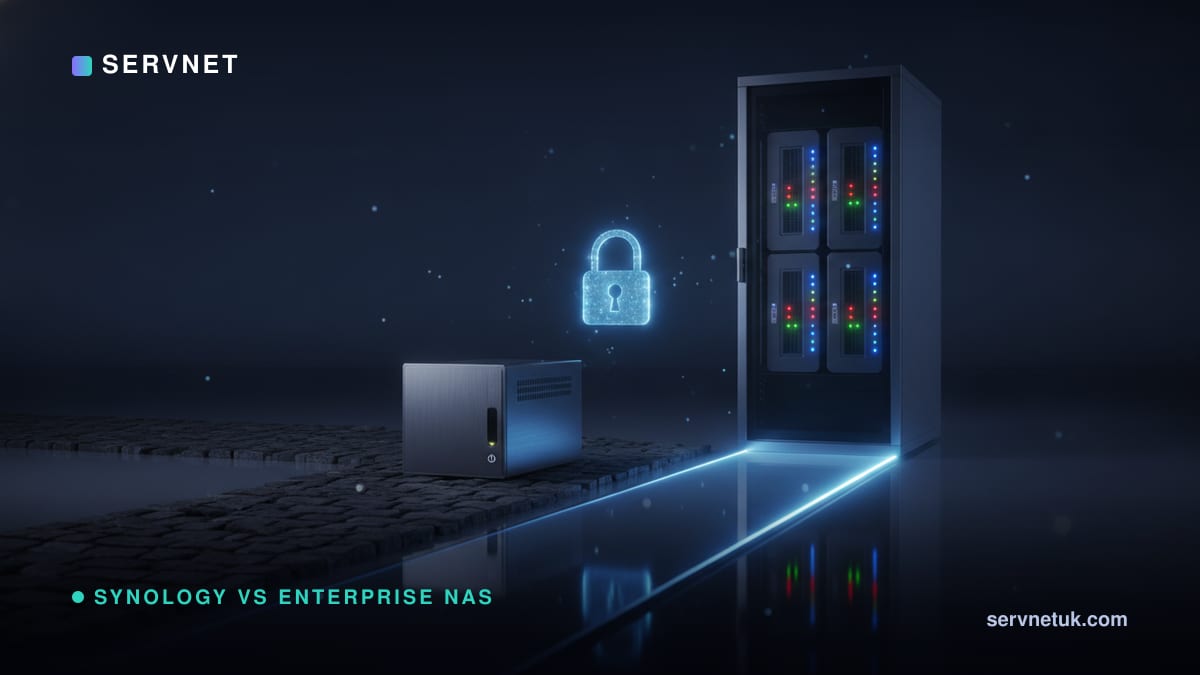
The UK’s National Cyber Security Centre, in analysis published in 2020, reported that the QSnatch campaign had infected 3,900 QNAP devices in the UK out of 62,000 worldwide and framed it as an ongoing legacy‑risk malware issue rather than a one‑off incident — proof that prosumer NAS boxes are a documented ransomware target class, not a hypothetical risk. Yet capacity isn't usually why UK firms outgrow Synology or QNAP. The real trigger is architecture: a single controller, a single power supply, and best-effort support becoming a genuine point of business failure. This piece uses verified Synology and QNAP vendor specs, OVHcloud UK pricing and NCSC threat data to define when that moment arrives, and give indicative costs to fix it rather than a full market survey.
View the data behind this chart
| Controllers | Failover | Max Capacity | |
|---|---|---|---|
| Prosumer NAS | Single, no redundancy | Manual, rebuild only | Vendor-dependent |
| SA3200D (dual) | Dual, auto-failover | <1 min downtime | 576TB, 36 bays |
| PAS7700 NVMe | Active-active dual | Continuous ops | Not disclosed |
The Core Question: Capacity Isn't the Trigger, Architecture Is
Most conversations about outgrowing Synology or QNAP start with a terabyte count. That's the wrong frame. A growing UK business can hold hundreds of terabytes on a well-specified box and still be fine — or hold a fraction of that and already be exposed, because the thing that actually breaks isn't storage space. It's what happens when a single controller, a single power supply, or a single vendor's best-effort support ticket stands between the business and its data.
Synology's 2026 enterprise-storage messaging reinforces this. The company positions its platform for file services, offsite backups and disaster recovery — recovery infrastructure, not just a shared drive. That's an admission, in effect, that the moment a NAS becomes business-critical, it needs to be treated as infrastructure with recovery objectives, not a convenient file share that happens to hold everything.
Defining the Tiers: Controller Redundancy Is the Real Dividing Line
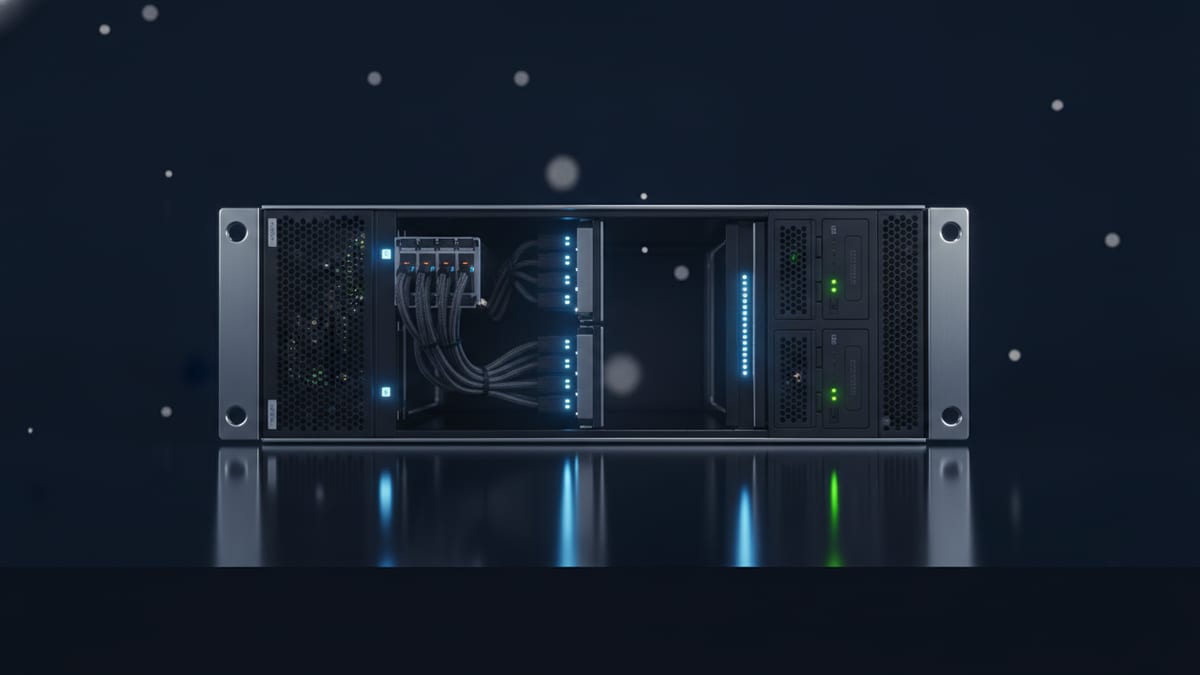
The clearest technical line between prosumer NAS and entry enterprise gear is controller architecture. Synology's SA3200D — a 2U, dual-controller shared-storage system supporting up to 36 SAS bays and 576 TB — is built with active-passive automatic failover to a secondary controller, with Synology stating downtime can be minimised to under one minute. By comparison, QNAP's enterprise-tier counterpart, the Enterprise ZFS series (such as the 16-bay ES1686dc or 24-bay ES2486dc), moves to dual active-active Intel Xeon controllers with battery-backed NVRAM write caching and ZFS self-healing data integrity, eliminating failover downtime entirely.
A typical desktop or single-controller rackmount NAS from either vendor has neither of those protections: a failed controller or power supply requires manual component replacement and a prolonged rebuild during which data remains at risk. Moving past SMB chassis to genuine third-party enterprise unified storage — such as a NetApp FAS or Dell PowerStore array — introduces multi-node scale-out clustering, non-disruptive firmware updates, and 24/7 4-hour on-site hardware response SLAs. That technical divide between manual component rebuilds, single-chassis dual controllers, and true enterprise scale-out architecture is the real graduation ladder.
Performance and Scalability: Where the Ceiling Actually Sits
Synology's own enterprise tier shows one clear architectural ceiling for this model: the SA3200D supports up to 36 SAS bays and up to 576 TB, via two RXD1219sas expansion units. For most growing SMBs that's a genuinely large ceiling. But Synology’s documentation indicates that the SA3200D’s built-in High Availability package is limited to that one pair of controllers and is not designed to form a separate high-availability cluster with another server unit. In other words, once a firm needs true scale-out resilience across multiple nodes, this platform's own architecture stops it.
That gap aligns with Synology's July 2026 PAS7700 launch, which introduces an active-active NVMe architecture aimed at continuous operations. Industry EMEA reported that the PAS7700 platform uses dual active‑active controllers aimed at continuous operations, a distinct architectural step up from the SA3200D’s dual‑controller high‑availability model, and Synology's launch materials describe it as designed for continuous operations during unexpected incidents. Taken together, Synology's product line suggests that single-box HA sits as a mid-tier option rather than the final destination for scale-out resilience.
The Ransomware Reality: NAS Boxes Are a Documented Target Class
This isn't a theoretical risk. The NCSC's 2020 warning on QSnatch framed it as a legacy-risk malware issue rather than a one-off incident, describing two campaign waves — 2014 to mid-2017, then late 2018 onward — before the joint UK/US alert was issued to address widespread enterprise and SMB infections.
QNAP NAS boxes were targeted again in January 2022, when TechRadar reported the DeadBolt ransomware campaign encrypting devices worldwide, and in June 2022, when Security Magazine reported QNAP warning users about renewed DeadBolt attacks — the same vendor issuing two DeadBolt-related warnings within the first half of 2022. As of August 2026, Senserva’s snapshot of the CISA Known Exploited Vulnerabilities catalogue lists 11 QNAP CVEs, confirming exploitation in the wild; some of these have been linked in public reporting to ransomware campaigns. That's a live, current snapshot, not history — and it's the strongest argument for treating a single-controller NAS holding business-critical data as an operational risk rather than a purely technical one.
Beyond the Box: What Enterprise Resilience Actually Costs in the UK
UK buyers need a real yardstick, but comparing on-prem appliances directly to cloud storage requires an upfront distinction: OVHcloud's UK Enterprise File Storage is a recurring OPEX cloud service proxy, not on-prem hardware CAPEX. Priced in early 2026 at £109.99 ex VAT per TB per month at the 1 TB tier (dropping to £87.99 ex VAT per TB per month at higher commitment), it pays for vendor-managed multi-datacenter replication, continuous snapshots, and offsite failover billed monthly rather than an outright hardware purchase.
For an on-prem like-for-like comparison, indicative UK hardware pricing reveals the true capital threshold. A barebone dual-controller SMB unit like the Synology SA3200D retails around £4,500–£5,500 ex VAT, while QNAP's dual active-active ES series sits around £7,500–£9,500 ex VAT barebones. Stepping up to tier-1 enterprise unified storage — such as an entry NetApp FAS2820 or Dell PowerStore 500T — typically demands £18,000 to £25,000+ ex VAT once drives, multi-node clustering licenses, and a mandatory 3-year 24/7 4-hour on-site mission-critical SLA are included. Owning on-prem hardware also means absorbing internal admin hours for failover testing and spare parts logistics. Storage finance options from UK leasing providers can spread that initial capital outlay across 36 to 60 months, making the comparison against recurring cloud rates genuinely like-for-like.
View the data behind this chart
| Phase | Starts (week) | Duration (weeks) |
|---|---|---|
| QSnatch Wave 1 | 0 | 3 |
| QSnatch Wave 2 | 4 | 3 |
| DeadBolt 2022 | 8 | 1 |
Real-World Scenarios: When Synology Still Fits, and When It Doesn't
Synology's own positioning around file services, offsite backup and disaster recovery is a legitimate use case, not marketing spin. A departmental file share, a backup target for a 3-2-1 strategy, or a DR copy sitting behind a primary array are all workloads where a well-configured Synology box — ideally one with the SA3200D's dual-controller design — is entirely appropriate, even inside an otherwise enterprise IT estate.
Where it stops fitting is scale-out. A firm that needs high-availability storage spanning multiple physical nodes runs straight into the SA3200D's own stated limit: no clustering with a second server unit. At that point the honest options are Synology's own active-active PAS7700 tier, a true enterprise SAN, or a managed service like OVHcloud's Enterprise File Storage — not forcing a single dual-controller box to do a multi-node job it was never built for.
A Decision Framework: The Specific Triggers to Watch For
Strip away the marketing and the graduation decision comes down to five concrete, checkable triggers rather than a gut feeling about age or capacity.
- •Single controller or single PSU currently protecting business-critical data, with no automatic failover path
- •Support is best-effort rather than a contracted response-time SLA, and downtime has a real revenue or compliance cost
- •The NAS vendor or model class has documented ransomware campaigns against it, as QNAP has with QSnatch and DeadBolt
- •The box is approaching its own architectural ceiling — for Synology's SA3200D, that's 36 bays, 576 TB, and no cross-server HA clustering
- •Recovery objectives now require offsite DR or multi-node resilience, not just a bigger local volume
The Verdict: Where Synology Sits on the Ladder
Synology isn't the wrong choice for a growing UK business — it's a vendor that has visibly built its own ladder, from single-controller NAS through the SA3200D's dual-controller HA up to the July 2026 active-active PAS7700. The mistake is staying on the wrong rung after the business has outgrown it: after a single-controller box becomes the one thing standing between the firm and a ransomware headline, or after scale-out needs collide with the SA3200D's no-cross-cluster limit.
The right move for most growing UK firms is to use a storage solution finder to map current and 12-month data growth against the specific triggers above, rather than waiting for a controller failure to force the decision. Whether that lands on a dual-controller Synology box, a true enterprise array, or a managed service priced per TB per month, the decision should be made on architecture and risk — not on how full the drive bays currently are.
Sources
Every figure in this article traces to the sources below.
- •Synology — SA3200D product specifications (controllers, bays, capacity, HA claims)
- •Synology — enterprise-storage positioning (file services, backup, DR)
- •Synology — PAS7700 active-active NVMe launch, July 2026
- •Industry EMEA — PAS7700 active-active vs active-passive architecture
- •Infosecurity Magazine — QSnatch UK/global infection figures
- •NCSC — QSnatch legacy-risk malware warning
- •TechRadar — DeadBolt ransomware campaign, January 2022
- •Security Magazine — QNAP renewed DeadBolt warning, June 2022
- •Senserva — QNAP CVEs in CISA KEV catalogue, 2026 snapshot
- •OVHcloud — UK Enterprise File Storage pricing
View the data behind this chart
| 1TB tier | Larger tier | |
|---|---|---|
| £ per TB/month | £109.99 | £87.99 |