

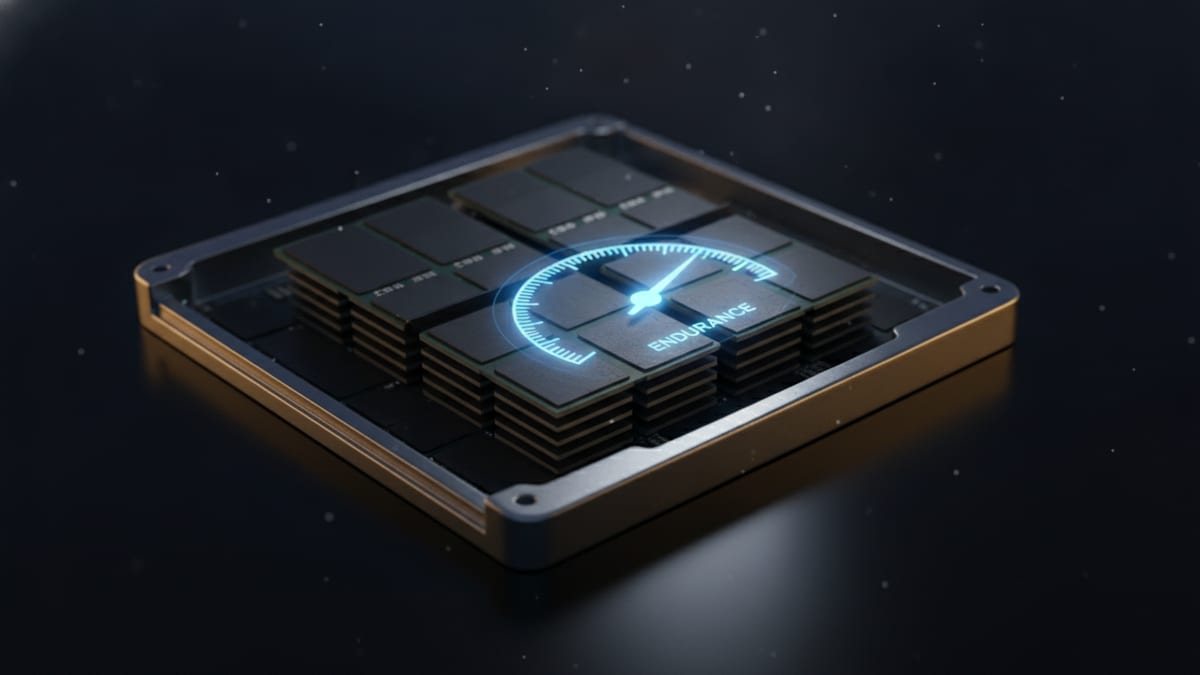
Enterprise QLC NAND cycles at roughly 1,000 program/erase cycles per cell — a fifth of the ~5,000 cycles typical TLC NAND tolerates. That sounds like a dealbreaker until you model the workload: under a stated random-write assumption with 4x write amplification, the resulting drive-level endurance comes out at under 0.14 DWPD over five years — comfortably inside the envelope for read-heavy analytics, archives and media libraries, but nowhere near enough for a churning database. This is the real 2026 QLC question for UK buyers eyeing the latest trends in enterprise SSD capacity: not whether QLC is safe, but whether your specific workload's write profile stays inside that thin margin.
View the data behind this chart
| QLC NAND | TLC NAND | |
|---|---|---|
| Program/erase cycles | cycles1000 | cycles5000 |
The Maturation of Enterprise QLC in Mid-2026
Enterprise QLC flash has moved past the experimental phase. Dell Technologies frames the trade-off cleanly: QLC suits capacity-intensive, latency-tolerant workloads, while TLC remains the better fit for heavy write workloads. That single distinction, restated in different words by TechTarget, Computer Weekly, HPE and Solidigm, is now the entire enterprise QLC conversation in 2026 — not whether the technology works, but whether your workload's write profile sits on the right side of that line.
The commercial pull is obvious. TechTarget notes that QLC's lower cost per gigabyte can make it attractive at enterprise scale despite real endurance and performance disadvantages. But 'attractive' and 'appropriate' are different questions, and the gap between them is where storage teams get burned — either by over-provisioning expensive TLC capacity they didn't need, or by deploying QLC under a workload that quietly burns through its endurance budget years ahead of schedule.
This piece sets out where the maths genuinely favours QLC, where it doesn't, and how a UK buyer should structure the decision rather than default to either extreme.
What Actually Changed Inside QLC — And What Didn't
QLC NAND stores four bits per cell rather than the three bits TLC uses, which Dell explains means distinguishing between 16 voltage states per cell instead of eight. More states packed into the same physical cell means denser, cheaper capacity — but also finer, more error-prone writes, because the controller has far less voltage margin when programming and reading each cell.
That architectural reality hasn't changed in 2026, and vendors aren't pretending it has. ScaleFlux's endurance analysis puts typical QLC cycling endurance at around 1,000 program/erase cycles, against roughly 5,000 cycles for TLC — a five-fold gap at the NAND level. What has matured is everything built around that limit: controller firmware, over-provisioning and workload-aware caching that keep drives operating safely within it, provided the workload is chosen correctly in the first place.
The Endurance Math IT Leaders Actually Need
Raw cycling endurance and drive-level endurance (DWPD) are not the same measurement, and conflating them is the most common mistake in QLC procurement conversations. Cycling endurance describes how many times a NAND cell can be programmed and erased before it degrades. DWPD describes how many times you can rewrite the drive's full capacity every day for its warranty period — and that number depends heavily on the actual write pattern and the drive's internal write amplification.
ScaleFlux models this explicitly: under a full-LBA-span random write workload with 4x intra-SSD write amplification, that 1,000-cycle NAND limit translates to a drive-level endurance of under 0.14 DWPD over five years. That's a thin margin — comfortably sufficient for infrequent, sequential or read-dominated writes, but it will exhaust quickly under sustained random write churn.
None of this touches raw read latency, where QLC increasingly holds its own. Dell cites modern QLC arrays achieving small-block latency around 30 microseconds — a figure that reflects read performance in current architectures, not the separate endurance question. A QLC drive can feel fast in day-to-day reads while still being the wrong choice if the workload's write intensity is misjudged. Before committing capital, model the real write pattern against the rated warranty — you can calculate the endurance of your QLC drives using our DWPD/TB calculator rather than relying on vendor headline numbers alone.
Where QLC Is Genuinely the Right Call in 2026
Across every vendor and analyst source examined, the same workload class keeps recurring as QLC's sweet spot: large, read-dominated datasets where raw capacity and read throughput matter more than write latency or endurance headroom.
Solidigm's own guidance narrows this further: good QLC candidates combine high read bandwidth, low latency and high quality-of-service needs, and remain read-intensive even when there's meaningful large-block write pressure. That's a more precise test than simply asking whether a workload is 'cold' — plenty of active, business-critical analytics platforms are read-intensive enough to qualify, even though they're anything but cold storage.
- •Analytics and machine learning platforms — TechTarget identifies machine learning and data analytics as ideal QLC workloads specifically because QLC's read speeds are a genuine strength.
- •Media and content libraries — TechTarget notes media streaming suits QLC because it needs high speed and capacity to host video files; Computer Weekly adds content delivery and video streaming to the same category.
- •Business intelligence, NoSQL and read-focused databases — Computer Weekly's list of good QLC fits centres on applications that are read-focused rather than write-heavy.
- •Large-scale batch and archival I/O — Meta targets QLC at workloads needing only around 10 MB/s/TB as a performance floor, or around 15–20 MB/s/TB for large batch I/O, both well below what TLC is built to sustain.
- •Non-latency-sensitive virtualisation, dev/test and analytics — HPE includes these among the mainstream and mixed workloads it considers fit for QLC, provided they aren't performance-critical.
Where QLC Is Still the Wrong Call
HPE is unambiguous that QLC is a poor fit for performance-critical applications needing higher endurance, lower latency and faster write speeds — and that guidance hasn't softened in 2026. The workloads to actively avoid are the ones where writes are frequent, random and unpredictable: core transactional databases, OLTP systems, and virtual desktop platforms with heavy churn.
Dell's framing puts it plainly: QLC suits capacity-intensive, latency-tolerant use cases, while heavy write workloads belong on TLC. Mixed virtualised environments sit in an awkward middle ground — HPE lists non-latency-sensitive VMware and dev/test as feasible, but only when they're genuinely non-latency-sensitive, not simply because 'virtualisation' sounds close enough to the workloads that do fit.
The commercial risk of getting this wrong runs in one direction only: a QLC drive deployed under a write-heavy workload burns through its endurance envelope years earlier than planned, turning a lower-capex purchase into an unplanned mid-life replacement — exactly the lifecycle cost a capacity-driven business case was supposed to avoid.
View the data behind this chart
| QLC Verdict | Endurance Need | Best Storage Tier | |
|---|---|---|---|
| Analytics & BI platforms | Strong fit | Low | QLC primary |
| Media & content libraries | Strong fit | Low | QLC primary |
| Archival & backup | Strong fit | Very low | QLC primary |
| Large batch analytics I/O | Strong fit | Low-medium | QLC primary |
| Core OLTP databases | Avoid | High | TLC required |
| VDI / high-churn VMs | Avoid | High | TLC required |
| Mixed virtualisation | Caution | Medium | TLC safer default |
The UK Buyer's Checklist — Procurement, Compliance and Workload Reality
For UK IT leaders, the QLC decision should start with a workload audit, not a price list. Classify each candidate system by its actual read/write ratio and retention profile before comparing quotes: a data lake with years of write-once, read-many analytics traffic is a very different proposition to a logging platform with the same nominal capacity but constant active writes.
Retention and compliance rules matter too. Long-retained datasets held to satisfy UK GDPR or sector-specific retention obligations often behave like archive workloads in practice — infrequent access, minimal rewriting — exactly the profile QLC handles well. Systems holding active records, audit logs or anything with ongoing write churn should stay on higher-endurance TLC tiers regardless of how attractive the QLC price point looks.
Procurement teams should also stress-test vendor endurance claims against their own write pattern rather than accepting a single headline DWPD figure, given how sensitive that number is to write amplification assumptions. Modelling your specific workload — rather than the vendor's reference workload — is worth the extra procurement step before signing off a capacity refresh.
Building a Tiering Strategy — Mixing QLC, TLC and HDD
Meta's data-centre engineering team positions QLC explicitly as a middle tier sitting between HDDs and TLC SSDs, aimed at workloads that still need meaningful per-terabyte performance — around 10 MB/s/TB as a floor, up to 15–20 MB/s/TB for large batch I/O — but don't need TLC's write headroom or absolute latency. That's a useful mental model for UK storage architects: QLC isn't a straight swap for either HDD or TLC, it's a distinct tier with its own sweet spot.
In practice that means a tiered architecture: TLC for active transactional and latency-critical workloads, QLC for read-heavy analytics, media and warm-to-cold data lakes, and HDD (or deeper archive media) for the coldest, least frequently touched capacity. Getting the workload classification right at each tier boundary matters more than which specific drive model you buy within it. If you're weighing this against a wider storage roadmap, it's worth reviewing comparing the total cost of ownership for SSDs versus HDDs before finalising tier boundaries.
The Verdict — A Decision Framework for 2026
Strip away the vendor marketing and the QLC decision reduces to three questions. First, what's the real read/write ratio of the workload, not the assumed one? Second, is the application latency-tolerant enough that occasional write-path overhead won't breach service levels? Third, does the data's retention and compliance profile behave like an archive with infrequent rewrites, or an active record with ongoing churn?
Answer read-heavy, latency-tolerant and archive-like, and QLC is very likely the right call — the cost-per-terabyte advantage that TechTarget and Dell both point to is real, and it compounds across a capacity-scale deployment. Answer no to any of the three, default to TLC; the endurance maths simply doesn't support QLC for workloads with sustained random write pressure, however tempting the sticker price.
Given how NAND pricing has been moving through 2026, it's also worth checking current market conditions before locking in a tier strategy — see our separate analysis on how to navigate the current NAND flash pricing landscape — because the economics of a QLC-vs-TLC decision can shift meaningfully depending on where you buy in the cycle.
Sources
Every figure in this article traces to the sources below.
- •Dell Technologies — QLC vs TLC architecture, voltage states and latency
- •TechTarget — QLC enterprise use cases and cost-per-gigabyte
- •Computer Weekly — QLC read-focused workload fit
- •Meta Engineering — QLC data-centre workload targets (MB/s/TB)
- •Solidigm — QLC data-centre readiness white paper
- •HPE — QLC vs TLC workload suitability
- •ScaleFlux — QLC cycling endurance and DWPD modelling
View the data behind this chart
| Layer | Detail |
|---|---|
| NAND cycling limit | ~1,000 program/erase cycles per cell |
| Controller & firmware mitigation | Over-provisioning reduces write amplification |
| Workload write profile fit | Read-heavy patterns stay in the envelope |
| Resulting drive endurance | Under 0.14 DWPD over 5 years in this model |