
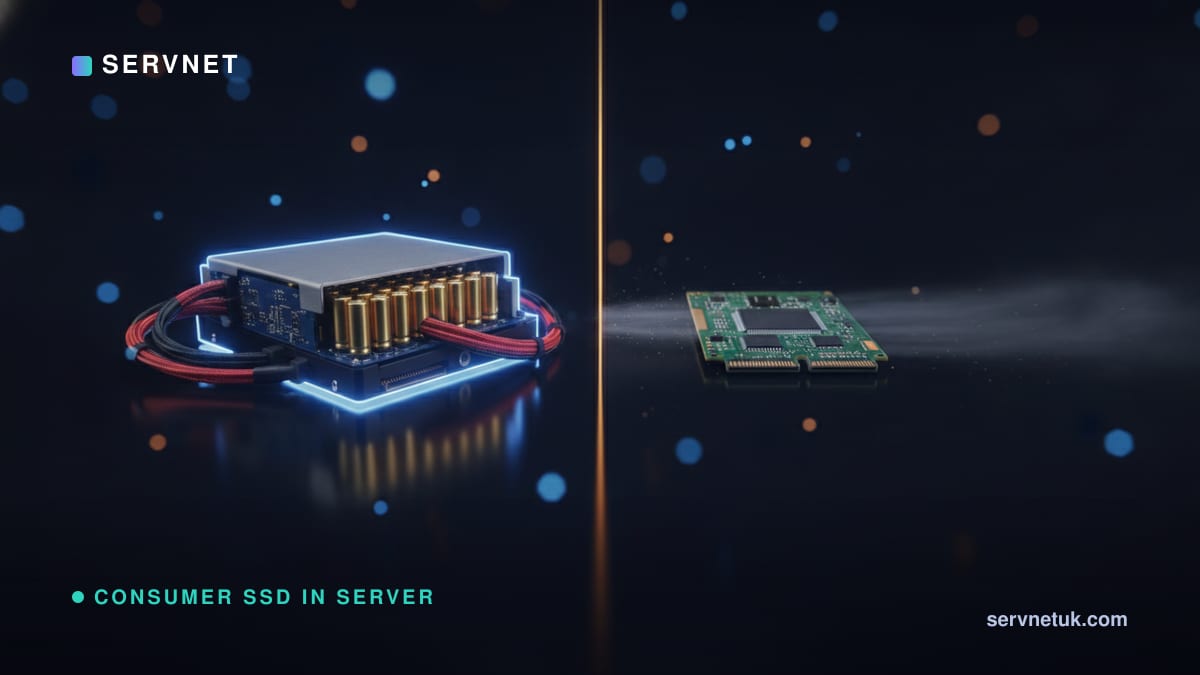
Deploying a consumer SSD in server infrastructure has become an alluring shortcut as flash storage budgets tighten across Britain. Wholesale NAND flash contract prices rose 55–60% quarter-on-quarter in Q1 2026 on TrendForce's revised figures, sharply driving up procurement costs across UK enterprise channels. However, substituting desktop or gaming drives into 24/7 production environments introduces critical systemic vulnerabilities. Mainstream consumer SSDs generally omit full hardware-based power-loss protection capacitor banks, rely on aggressive dynamic caching that collapses under sustained write operations, and lack firmware tuning for enterprise storage controllers. While retail drives can suffice in isolated, stateless roles, evaluating enterprise SSDs and NVMe drives reveals that the initial hardware savings are rapidly consumed by silent corruption, degraded array performance, and unexpected drive replacements.
View the data behind this chart
| UK Street Price (£) | Early 2025 | Late 2025 | Mid-2026 |
|---|---|---|---|
| Commercial 2TB NVMe | 120 | 220 | 320 |
| Commercial 1TB SATA | 60 | 100 | 145 |
Consumer SSDs in Servers: A 2026 Reality Check for UK IT Pros
Procurement pressures across the UK have escalated dramatically throughout 2026. Following contract price increases of 55–60% in wholesale NAND flash during the first quarter of 2026 (TrendForce's February revision of a 33–38% forecast), enterprise IT departments and managed service providers face substantially higher replacement and expansion costs. In the UK commercial market, projections from hardware specialists BVM and Hardvance show a commercial 1 TB SATA SSD reaching about £145 in mid‑2026—around 45% higher than the benchmark £100 late‑2025 level, and more than double the roughly £60 early‑2025 price point. Similarly, UK commercial projections from BVM and Hardvance show a 2 TB NVMe SSD rising from about £120 in early 2025 and £220 in late 2025 to around £320 by mid‑2026, a roughly 45% increase over the late‑2025 level.
These pricing shifts have tempted engineering managers to consider retail M.2 NVMe and SATA drives to populate storage shelves, virtualisation hosts, and commercial network-attached storage (NAS). Spot and street prices illustrate the immediate allure: TrendForce’s late‑August 2026 street‑price snapshot quotes client drives in USD, listing a Silicon Power US75 1 TB at $177.47 (approx. £140), an ADATA Ultimate SU650 960 GB at $180.28 (approx. £142), and a Samsung 990 Pro 1 TB at $239.99 (approx. £189). On paper, slotting these client drives into a standard chassis appears to trim hundreds of pounds from an initial bill of materials.
However, treating consumer and enterprise solid-state drives as interchangeable commodities misunderstands the mechanical and algorithmic realities of flash storage. The Servnet UK 2026 Storage Price Index compares 30 TB TLC SSDs, 30 TB QLC SSDs, and 30 TB HDDs, illustrating that current enterprise storage price analysis in the UK is focused on very high-capacity density rather than consumer‑sized drives, where predictable latency, continuous availability, and data integrity govern infrastructure design. Retail drives are primarily engineered for short, bursty desktop workloads, rather than the persistent, high‑concurrency queue depths that typical server deployments demand.

The Core Divide: Controller Firmware, Over-Provisioning, and NAND
The primary differences between consumer and enterprise solid-state drives stem from firmware design, controller architecture, and NAND cell management. Consumer TLC drives are built to balance unit cost against peak burst speeds for single-user client operating systems. Under the hood, consumer TLC flash in mainstream NVMe drives typically falls in the 1,500 to 3,000 program/erase (P/E) cycle range per cell. To deliver impressive performance figures on marketing spec sheets, client controllers dedicate a portion of their flash to dynamic pseudo-SLC (pSLC) caching. This mechanism allows files to be written rapidly in single-bit mode before the controller migrates the data to TLC blocks in the background during system idle periods.
In a commercial server environment, system idle periods rarely occur. Database logging, virtual machine disc heartbeats, web traffic logging, and background indexing generate an uninterrupted stream of write commands. Once a consumer drive's pSLC cache is exhausted under a sustained server workload, the controller must read, erase, and write TLC blocks simultaneously. This causes write speeds to collapse from gigabytes per second to tens of megabytes per second, spiking command latency across the storage subsystem.
Enterprise drives circumvent this behaviour by utilising sophisticated controller firmware tuned specifically for 24/7 mixed workloads. Rather than using aggressive, volatile caching algorithms, enterprise units typically ship with substantially higher factory over‑provisioning—commonly in the tens of percent of raw NAND capacity—kept invisible to the operating system. This spare capacity gives the controller dedicated space for continuous background garbage collection, wear levelling, and bad-block retirement without stalling active host I/O requests. When evaluating flash longevity, buyers often calculate DWPD and TBW for SSDs to understand how over-provisioning and firmware efficiency protect write pipelines over several years.
Power Loss Protection: Why a Rack UPS Cannot Replace On-Drive Capacitors
One of the most critical technical hazards of placing a consumer SSD in server roles is the lack of full hardware Power Loss Protection (PLP). As documented in server storage analyses by ServerMall and technical literature from sicomp.vn, enterprise SSDs incorporate banks of onboard tantalum or discrete capacitors. These capacitors provide the physical energy reservoir necessary to complete in-flight memory operations whenever the primary bus voltage drops unexpectedly.
When an enterprise drive experiences an abrupt power interruption, its controller senses the voltage drop and immediately draws power from these onboard capacitors. Over a window spanning milliseconds to seconds, the drive flushes dirty metadata, internal translation tables (L2P or logical-to-physical mapping), and uncommitted data from volatile DRAM cache into non-volatile NAND blocks before shutting down cleanly. Without this mechanism, any dirty data residing in cache is instantly lost.
A common misconception among IT buyers is that an uninterruptible power supply (UPS) within a UK rack enclosure eliminates the need for drive-level PLP. As ServerMall emphasises, PLP is not a substitute for a UPS, and a UPS cannot replace PLP. Unscheduled power interruptions inside a server can occur independently of mains failure: kernel panics, operating system crashes, tripped power distribution units (PDUs), faulty dual-redundant server power supplies, or hot-unplugging a drive sled all sever the electrical rail instantly. On a consumer SSD lacking PLP capacitors, an abrupt outage during a write cycle can corrupt translation tables or filesystem metadata, potentially leaving the volume unmountable or causing database transactions to be lost or left in an inconsistent state.
Endurance Realities: DWPD, TBW, and Wear-Out Curves
Endurance metrics between client and server flash diverge significantly. Client drives are marketed using Terabytes Written (TBW), representing the cumulative volume of data the manufacturer warrants can be written to the drive across its warranty lifecycle. A 2026 endurance guide puts a 1 TB consumer TLC drive typically in the 300–1,200 TBW range (with stronger models at 600+ TBW), 2 TB TLC generally around 600–1,200 TBW, and 4 TB TLC roughly 1,200–2,400 TBW.
In commercial server environments, storage durability is normalised as Drive Writes Per Day (DWPD). DWPD measures how many times the drive's full usable capacity can be rewritten every single day across its warranty period. The ServerMall 2026 guide links these figures explicitly with the planning formula TBW = DWPD × Capacity(TB) × 365 × Years. Using this standard formula reveals the stark capability gap between tiers.
A 2026 enterprise storage guide at sicomp.vn notes that typical consumer SSDs are around 0.3 DWPD over a 5‑year warranty, while enterprise lines often start around 1 DWPD for read‑intensive, ~3 DWPD for mixed‑use, and can reach up to ~10 DWPD for write‑intensive models. For an IT manager deploying a 1 TB consumer drive rated at 0.3 DWPD in a server hosting transaction-heavy databases, the 300 GB daily allowance is quickly consumed by logging and write amplification. To better understand how these flash architectures handle varied workloads, engineers often learn about QLC, TLC, and MLC NAND types before committing hardware to heavy duty cycles.
The Cost Equation: Initial Street Savings vs UK Replacement TCO
Evaluating the true cost of storage requires balancing upfront acquisition costs against Total Cost of Ownership (TCO). With commercial 1 TB SATA and 2 TB NVMe drives elevated to roughly £145 and £320 as noted above, retail alternatives can appear superficially tempting. TrendForce street pricing lists options such as a Silicon Power US75 1 TB at $177.47 (approx. £140) or an ADATA Ultimate SU650 960 GB at $180.28 (approx. £142), which seem to undercut enterprise benchmarks on paper, particularly when scaled across 8-bay or 16-bay storage chassis.
However, the operational calculation unravels when consumer drives encounter enterprise storage controllers and Host Bus Adapters (HBAs). Consumer SSDs are rarely certified on the qualification matrices of enterprise server vendors. Because consumer firmware prioritises internal error-recovery loops—taking seconds to retry degraded NAND cells rather than failing the sector immediately—hardware RAID controllers frequently interpret the delayed response as an unresponsive drive. The controller drops the SSD from the array, triggering an unexpected RAID rebuild.
During a RAID rebuild, parity calculations place extreme read and write stress across every remaining drive in the array. If the array is populated with identical consumer drives of the same batch and age, the rebuild workload frequently drives secondary disks beyond their uncorrectable bit error limits, resulting in catastrophic multi-drive array failure. Factoring in out-of-hours engineer callouts, drive replacement procurement, and data restoration overhead, the £175 saved on an individual drive invoice quickly creates a multi-thousand-pound operational liability.
View the data behind this chart
| 1 TB TLC | 2 TB TLC | 4 TB TLC | |
|---|---|---|---|
| Lower Bound TBW | TBW300 | TBW600 | TBW1200 |
| Upper Bound TBW | TBW1200 | TBW1200 | TBW2400 |
"Prosumer" Drives: A Bridge Too Far for 24/7 Commercial Roles?
To bridge the performance and reliability gap, IT teams frequently look toward 'prosumer' NVMe drives. High-end consumer drives like the Samsung 990 Pro 1 TB—quoted by TrendForce at $239.99 (approx. £189) in late August 2026—feature dedicated onboard DRAM caches, cutting-edge PCIe controllers, and higher burst performance than budget client drives. With 1 TB consumer TLC endurance extending toward the upper 1,200 TBW boundary, these premium retail drives appear capable of handling light enterprise duty.
Nonetheless, prosumer drives remain bound by the physical constraints of client hardware. Despite carrying an integrated DRAM cache, a drive like the 990 Pro is a consumer SSD and does not implement the full hardware PLP capacitor banks found on enterprise models. If the power rail drops while that high-speed DRAM cache holds uncommitted database transactions, the data is permanently lost. Furthermore, prosumer firmware is tuned for bursty gaming, video editing, and workstation rendering rather than high-concurrency 24/7 server workloads. When subjected to dozens of simultaneous asynchronous I/O threads, their latency profiles exhibit significant jitter.
Thermal throttling presents another major operational hurdle in rackmount servers. Prosumer M.2 drives rely on passive heatsinks designed for desktop airflow patterns, which draw air vertically or across an open motherboard. In 1U or 2U server chassis, airflow is driven horizontally by high-RPM chassis fans. Without an enterprise U.2, U.3, or EDSFF enclosure designed to channel front-to-back chassis air across high-grade thermal pads, prosumer M.2 drives rapidly breach thermal thresholds under sustained write loads, causing controller throttling and severe I/O stalls.
When to Break the Rules: Legitimate Low-Stakes Roles and Health Monitoring
While deploying consumer SSDs in primary storage arrays or database volumes is an unacceptable operational gamble, there are specific, isolated server scenarios where client flash can be justified. RankedSSD's 2026 guidance advises that 24/7 servers and NAS environments should use drives with published DWPD ratings, hardware PLP and firmware designed for continuous operation as a baseline rule. However, when workloads are stateless, non-critical, and strictly decoupled from production databases, retail drives can deliver practical utility.
Permissible low-stakes roles include dedicated operating system boot drives running lightweight Linux hypervisors that load entirely into system RAM after startup, local scratch disks used for temporary media encoding or build compiling where data is discarded immediately, and ephemeral caching layers where original data resides securely on enterprise-backed SAN or NAS infrastructure. In these deployments, a drive failure causes minor operational inconvenience rather than permanent data loss.
If consumer SSDs are deployed in these constrained roles, rigorous monitoring is mandatory. IT administrators must use SMART polling tools to track lifetime wear indicators, particularly percentage used, reallocated sector counts, and host write volume against the manufacturer’s TBW ceiling. Early warning signs of impending failure include unexplained latency spikes in I/O queues, an acceleration in the consumption of reserve NAND blocks, and filesystem read-only remounts triggered by controller timeouts. Organisations seeking to lower infrastructure costs without accepting consumer drive vulnerabilities can also explore refurbished enterprise storage options to secure hardware PLP and high DWPD ratings at competitive capital expenditures.
Warranty, Support, and Legal Realities for UK Commercial Deployments
A final, critical consideration for UK IT leaders is the legal and commercial framework governing warranty support. Consumer and prosumer SSDs are sold under retail consumer warranty terms. Crucially, almost all client SSD warranties are dual-limited: coverage is valid for either a fixed calendar period (typically 3 to 5 years) or until the specified TBW threshold is crossed, whichever occurs first. A 1 TB drive rated for 600 TBW deployed into an active write environment that consumes 1 TB per day will void its manufacturer warranty in under two years.
Furthermore, consumer warranty terms rarely provide commercial service-level agreements (SLAs). If a retail drive fails in a production server, the RMA process typically requires returning the defective drive to a retail distributor or manufacturer depot, followed by a turnaround period spanning multiple weeks. During this window, the server runs in a degraded state unless the organisation maintains its own unbudgeted on-site cold spares. By contrast, commercial enterprise storage contracts provide advanced hardware replacement, cross-shipping, and on-site engineering support within defined 4-hour or next-business-day windows.
Under UK commercial practice, installing non-qualified consumer hardware into enterprise server chassis can also invalidate existing hardware support contracts with server OEMs. If an unqualified retail M.2 SSD causes bus contention, triggers thermal warnings, or crashes a storage backplane, server support vendors may refuse to troubleshoot backplane or controller faults until the non-certified hardware is removed. The minimal initial savings achieved on drive purchase prices are entirely eclipsed by the operational risks of invalidated system warranties, unrecoverable data loss, and unbudgeted replacement cycles.
Sources
Every figure in this article traces to the sources below.
- •Servnet Ltd — Q1 2026 NAND flash contract price increases
- •BVM — UK commercial SSD pricing benchmarks 2025–2026
- •Hardvance — UK projected mid-2026 SATA and NVMe SSD prices
- •TrendForce — Flash and consumer SSD street pricing data (August 2026)
- •ServerMall — Technical comparison of server vs consumer SSDs and PLP architecture
- •Newegg Insider — Flash endurance ratings, P/E cycles, and TBW guidelines
- •sicomp.vn — Enterprise vs consumer DWPD workloads and PLP corruption risks
- •RankedSSD — Operational rules for NAS and enterprise storage selection
- •Servnet Ltd — High-capacity 30 TB TLC/QLC benchmark index