
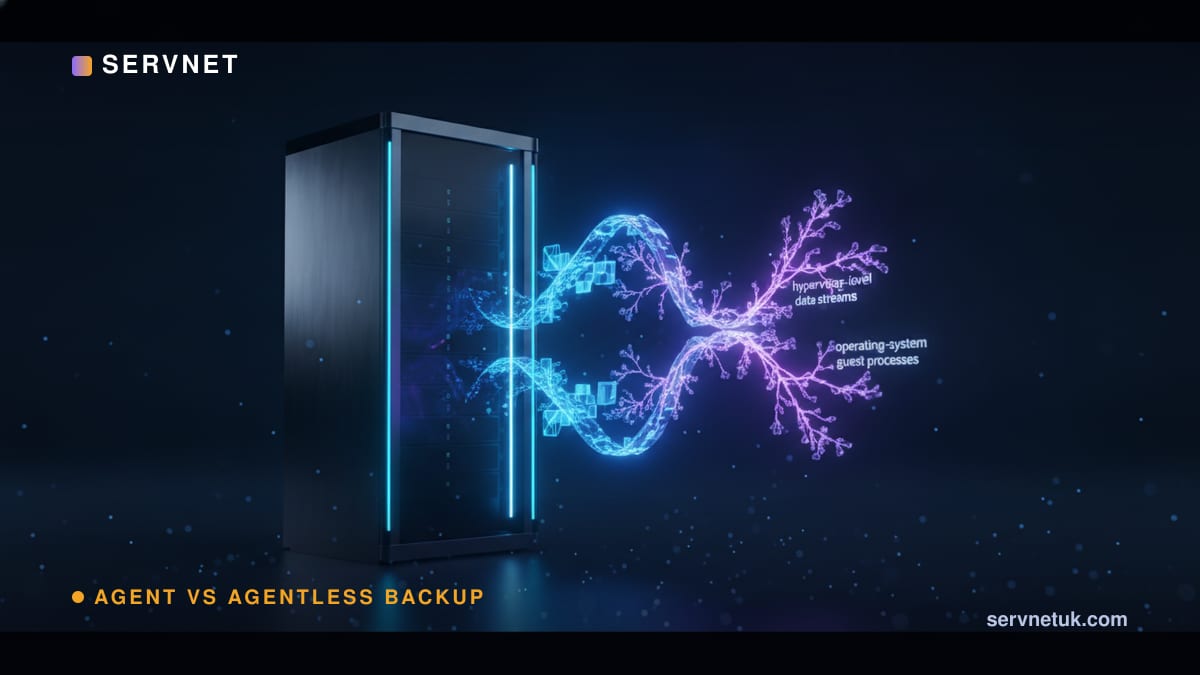
Deploying enterprise data protection across a modern estate inevitably forces a fundamental architectural decision: agent vs agentless backup. Agentless protection serves as the operational standard for virtualized workloads by eliminating agent deployment and maintenance inside individual guest VMs. Standard hypervisor snapshots operate strictly at the storage block level, capturing disk blocks rather than in-flight database transactions and producing crash-consistent restore points by default. Conversely, physical servers require an OS-level agent or host-level protection method, as agentless VM-style snapshots depend on a virtualization hypervisor management plane. Raw VM snapshots do not manage database transaction logs; production SQL Server, Oracle, and SAP HANA environments require application-aware backup workflows and log truncation to achieve point-in-time recovery. Evaluating how these mechanisms interact across VMware vSphere, Microsoft Hyper-V, cloud platforms, and physical systems—alongside illustrative UK commercial pricing models—determines whether an organisation can standardise on an agentless engine or must maintain a hybrid protection topology.
View the data behind this chart
| Infrastructure Type | In-Guest Footprint | Consistency Engine | |
|---|---|---|---|
| VMware vSphere VMs | Agentless (Proxy) | None / VMware Tools | VADP and CBT APIs |
| Microsoft Hyper-V VMs | Agentless (Host) | None / Integration Services | Host CBT and VSS Snapshots |
| KVM & Cloud Management | Agentless Host Layer | QEMU Guest Agent | Native Snapshot Frameworks |
| Physical & Bare Metal | Local OS Agent | Dedicated System Service | OS & In-Guest APIs |
Core Architectural Mechanics: Hypervisor APIs vs In-Guest Daemons
Understanding the technical boundary between agent and agentless data protection requires examining where backup execution code actually runs. In an agent-based architecture, dedicated backup software is installed directly within the operating system of every protected machine. This agent runs as an in-guest daemon or service. Agent-based software uses direct OS-level access to coordinate files, databases, and block-level change tracking. The primary operational advantage is granular visibility across local processes, open files, in-flight transactions, and specific database engines such as SQL Server, Oracle, and SAP HANA. The primary administrative drawback is ongoing lifecycle overhead, as each agent must be deployed, patched, authenticated, and maintained across varied Windows and Linux distributions.
Agentless backup eliminates permanent backup agents within guest VMs by delegating execution to the hypervisor host or an off-host backup proxy appliance. To capture data, the backup system communicates directly with the hypervisor management plane—such as VMware vSphere APIs for Data Protection (VADP) or Hyper-V WMI and VSS frameworks. When a backup job executes, the system instructs the hypervisor to generate a point-in-time snapshot of the VM's virtual disks. The backup proxy then reads snapshot data directly through SAN, virtual appliance (HotAdd), or network transport.
To make daily backups viable across large virtual estates, agentless systems depend heavily on Changed Block Tracking (CBT). Rather than reading the entire virtual hard disk for every incremental run, the backup proxy queries hypervisor CBT metadata to identify and extract only the specific disk blocks modified since the previous restore point. This architecture offloads CPU and memory overhead from guest operating systems to dedicated backup proxies, centralising network traffic and storage access.
Changed Block Tracking, I/O Penalty, and Fallback Behaviour
While agentless backup provides substantial administrative savings, hypervisor-level snapshotting introduces distinct storage I/O and latency considerations. During a snapshot operation, the hypervisor redirects new incoming writes to a delta disk or copy-on-write structure while the backup proxy reads the static base state. Throughout this backup window, storage operations must traverse the snapshot chain. Once the backup proxy completes changed-block extraction via CBT, the hypervisor consolidates the snapshot, committing accumulated delta writes back into the base virtual disk.
On write-intensive workloads, extended snapshot lifecycles and consolidation operations create measurable storage I/O penalties. Furthermore, incremental efficiency depends strictly on the integrity of hypervisor change-tracking metadata. If CBT metadata becomes corrupt, undergoes an unscheduled reset, or encounters a modified change-tracking UUID, the backup engine cannot identify changed sectors and falls back to a full-disk read.
Operational parameters and vendor implementations can also force full-disk reads. For example, MagnusBox backup software enforces an automatic full read when more than 50% of virtual disk blocks change between backup runs, or when virtual disk geometry is modified. While this 50% threshold is an implementation rule specific to MagnusBox rather than a universal hypervisor standard, it demonstrates how backup engines handle invalidated or overwhelmingly altered change-tracking records.
Consistency Levels and Transaction Log Realities
A key architectural consideration in data protection is distinguishing between the different levels of data consistency and their corresponding recovery outcomes:
1. Crash-Consistent VM Image: An unquiesced VM snapshot is generally crash-consistent rather than application-consistent. It captures disk blocks as they exist at a single instant in time. Recovery relies on the guest filesystem and application crash-recovery behaviour (such as journal replay upon boot), so pending transactions in volatile memory are not captured. Recovery validation requires test-mounting or booting the VM to confirm the OS and filesystem recover cleanly.
2. Filesystem-Consistent Backup: Filesystem consistency flushes pending file system buffers to disk and freezes write operations before taking the snapshot, using Windows VSS or Linux filesystem freeze hooks (such as fsfreeze). Restores confirm filesystem structure integrity without requiring volume repair tools upon boot.
3. Application-Consistent Backup: Application-aware processing quiesces running database services and flushes active transaction logs to disk prior to snapshot generation. Hypervisors orchestrate this state via integration tools—such as VMware Tools quiescing, QEMU Guest Agent integration, or native VSS writers (such as Arcserve UDP's coordination with Microsoft VSS). Recovery validation confirms database consistency and clean service startup without manual log replay.
4. Transaction-Log Point-in-Time Recovery: Raw VM snapshots do not manage database transaction logs. Production SQL Server, Oracle, and SAP HANA workloads require dedicated application-aware backup workflows that systematically truncate inactive transaction logs. Without automated log truncation, database transaction logs grow indefinitely until disk storage is exhausted. Full application integration enables point-in-time recovery, allowing database administrators to roll back transactions to a precise minute or second.
Modern enterprise platforms frequently combine hypervisor snapshots with temporary guest-level helpers or credentials to achieve application consistency while retaining an agentless operational footprint.
Cross-Platform Hypervisor and Cloud Architecture
Multi-platform infrastructure requires backup architects to evaluate how snapshot and CBT APIs operate across virtualization and cloud environments. In VMware vSphere environments, host-based agentless protection uses native vSphere APIs for Data Protection (VADP) and hypervisor CBT. As documented in HPE reference architectures for Veeam and HPE Morpheus VM Essentials, host-based agentless protection uses native hypervisor snapshot APIs and hypervisor-level CBT so proxies read only modified blocks. Backup proxies route data through dedicated SAN transport, virtual appliance hot-add, or management network paths.
Microsoft Hyper-V environments provide agentless VM protection through native Resilient Change Tracking (RCT) and host-level VSS coordination. In Arcserve UDP environments, for example, Hyper-V changed-block tracking reads only modified virtual disk blocks, minimising read I/O and storage consumption while native VSS writers guarantee application-consistent snapshots across guest partitions.
Alternative hypervisors and public cloud platforms apply distinct snapshot, change-tracking, and quiescing mechanisms. KVM-based platforms rely on QEMU Guest Agent for guest filesystem quiescing alongside QEMU dirty bitmaps for change tracking. Public cloud environments (AWS, Azure, Google Cloud) expose native volume snapshot APIs, but snapshot frequencies, application consistency hooks, retention lifecycles, and data egress costs differ fundamentally from on-premises hypervisors. Cloud-native protection requires evaluating platform API capabilities and data transfer fees alongside guest-agent options.
The Physical and Bare-Metal Frontier
Despite widespread virtualization and cloud adoption, most enterprise estates retain dedicated physical hardware. High-performance database clusters, legacy enterprise hosts, bare-metal compute nodes, and remote branch endpoints operate outside hypervisor clusters. For these machines, agentless VM-style protection is unavailable because no hypervisor management plane exists to abstract the storage layer.
Physical servers require an OS-level agent or dedicated storage-array snapshot integration. In an agent-based implementation, the backup software installs directly within the operating system, coordinating with local volume managers—such as Windows VSS or Linux LVM snapshots—and tracking modified blocks directly across the operating system's storage stack.
Physical deployments also introduce distinct restore challenges. While recovering an agentless VM typically involves generating a new virtual machine container and streaming blocks back to a datastore, restoring a bare-metal physical machine requires system state, partition layouts, boot sector configurations, and hardware-specific storage controller drivers. Engineering teams must evaluate documented bare metal recovery requirements when architecting protection across physical infrastructure.
View the data behind this chart
| Server (per node) | User (per seat) | SharePoint (tenant) | |
|---|---|---|---|
| Monthly Fee (£ excl VAT) | £40 | £4 | £50 |
Security Architecture, Blast Radius, and Compliance Models
The security models of agent and agentless architectures present contrasting operational risks and credential boundaries. Agent-based backup multiplies the endpoint attack surface. Because a backup agent executes with local administrative or root privileges to access protected system files and database stores, every installed agent represents a potential target for privilege escalation or vulnerability exploitation. System administrators must continuously monitor Common Vulnerabilities and Exposures (CVEs), manage agent version patching lifecycles, and open specific firewall ports across network segments to facilitate agent-to-server traffic.
Conversely, agentless backup eliminates endpoint agents but concentrates operational and security dependence on the hypervisor and central backup server. To perform host-level snapshots, mount virtual disks, and orchestrate guest quiescing, the central backup server or proxy requires elevated administrative credentials for the hypervisor management plane. If the backup server or its API credentials are compromised, an attacker gains broad administrative reach across the hypervisor, exposing every hosted VM simultaneously. Securing an agentless environment requires strict identity and credential separation, dedicated backup service accounts with constrained API permissions, and isolated management network segments.
For UK organisations operating under regulatory and compliance frameworks, this architectural divide impacts audit scoping. An agent-based model introduces numerous individual software daemons into the scope of vulnerability scanning, requiring continuous patch compliance across all endpoints. In an agentless model, compliance validation shifts to the security architecture of the hypervisor management plane, proxy access controls, repository immutability, and air-gapped isolation. Evaluating these elements alongside modern backup storage solutions ensures that audit trails reflect robust privilege separation and cyber resilience.
UK Enterprise TCO: Commercial Breakdown for Mixed Estates
Formulating a realistic Total Cost of Ownership (TCO) model requires UK infrastructure managers to establish a structured calculation framework rather than relying on isolated pricing metrics. While individual UK service providers publish rate cards that serve as illustrative commercial examples, VAT, software licensing, repository storage, infrastructure, capacity, and contract terms vary substantially across suppliers.
A practical backup TCO framework should normally evaluate at least these eight cost components:
1. Protected Capacity: Baseline source data volume and daily change rates across physical, virtual, and cloud workloads.
2. Retention Requirements: Local operational restore windows versus long-term compliance retention periods.
3. Immutable and Off-Site Copies: Secondary cloud or off-site tiers for ransomware resilience. For example, published pricing from UK provider Defended Solutions offers one illustrative baseline of £345 per month covering the first 10 TB, with additional usage billed on a per-terabyte tier under an initial 12-month commitment before moving to rolling monthly terms.
4. Network Egress and Bandwidth: Data transfer charges associated with cloud snapshot extraction or replication.
5. Backup Infrastructure and Proxies: Dedicated compute and local repository hardware required to run backup proxies, deduplication appliances, and snapshot consolidation engines. On-premises hardware incurs ongoing rack space, cooling, and power overheads that must be factored into hardware lifecycle budgets.
6. Software Licensing: Per-socket, per-VM, per-agent, or per-terabyte software licensing from enterprise vendors.
7. Management and Operational Support: Outsourced or internal operational management fees. As one illustrative pricing example, UK provider DeadSimple Computing publishes management pricing of £40 per protected server per month (excluding VAT), £4 per protected user per month, and £50 per SharePoint tenant per month, with underlying software licenses, storage, and disaster recovery infrastructure charged separately.
8. Implementation and Recovery Testing: Regular automated and manual recovery testing required to validate RPO and RTO compliance.
When modeling total expenditure, UK buyers must assess the administrative labour differential. An estate with hundreds of supported VMs may reduce agent deployment and patching effort by standardising on agentless protection, subject to product and workload exceptions, but accommodating physical servers and demanding database instances requires balancing enterprise backup software options across a hybrid deployment.
Practical Decision Framework and Checklist: Structuring Your Estate
The ultimate validation of any backup architecture is its recovery agility. Instant VM recovery boots a failed VM directly from backup storage while background processes migrate data to production disks. Granular recovery, by contrast, relies on catalog indexing to extract individual database tables, mailbox items, or files without restoring the entire machine. IT leaders must validate achievable RTOs and restoration granularity through representative testing.
To select the correct architecture across a mixed infrastructure estate, IT leaders should apply this practical decision checklist:
• RPO and RTO Thresholds: Determine maximum tolerable data loss and downtime per workload. CBT can help support frequent VM image backups, but achievable RPO depends on scheduling, workload, infrastructure and— for databases—separate transaction-log protection.
• Application-Consistency Requirements: Identify which workloads require crash-consistency, filesystem-level quiescing, application-consistent writer flushes, or continuous database transaction-log truncation.
• Restore Testing Validation: Regularly validate recovery through automated sandbox testing, boot verification, database integrity checks, and point-in-time log rollbacks.
• Immutability and Ransomware Isolation: Implement write-once-read-many (WORM) storage, air-gapped repositories, or dedicated immutable off-site copies to protect backup data against ransomware tampering.
• Identity and Credential Separation: Prevent credential concentration by isolating backup proxy service accounts from hypervisor root privileges, enforcing role-based access control, and eliminating shared local agent credentials.
• Cloud Controls and Egress Costs: Account for platform-specific snapshot and change-tracking APIs in public cloud environments, budgeting for retention windows and network egress fees when moving data off-platform.
• Physical and Bare-Metal Coverage: Mandate OS-level backup agents or supported platform tools for physical hardware where hypervisor APIs do not exist.
By aligning each infrastructure segment with its technically optimal protection method and using a reliable backup and DR sizing calculator to budget repository capacity, UK enterprise IT teams can build a resilient, compliant, and cost-controlled data protection strategy.
Sources
Every figure in this article traces to the sources below.
- •Vinchin Backup — Under the hood of agentless vs agent-based backup
- •Storware — Agent-based vs. agentless backup architectural overview
- •Scality ARTESCA — Backup agent mechanics and operational trade-offs
- •HPE — Veeam with HPE Morpheus VM Essentials Reference Architecture
- •Arcserve — Arcserve UDP appliance technical whitepaper
- •MagnusBox — VM backup methods: agentless vs inside the guest
- •DeadSimple Computing — UK business backup pricing breakdown
- •Defended Solutions — UK offsite backup pricing and commitments
View the data behind this chart
| Layer | Detail |
|---|---|
| Production Workload Tier | Physical bare-metal servers, virtual machines, and cloud instances |
| Quiescing & Coordination Interface | OS backup agents, VMware Tools, QEMU guest agent, or native VSS writers |
| Data Transport & Changed-Block Engine | Hypervisor snapshot APIs, backup proxy systems, or agent network daemons |
| Target Storage Repository | On-premises resilient appliances and off-site contracted storage tiers |