
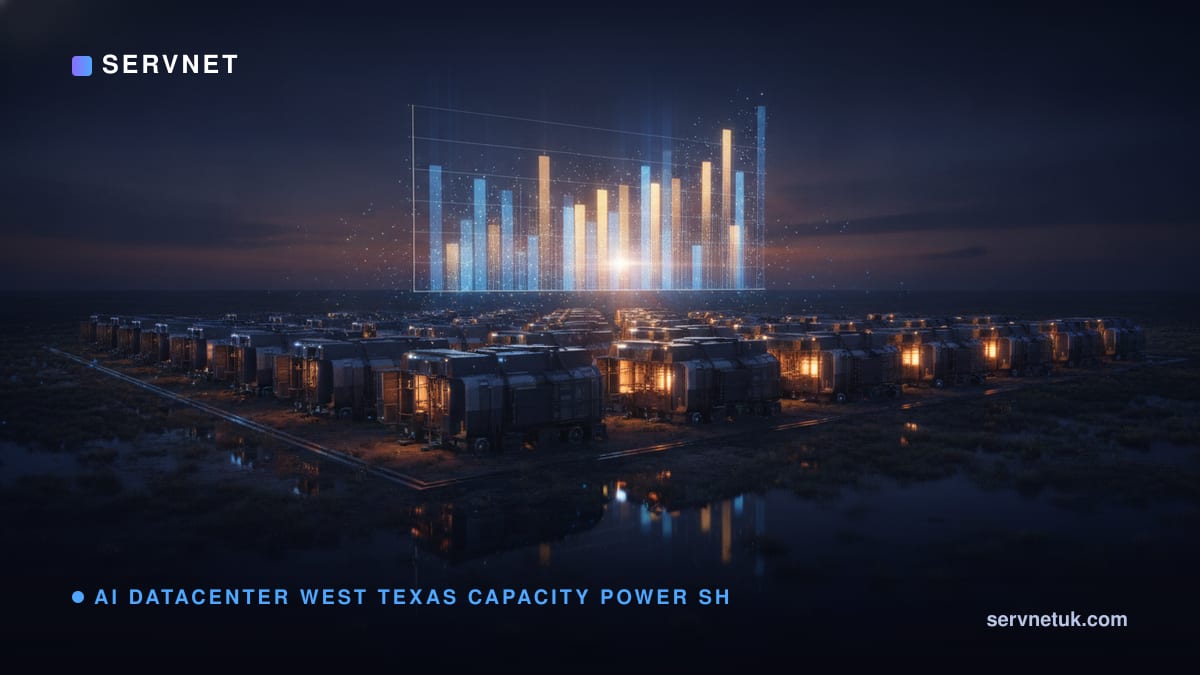
Bitcoin treasury firm Empery Digital has put $20 million into Cardinal Data Power, backing a West Texas campus with a 750MW first phase and plans to scale beyond 5GW. For UK buyers, it's another signal that gas turbines, land and engineering talent are being locked up an ocean away.
View the data behind this chart
| Cardinal Data Power | Pacifico GW Ranch | OpenAI Stargate | Meta Hyperion | |
|---|---|---|---|---|
| Planned capacity | GW5 | GW5 | GW7 | GW5 |
The deal: $20m for an 8% stake in a gigawatt-scale bet
Empery Digital's $20 million investment gives the Nasdaq-listed firm an approximately eight percent stake in Cardinal Data Power (CDP), part of a $70 million Series A round led by Hood River Capital Management. The transaction was signed and completed on July 20, according to an SEC filing.
CDP, headquartered in Dallas and founded by the Lyda Hunt Allred and Barbara Crow Hunt families through their Cavallo Holdings and Stratford Bridge Holdings offices, is developing a behind-the-meter campus in West Texas. A letter of intent covers a 750MW first phase, with access to more than 3,500 acres. First power is expected in 2027, gross capacity could hit roughly 1GW by 2029, and the site is designed to expand beyond 5GW over time. The company has reserved reciprocating engine generation capacity from an unnamed manufacturer via an independent power producer agreement.
Why this is bigger than one funding round
CDP isn't an isolated bet. West Texas has become the default address for multi-gigawatt AI builds: Pacifico Energy has secured a 7.65GW air permit for its 5GW GW Ranch project, Chevron is building its first gas-fired plant specifically to power data centers there, and Circe Energy has ordered 2GW of natural gas generation capacity from Cummins for a 1,950-acre Permian site. Microsoft's 2GW Pecos campus carries a 20-year Chevron PPA for up to 2.67GW.
Layer on OpenAI's Stargate expansion, now tracking toward nearly 7GW of planned capacity and over $400 billion of investment, plus Meta's Hyperion plan growing to 5GW in Louisiana, and the picture is clear: 5GW-class AI campuses are no longer a hypothetical, they're a procurement queue. TD Cowen has estimated Oracle alone is chasing about 5GW of US capacity for OpenAI training workloads by the end of 2026, backed by roughly $159 billion in combined GPU and data center capex.
What a Texas gigawatt race means for UK power costs
The direct read-across to the UK is limited — none of this reporting quantifies a UK price effect. The credible, indirect risk is supply chain gravity: when reciprocating engines, gas turbines, transmission hardware and specialist construction labour are being pre-booked at gigawatt scale across West Texas, West Virginia and the US Midwest, that tightens global lead times for the same equipment classes UK operators need for backup generation, switchgear and cooling retrofits.
UK buyers already contending with grid connection queues and rising energy costs should treat this as reinforcing evidence, not a new alarm. Our own breakdown of the UK data centre power and energy landscape shows domestic constraints are largely homegrown — but a US equipment crunch adds a second pressure point on top.
Colocation availability: the scarcity squeeze compounds
US hyperscalers and AI-native tenants soaking up 5GW-plus of committed capacity across a handful of Texas counties changes global vendor priorities. Manufacturers and EPC contractors will naturally route capacity toward the largest, fastest-paying contracts first. That's relevant for anyone choosing a UK colocation datacentre in 2026, because power availability — not floor space — is increasingly the binding constraint on new capacity coming online.
It also matters for density planning. As GPU racks push toward the higher end of current GPU rack power density trends, UK facilities competing for the same cooling and power infrastructure vendors as US megaprojects may see longer procurement cycles for critical kit.
- •Reciprocating engine and gas turbine capacity is being reserved years ahead in the US
- •UK operators upgrading for AI workloads compete for the same global equipment pool
- •Grid-scale power deals (PPAs, behind-the-meter gas) are becoming the norm for new AI capacity
What UK infrastructure buyers should do now
Given the scale of US commitments, UK buyers should treat 2026 procurement planning as time-sensitive rather than routine. That means locking in power and cooling capacity earlier in any refresh cycle, and stress-testing supplier lead times before committing to a deployment date. Our power and cooling tools can help model realistic capacity headroom against rising rack densities, while guidance on hosting AI racks in UK colocation covers the practical power and thermal thresholds operators are hitting today.
Budget owners should also revisit total cost assumptions. Our recent analysis of the AI infrastructure cost shock for UK buyers is a useful companion read, since equipment scarcity driven by US gigawatt projects is one of the underlying forces behind that shock. Anyone specifying new server estates should also revisit server configuration choices against realistic power budgets rather than best-case density figures.
- 01DataCenterDynamics — Empery Digital invests $20m in Cardinal Data Power · 24 July 2026
- 02DataCenterDynamics — FO Permian Partners unveils 5GW off-grid gas power solution for Texas data centers · 1 July 2026
- 03DataCenterDynamics — Pacifico secures 7.65GW air permit for GW Ranch project in West Texas · 1 July 2026
- 04DataCenterDynamics — Chevron selects West Texas for first natural gas plant to power data centers · 1 June 2026
- 05DataCenterDynamics — Microsoft plans 2GW data center campus in Pecos, Texas · 1 June 2026
- 06DataCenterDynamics — TD Cowen: Oracle seeking 5GW US data center capacity for OpenAI training workloads by end of 2026 · 1 June 2026
- 07Tom's Hardware — Meta expands Colossal Hyperion AI supercluster plans to 5GW · 1 June 2026