

Google's new TPU 8tx delivers the company's first cloud TPU system with hardware-enforced confidential computing — but it runs on 5th Gen AMD Epyc Turin, not Google's own Axion processor. For UK buyers evaluating hardware-based confidential computing, the choice says more about procurement discipline than chip design.
View the data behind this chart
| TPU 8t | TPU 8tx | TPU 8i Max | |
|---|---|---|---|
| Host CPU | Axion (Arm) | AMD Epyc Turin | Axion (Arm) |
| FP4 compute | 12.6 petaflops | 12.6 petaflops (inherited) | Not disclosed |
| HBM capacity | 216GB | 216GB (inherited) | Not disclosed |
| Confidential computing | No | Hardware-enforced (first) | No |
| Primary use case | Training | Regulated/gov secure workloads | Long-context inference |
What Google actually announced
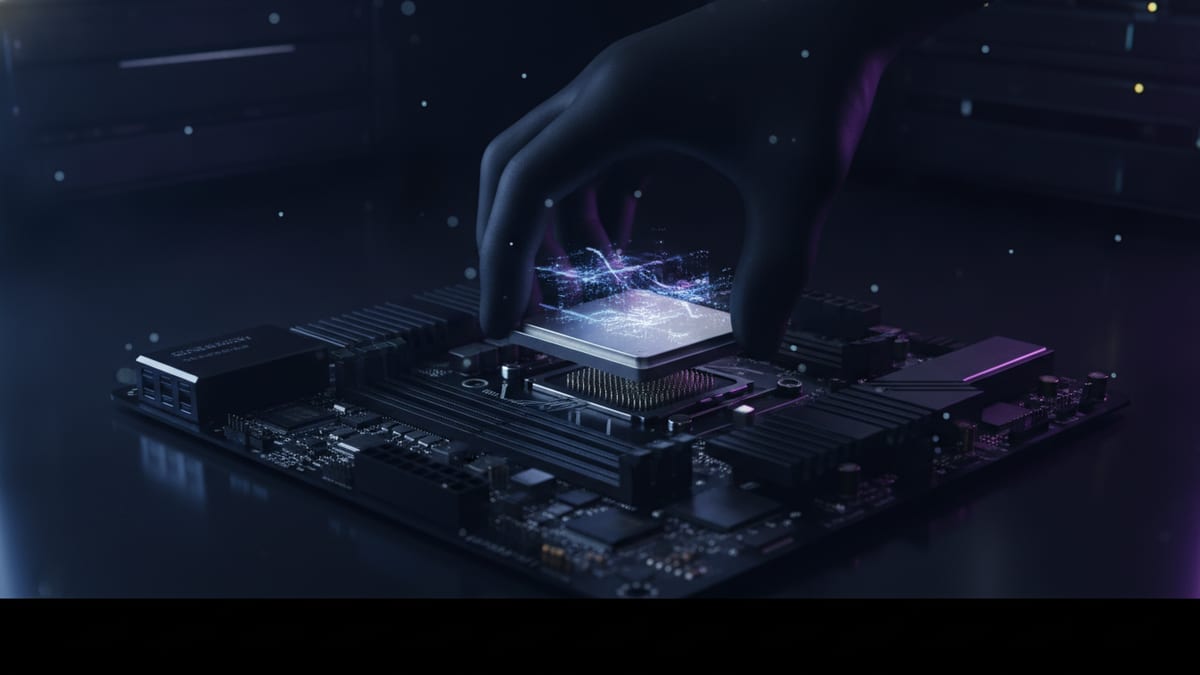
Alongside the dual-chip TPU 8i Max, Google introduced the TPU 8tx — announced on 9 November 2026 — a confidential-computing variant that reuses existing TPU 8t silicon but pairs it with 5th Gen AMD Epyc 'Turin' host CPUs instead of Google's Arm-based Axion processor. Both companies describe it as the first cloud TPU system with hardware-enforced confidential computing.
As ServeTheHome has noted, Google describes this as its fourth eighth-generation TPU system announced in one year, though the two newest additions are system-level configurations built on existing silicon rather than fresh chip designs. Secondary reporting says the 8tx retains TPU 8t's 12.6 petaflops of FP4 compute and 216GB of HBM, while swapping in the lower-latency Boardfly interconnect originally built for the TPU 8i — Google claims up to 2x lower latency than the standard 8t, with near-zero performance penalty; test conditions have not been published.
Why Axion got passed over
Google has not stated directly why it skipped Axion, the Neoverse V2-based processor it launched as its first in-house data centre CPU in 2024. But its own documentation is telling: Google's currently documented Confidential VM support is limited to AMD SEV and Intel TDX, which helps explain the choice of an x86 host — there are no Axion-based C4A or N4A confidential instances, and TPUs currently cannot attach to Confidential VMs at all.
That suggests Google would have needed additional qualification work for an Axion-based design, whereas AMD says Google security experts have deeply reviewed its security-processor firmware — a factor that may have made the x86 route faster for a product whose entire value proposition is trust.
How the confidential trust chain actually works
AMD says its SEV technology works with the TPU to extend protection to the accelerator, checking each accelerator's identity and security configuration before granting it access to protected memory. Prompts, model weights and intermediate data stay encrypted both in host memory and in transit. Google describes the outcome as "keeping sensitive data and model weights protected and isolated even while in active use."
AMD says SEV already underpins Google's Confidential VMs, Confidential GKE, Confidential Space, and confidential Spark and Dataflow services — so extending it to TPU 8tx reuses infrastructure Google's own security teams already understand, rather than building a parallel Arm-based trust model from scratch.
An AMD endorsement, not an AMD TPU
It's worth being precise about what this isn't. ServeTheHome reported that Turin was selected in part because it matches TPU 8t's PCIe Gen5 x16 interface — ServeTheHome also noted that a future Gen6 host would add no accelerator bandwidth today, and that Google's own qualification schedule for next-generation hosts reportedly runs into 2027. The Epyc chips sit in separate sockets from the TPU silicon; this is a confirmed host-processor win, not confirmation of the August rumour — reported via a SemiAnalysis client note — that Google is working with AMD on tighter CPU-TPU integration for a future TPU v10 generation.
Markets reacted anyway: AMD closed at $508.58 on 9 November, up 13.26% on more than twice its recent average volume, after an intraday high of $515.18, with contemporaneous market reports noting an upgrade to Outperform and a $600 price target from Oppenheimer's Rick Schafer. Not all of that move belongs to the TPU news, but it may have contributed to the move for a company recently described in its own CEO's remarks as data centre-first. Buyers assessing AMD Epyc Turin processors for their own estates should note the data point without overreading it.
What this means for UK infrastructure buyers
The headline lesson isn't about Arm versus x86 performance — it's about procurement maturity. Even a hyperscaler that designs its own silicon still reaches for an external vendor's host processor when certification, attestation tooling and audited firmware are more mature elsewhere. UK buyers building hardware-based confidential computing into regulated AI workloads should treat ecosystem depth, not brand loyalty, as the deciding factor.
Google Cloud's Mark Lohmeyer has indicated select customers will be able to deploy TPU 8tx in their own data centres, and Oracle has separately confirmed plans to offer TPUs on its own cloud — meaning hardware attestation is becoming the mechanism that lets a model owner place sensitive weights on infrastructure someone else physically operates. Organisations weighing dedicated AI inference infrastructure against training clusters should factor this attestation layer into any multi-tenant or off-premises deployment plan.
View the data behind this chart
| Intraday high | Day close | |
|---|---|---|
| AMD share price | $515.18 | $508.58 |
Before you shortlist it
Several details remain unresolved, and procurement teams should treat them as open questions rather than settled facts.
Pricing, UK regional availability and independent verification of the claimed 2x latency improvement have not yet been published. Confidential VM attachment to TPUs is still not generally supported outside this specific configuration, and Google has left enough of the security architecture undocumented that early claims deserve scrutiny once customers can actually test them against workloads modelled through tools like Servnet's AI GPU sizing calculator or benchmarked against findings in our AI servers data study.
- •No confirmed UK pricing or per-hour cost for TPU 8tx yet
- •TPU-to-Confidential VM attachment remains unsupported outside this launch
- •Latency claims (up to 2x vs TPU 8t) are vendor-stated, not independently benchmarked
- •Axion remains in use elsewhere in Google's 8th-gen TPU line — this is a targeted choice, not a retreat
- 01TechRadar Pro — Google turned to AMD EPYC, not its own Axion chips, to secure its first confidential TPU · 12 November 2026
- 02StorageReview — Google Adds Confidential TPU 8tx and Dual-Chip TPU 8i Max · 11 November 2026
- 03ServeTheHome — Google TPU 8tx, 8i Max, AMD Epyc Turin · 10 November 2026
- 04Tom's Hardware — Google adds two new specialized chips for AI agents and security · 9 November 2026
- 05Data Center Dynamics — Google expands eighth-generation TPU portfolio · 10 November 2026
- 06The Register — Google touts private AI compute · 12 November 2025
- 07theregister.com
- 08techradar.com